

Raydium Exchange Review 2026
- Basic swaps are beginner-friendly
- New token launches through Launchlab and AcceleRaytor
- Highly-customizable transaction settings
Since its launch in 2021, Raydium has quickly gained popularity on Solana as a decentralized exchange (DEX) and an automated market maker (AMM). Now one of the largest native Solana protocols, it offers users a comprehensive suite of trading and investment tools suitable for both beginners and experienced traders.
In this Raydium exchange review, we detail the platform’s pros and cons, its top features, and how to get started. To evaluate the Radium exchange, we performed real transactions, including swaps, perpetual swaps, and fiat-to-crypto conversions. We also analyzed the platform’s security and ease of use to provide a complete overview of the Raydium exchange in 2026.
Raydium Exchange Review: Pros and Cons
In our testing, we found Raydium generally user-friendly, with a few caveats. Users with basic familiarity with crypto wallets should have little trouble completing simple swaps. The platform is easy to use for beginners, whether you’re using the mobile or desktop web app. Easy access to new token listings, including popular meme coins, adds to Raydium’s appeal, particularly for active traders.
However, perpetuals seemed like a force fit on the platform, perhaps to replace the limit order functionality that it removed in 2022. We recommend perpetual futures trading on Raydium for advanced users or those willing to invest time in researching the (sometimes outdated) documentation.
Pros
- Beginner-friendly swaps platform
- Access to new token launches
- Easily customizable transaction settings
- Support for popular non-custodial wallets
Cons
- Complex perpetuals trading interface
- Out-of-date documentation
- High fees for fiat-to-crypto transactions
What is Raydium?
The Raydium platform is a popular decentralized cryptocurrency exchange on the Solana blockchain that allows traders to swap tokens using a non-custodial crypto wallet. The platform uses an automated market maker (AMM) to manage pricing in liquidity pools, automatically adjusting the price of token pairs based on the buying or selling activity.
Launched in 2021 by AlphaRay, a pseudonymous developer with an extensive background in algorithmic trading and traditional finance markets, it approached crypto trading from a brand new perspective. The platform combines an automated market maker inspired by Uniswap with an order book for perpetual trading in a setup similar to centralized exchanges (CEXs) and traditional markets.
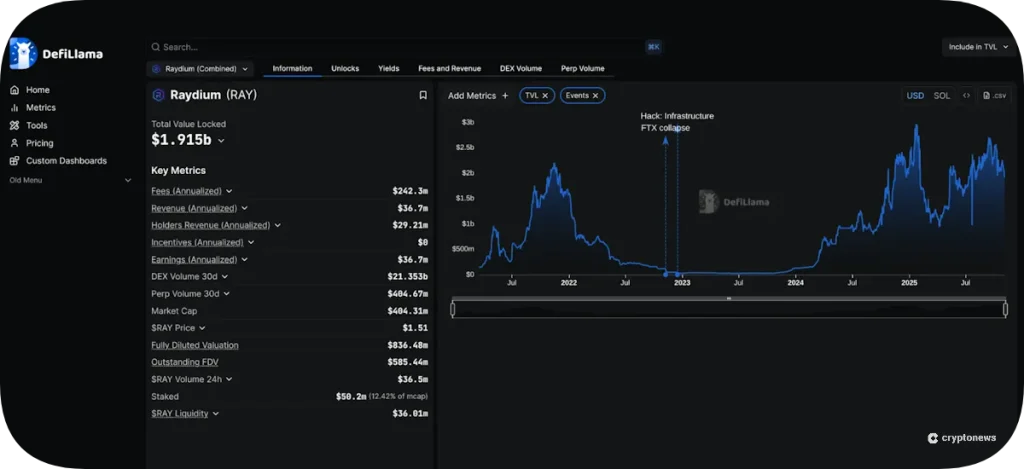
Its technological innovation and perfect launch timing amid the height of the 2021 bull market helped Raydium quickly gain traction and establish itself among the top platforms on Solana. However, after the FTX collapse, Raydium’s order book functionality was also removed, as it was provided by the FTX-linked Serum protocol.
At the time of writing, the exchange’s total value locked (TVL), a measure of value locked in the platform’s smart contracts, ranges from just under $2 billion to approximately $3 billion, with TVL changing based on which coins see the most trading action.
What Type of Exchange is Raydium?
Raydium is one of the top decentralized exchanges on Solana. In contrast to centralized exchanges (CEXs), blockchain DEXs enable users to buy, sell, or trade without intermediaries. Instead of using a broker or a traditional crypto exchange that provides custody for assets, Radium enables users to hold their crypto assets in a non-custodial wallet, which they use to approve transactions on the platform.
Structures for DEXs vary, with most using an automated market maker that adjusts the price of two or more assets held in a liquidity pool based on each token’s ratio in the pool. Buying pressure for Token A causes its price to rise relative to Token B in the pool, and vice versa.
However, while Radium uses a now-familiar AMM at its core, the platform also incorporates a perpetual futures trading platform with up to 100x leverage and support for limit orders. Although the docs reference 40x max leverage, BTC, ETH, and SOL trading both support up to 100x on the live platform. This flexible structure with both spot and futures trading makes the platform more appealing for a wider range of trading goals.
Is the Raydium Exchange Safe and Trustworthy?
The Raydium Exchange offers a generally safe platform for swaps and trading. However, the DEX has experienced some security incidents and performance issues in the past. In this next section of our Raydium exchange review, we’ll examine the project’s safety.
Security and Performance Issues
Raydium suffered an exploit in December 2022 which compromised the “owner authority” private key for specific pools on the platform. The exploit enabled attackers to drain $4.4 million from the pools. Raydium established a claim portal, using unlocked RAY tokens from the project’s decentralized autonomous organization (DAO) treasury. A hot-patch stopped any further draining of funds.
In earlier performance-related incidents, bots attempted to acquire newly launched IDO (initial DEX offering) tokens during oversubscribed launches on Raydium’s AcceleRaytor launch service, including the SolChicks and Grape Protocol launches. This bot attack became a de facto Distributed Denial-of-Service (DDoS) attack, preventing real users from accessing the platform.
Audits and Mitigation
Although Kudelski Security had audited Raydium pre-hack, new audits from OtterSec, MadShield (now OShield) assured users that the protocol has since been well patched. Halborn also performed a Launchlab audit in 2025.
Additionally, Raydium launched a Bug Bounty program to incentivize the community to report critical vulnerabilities.
Non-Custodial Structure
While the Bug Bounty and multiple audits assure that the platform is secure, Raydium’s strongest advantage is in its non-custodial nature. User funds remain in self-custody crypto wallets under users’ control. Unlike a centralized exchange, the platform never has access to the private keys that control your crypto assets on the Solana blockchain.
Raydium Supported Coins and Networks
Raydium supports trading for more than 3,300 coins, with the largest trading volume typically centering on meme coins, such as Jelly-My-Jelly, SPX6900, and BOOK OF MEME. Raydium’s own token, Raydium (RAY), was among the top 25 most traded crypto tokens on the platform at the time of writing.
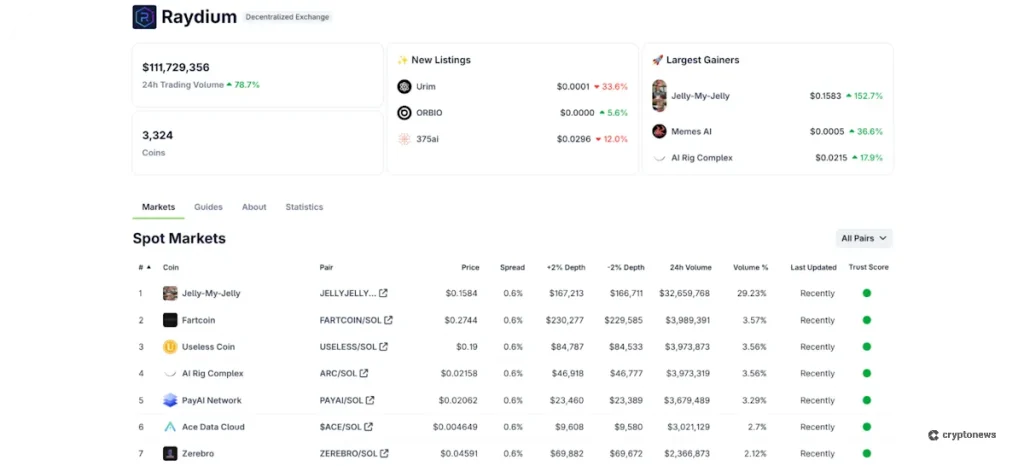
The platform only supports Solana-based tokens and requires a Solana wallet to access swaps. Most leading tokens are also paired with Solana (SOL) rather than a stablecoin like USDC. SOL pairing makes memecoins on Solana extremely volatile, attracting short-term traders.In total, Raydium hosts more than $21 billion in swap trading monthly, with its perpetual swaps (perps) adding another $400 million in 30-day trading volume.
Raydium Key Features
The Raydium DEX offers an easy-to-use yet powerful trading platform, focusing on a handful of key features that have fueled its recovery since its post-hack lows. The following sections of our Raydium exchange review focus on five key platform features: swaps, perps, RAY staking, liquidity pools, and cash-to-crypto purchases.
Swaps
Raydium offers one of the more user-friendly swap platforms. Swaps follow an intuitive flow. However, custom settings, such as priority gas fees and slippage settings, are tucked away in the top menu where they might be missed.
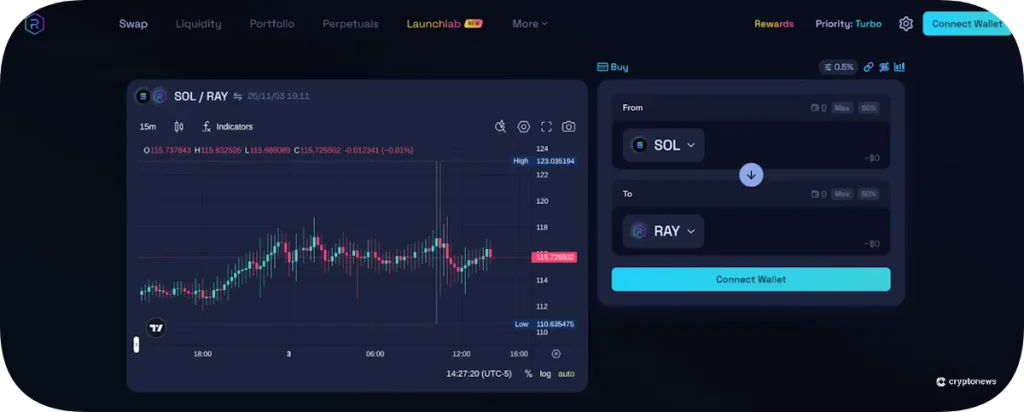
Users can customize their transaction speed and set slippage for the session. By default, slippage is set to 0.5%, meaning that transactions with a price variance greater than 0.5% will not execute.
The pricing for each token in a trading pair fluctuates based on the ratio of tokens in the liquidity pool, although SOL pairing loosely tethers token prices to Solana’s market value.
Perpetuals
A perpetual futures contract allows traders to bet on the future price of a supported cryptocurrency without taking delivery of the underlying asset. As the name suggests, perpetual swaps traders can keep trades open indefinitely, provided they remain within their maintenance margin requirements. Notably, Raydium states this feature is still in Beta (and not available for US traders). However, we observed smooth operation during our Raydium exchange review. The platform uses a gasless Central Limit Order Book (CLOB), allowing fixed price limit orders, which are not currently supported by the standard swap interface.
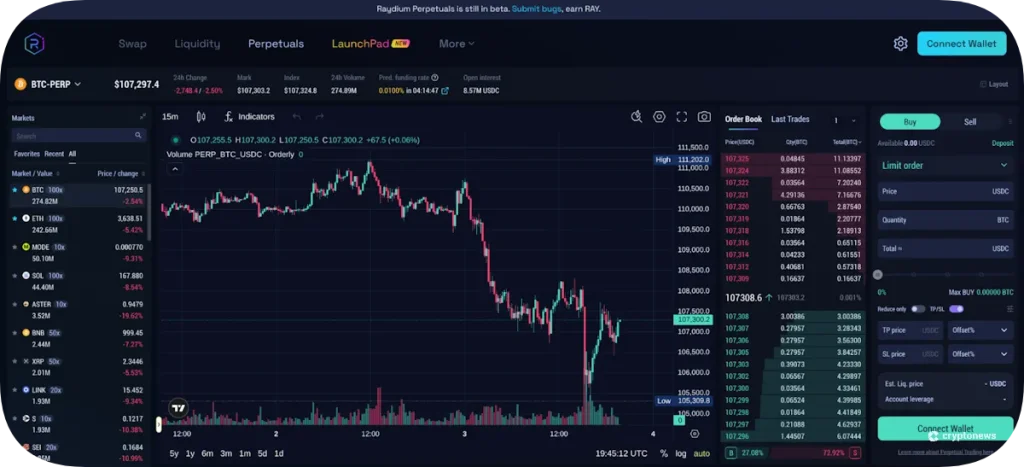
Max leverage for BTC, ETH, and SOL is 100x, with other assets supporting from 5x to 50x leverage.
- BTC, ETH, SOL: 100x
- BNB, XRP, DOGE: 50x
Less established assets and the platform’s limited selection of higher-volatility meme coins offer 5x to 20x leverage.
However, unlike swaps, which offer a straightforward experience that’s kind to new traders, Raydium’s perpetual contracts require users to create an account with Orderdly and generate an API key. Orderly provides fast offline computation for trading speeds on par with centralized exchanges (CEXs).
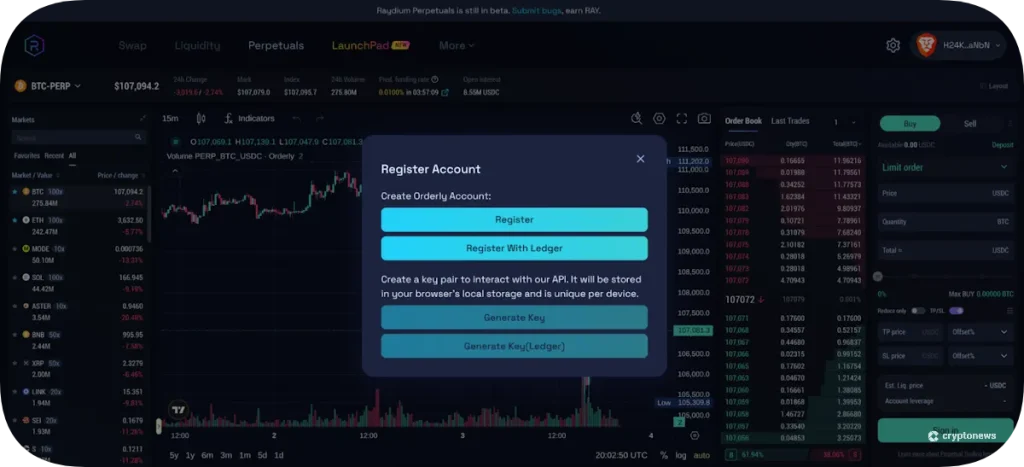
Futures markets use Off-Chain Order Matching, whereby trades are executed in a neutral environment off-chain without MEV (miner extractable value) risks. Trades ultimately settle on-chain, using USDC as the settlement asset.
The trading volume for perps trades on Raydium lags behind that of swaps by a large margin, even with the benefit of leverage driving trade sizes higher. This disparity suggests the perpetual swaps platform isn’t attracting as many average users, possibly due to its complexity and a limited selection of trading pairs.
Staking
We’ll discuss the RAY token in more detail later in our Raydium exchange review. However, the RAY token is at the heart of the platform’s staking feature, allowing users to earn a percentage of platform revenue, while also granting priority access to new token launches.
- Users stake by locking RAY tokens in a single-sided (one token) smart contract.
- Raydium converts protocol fees, paid in various tokens, to RAY.
- Stakers automatically receive a percentage of Raydium’s trading fees (0.03% for standard pools, paid in RAY).
- Larger stake commitments grant priority access to new tokens launched through AcceleRaytor.
- Staking RAY grants holders governance rights, allowing them to vote on protocol changes.
Staking on the platform generally represents a low-risk yield strategy. Currently, about 12% of the RAY supply is locked in the platform’s staking contract.
Liquidity Pools
Similar to well-known DEX platforms like Uniswap, Raydium offers two types of liquidity pools (LPs): full range and concentrated liquidity. To users performing swaps, these two types of liquidity pools work together to supply liquidity for swap markets. However, for liquidity providers, the option to choose between full-range and concentrated positions makes the platform more viable and attracts more liquidity at the current trading range.
The choice of liquidity pool types offers passive income opportunities for liquidity providers, although concentrated liquidity positions may require more maintenance. Third-party tools also enable hands-off rebalancing for fixed-range positions.
Constant Product Market Maker (CPMM)
Raydium’s standard full range pools follow the time-tested constant product formula (x × y = k) used by Uniswap V2. Full-range Liquidity providers earn 0.22% on swaps (0.03% goes to RAY stakers).
Concentrated Liquidity Market Maker (CLMM)
Concentrated liquidity offers more efficient use of capital and supplements the full range of liquidity markets. This structure offers additional income opportunities for liquidity providers while reducing slippage for traders making swaps.
Raydium supports a range of fee structures from 0.01% to 1% or more, with 84% of the fees going to LP providers. The balance of fees is split between RAY stakers and the protocol treasury. Notably, CLMM positions can also cover the full range (zero to infinity).
Fiat Purchases
As a decentralized exchange, Raydium does not natively support fiat-to-crypto purchases. However, the platform integrates with MoonPay, a third-party provider that acts as a fiat onramp. Using MoonPay allows you to purchase SOL or four other supported assets using fiat currency, such as USD, EUR, GBP, and other currencies.
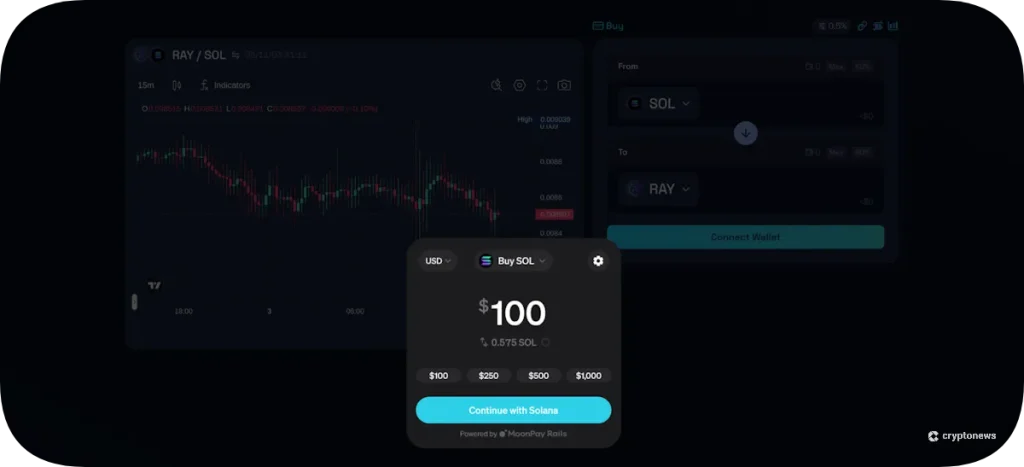
Notably, using MoonPay requires users to complete basic Know Your Customer (KYC) identification verification. The MoonPay platform supports purchases via debit or credit cards. Fees vary depending on market conditions, but typically range between 4% and 7%, including processing fees and a markup (spread) that allows the platform to lock in a price for your purchase.
Raydium Launchlab
Technically, Raydium offers two launchpads, each with differing market goals: the newer Launchlab and the platform’s well-established AcceleRaytor launchpad.
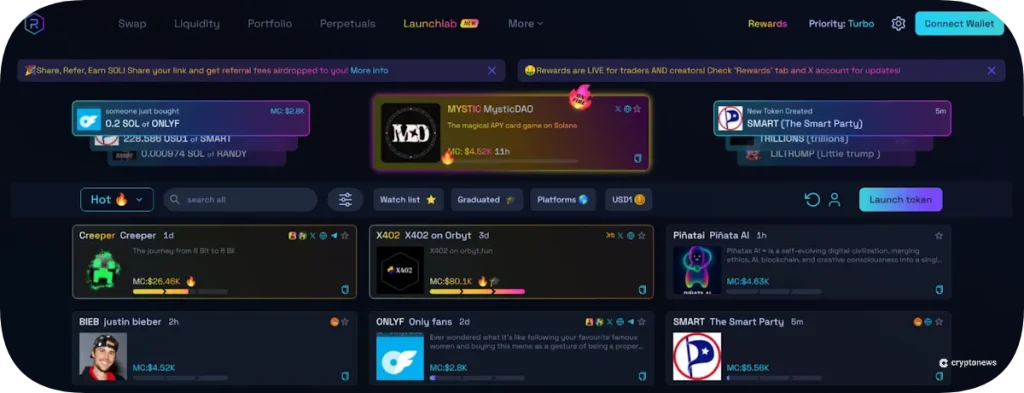
Launchlab offers permissionless token creation, allowing anyone to create a memecoin (its primary focus) or utility token with a simple process. Raydium’s Launchlab offers two ways to get started, including JustSendIt Mode and Launchlab Mode (Pro).
- JustSendIt Mode: This simple launchpad mode uses default parameters (token supply) and utilizes a bonding curve. When the token’s market cap reaches critical mass, the token automatically deploys to the main Raydium full-range Constant Product Market Maker (CPMM) liquidity pools. Tokens that don’t achieve a predetermined market cap (85 SOL as of this writing) typically sell off as traders lose faith, often reaching near-zero levels.
- Launchlab Mode (Pro): This option offers token creators more control over launch specifics, including total supply and customizable minimum market cap requirements (30 SOL minimum). Creators can also customize the shape of the bonding curve to achieve their launch and distribution goals.
Creators can earn a percentage of trading fees for the token before launch (1%), as well as up to 10% after a successful launch.
Raydium also offers its well-known AcceleRaytor platform. This tool offers crypto investors a curated selection of tokens chosen by the Raydium team. Raydium uses a tiered allocation model or a lottery system to determine allocation eligibility for prospective investors. RAY staking plays a key role in these allocations.
What is the Best Wallet to Use With Raydium?
The Raydium decentralized application (dApp) uses a non-custodial structure, meaning users control their crypto assets through self-custody wallets. The user controls the private keys that prove ownership of the wallet’s assets.You’ll need a wallet that supports the Solana blockchain or a multichain wallet that supports Solana alongside other networks you might use. The Best Wallet app fits this use case well, supporting 60+ blockchains, including Solana, Bitcoin, Ethereum, and more. Best Wallet is available for Android and iOS mobile devices and supports WalletConnect, a popular standard for ensuring wallet compatibility.
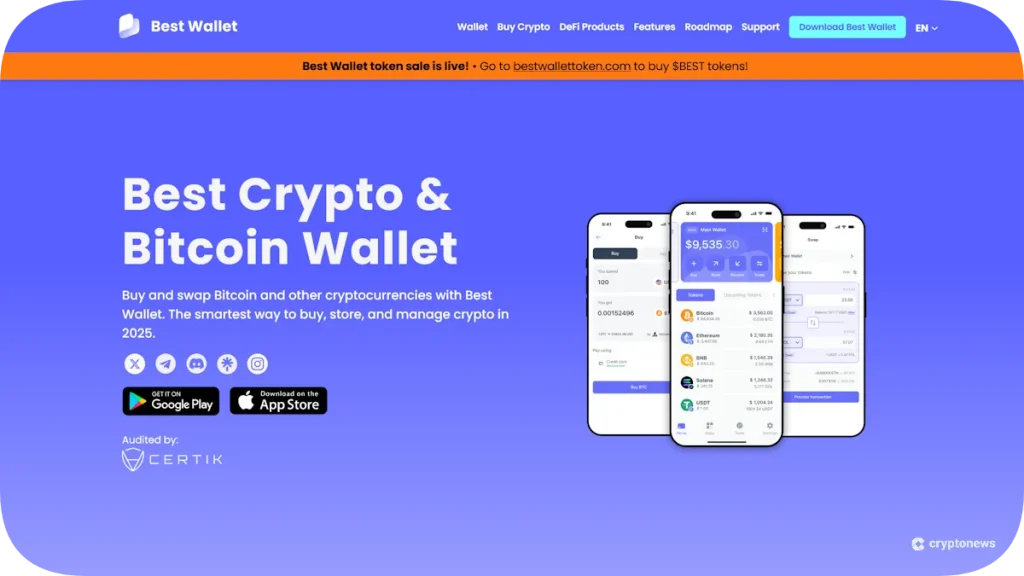
Built to combine security with ease of use, Best Wallet uses Multi-Party Computation (MPC) to protect your private keys. This strategy allows a simple sign-on for recovery, bypassing cumbersome recovery phrases.
Just download the Best Wallet app using the official links, follow the setup instructions, and navigate to Raydium.io to connect.
Raydium (RAY) Token
The Raydium is a multi-faceted platform token that enables sharing ownership of the Raydium protocol.
- First, the token acts as a governance token, allowing holders to vote on protocol improvements using staked RAY tokens.
- Users who stake RAY also earn a percentage of protocol fees. As explained earlier, the Raydium protocol automatically converts a portion of the liquidity pool fees to RAY, paying a yield to stakers.
This buying pressure (sell LP fee tokens to buy RAY) creates demand for the Raydium token. However, only about 50% of the supply is circulating, with much of this reserve held for future ecosystem rewards and LP mining rewards. Ultimately, the RAY token’s price reflects the platform’s revenue (yield for stakers) relative to the total supply, including tokens not yet circulating.
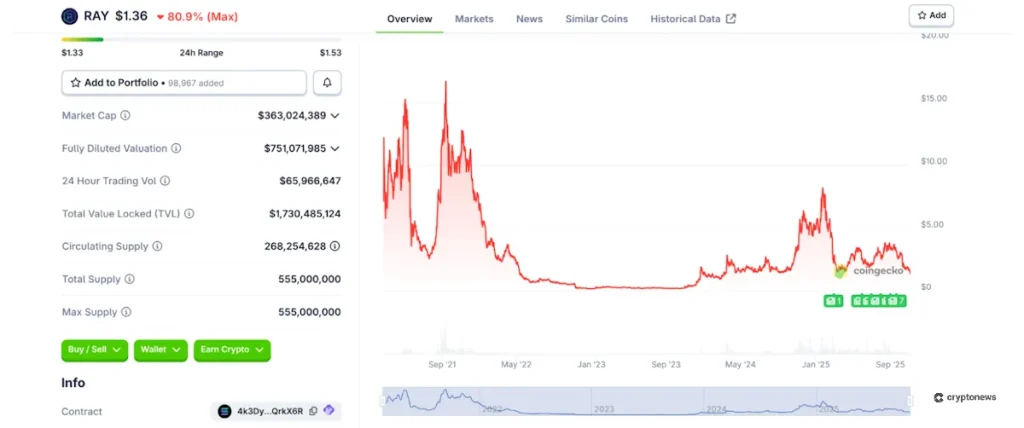
Raydium’s token price has fallen considerably since its 2021 bull-market highs, from more than $15 at the peak to $1.36 on the current price chart. Future price action depends on the platform’s performance within the competitive Solana space, where Raydium shares the DEX market share with other innovative trading platforms. These include the Jupiter DEX, which supports limit orders for spot swaps, a feature Raydium had to abandon early on.
RAY’s comparatively low price, combined with a capped supply, makes it a potentially attractive investment if you believe the platform will grow its market share. You can buy the token through dozens of crypto exchanges, including MEXC, Binance, KuCoin, and OKX. Alternatively, you can buy the RAY token through the Best Wallet app mentioned earlier or by swapping SOL for RAY on Raydium.
Raydium Fees
Fees for using the Raydium platform vary depending on the activity you need to perform. Notably, Raydium allocates the bulk of the total transaction fees to liquidity providers, who also assume the price risk by funding LPs. Raydium’s swap fees are higher than the trading fees on the lowest-fee crypto exchanges, but competitive with those of similar decentralized exchanges.
- Swap Fees: Basic swaps come with a variable fee that depends on the pool used for your swap. Standard pools come with a 0.25% fee, whereas fees for concentrated liquidity pools range from 0.1% to 1% or higher (rare). Raydium intelligently routes your swap to the pool with the best price, including fees.
- Future Trading Fees: Futures fees vary based on the type of order used. Limit orders incur 0% fees, whereas market orders pay taker fees of 0.025%. Additionally, traders pay (or receive) a variable funding rate every eight hours, depending on the token contract price relative to the spot price.
- Fiat-to-Crypto Fees: Buyers pay a 4% to 7% fee when purchasing crypto with fiat money through MoonPay, a third-party provider. This additional cost includes a spread (a buffer that guarantees a price for a limited period).
- Launchlab: Buyers for Launchlab tokens pay a 1% fee when swapping on the initial bonding curve. This fee funds the ecosystem, with a portion allocated to RAY token buybacks.
Raydium allows users to fine-tune two cost-related settings: gas fees and slippage. Users can manage gas costs by adjusting the Transaction Priority Fee. Users can also adjust granular control over slippage in the settings, ensuring that transactions execute only when within a specified price range.
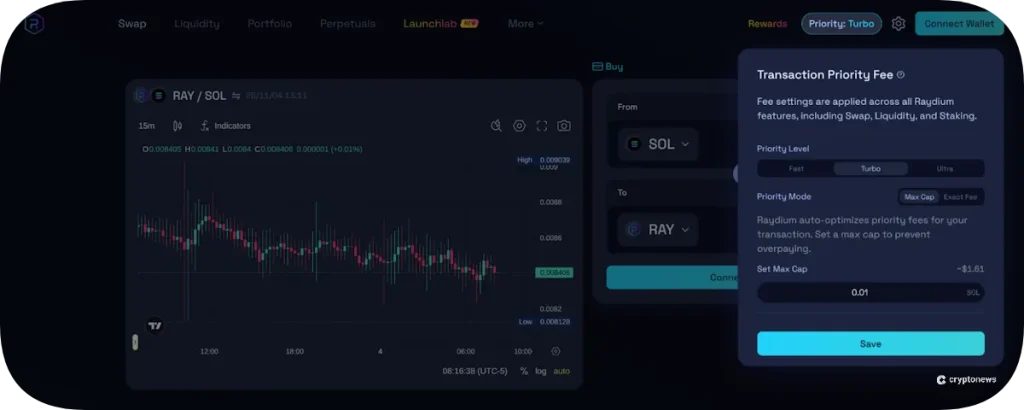
Raydium does not charge specific withdrawal fees, but standard network fees can apply.
Is Raydium User-Friendly?
Raydium’s user-friendliness varies depending on which platform features you use. Basic swaps proved intuitive, with user settings like priority fees and slippage within reach. However, when navigating to the Perpetual Futures tab, users could easily become overwhelmed. If you’re new to trading with leverage, it’s wise to familiarize yourself with how Raydium Perps work and the platform’s Trading Basics help page.
Other features, including fiat-to-crypto purchases and Launchlab trading, were easy to navigate. While the platform isn’t as easy to navigate as beginner-friendly crypto exchanges, users with basic knowledge of crypto wallets should be able to use Raydium with relatively few questions.
As of this writing, Raydium does not offer a mobile app. However, we did find an app labeled as Raydium. Fake apps may be phishing attempts that could put your digital assets at risk. The official web app is mobile-friendly, removing the need for a dedicated mobile app.
Best Raydium Alternatives
Several apps and platforms offer competitive trading features, including Best Wallet, which we discussed briefly before. Other apps well-suited to active traders include CoinFutures and MEXC DEX+. Let’s review these alternatives next as part of our Raydium review.
Best Wallet
The Best Wallet mobile app combines the security features of a non-custodial wallet with trading features, including built-in DEX support. The app allows users to buy cryptocurrencies directly, swap crypto assets (including cross-chain swaps), and connect with dApps like Raydium.
Integrated support for Solana makes Best Wallet well-suited for Solana users seeking greater flexibility. Additional support for Bitcoin, Ethereum, BNB Smart Chain, and other popular blockchains makes Best Wallet a powerful tool for managing crypto assets on a wide range of chains.
CoinFutures
The CoinFutures app offers an easy-to-use alternative to futures trading on Raydium or other platforms. CoinFutures does not require KYC and supports 11 leading cryptocurrencies. You can bet on the future price of BTC, ETH, SOL, and other top assets with up to 1,000x leverage.
The platform replaces complicated settings with simple point-and-click options that let you set up a trade in seconds. Automated trade settings let you exit your position safely at levels you define. CoinFutures supports iOS, Android, and Windows with a single login.
MEXC DEX+
The MEXC DEX+ platform combines the convenience of a centralized exchange with access to a myriad of leading decentralized exchanges. You can trade nearly any token on any supported chain without managing multiple wallets.
MEXC DEX+ supports top Solana DEXs, such as Raydium, Jupiter, and Orca, as well as DEX apps on other chains, including Ethereum, BNB Smart Chain, Base, and others.
Does Raydium Require KYC?
In general, Raydium is a no-KYC crypto exchange. Swaps use a non-custodial wallet, which means that basic swaps do not require KYC. Similarly, perpetuals also center on a non-custodial wallet. Although perps require registration to obtain an API key, this is not the same as KYC. Other features, including Launchlab trading, also do not require KYC.
However, when buying through MoonPay, users must complete basic KYC identification. As a third-party payments provider, MoonPay is responsible for safeguarding your personally identifiable information (PII). Users should be aware that KYC requirements link their identity to a specific crypto wallet address.
How to Get Started With Raydium
Next in our Raydium exchange review, we’ll walk you through how to use the platform and start trading.
1. Connect a Solana Crypto Wallet
Raydium provides non-custodial access to swaps and trading markets. Choose a non-custodial wallet that supports Solana and works with your trading workflow (mobile or desktop). In this example (desktop), we’ll simply use the built-in wallet from the Brave Browser. Other popular desktop options include Phantom Wallet and Solflare.
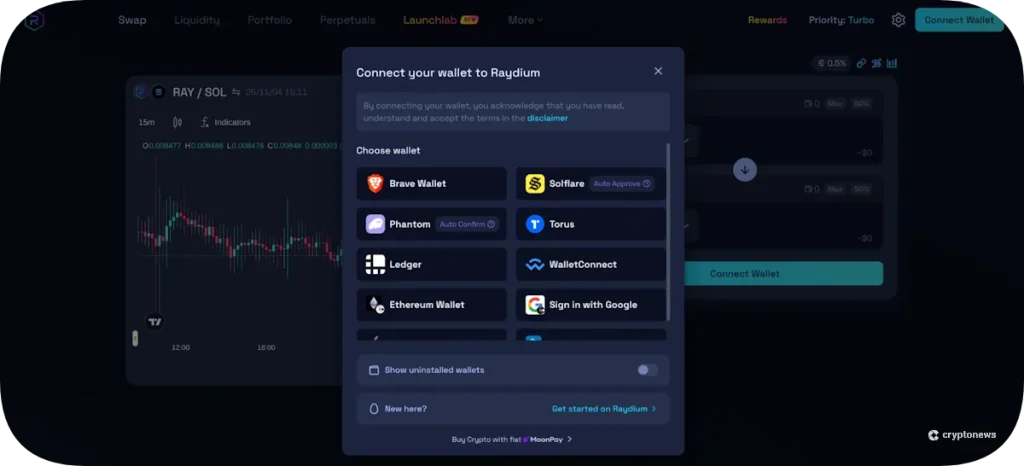
Navigate to the Raydium website and tap on the Connect button. Then, choose your preferred wallet app.
2. Choose Your Tokens and Swap Amounts
On the right side of the interface, choose a payment token. The default is SOL, but Raydium can automatically perform additional swaps if needed to complete the transaction. For example, if you want to swap BONK for RAY, the platform will swap BONK for SOL and then swap SOL for RAY.
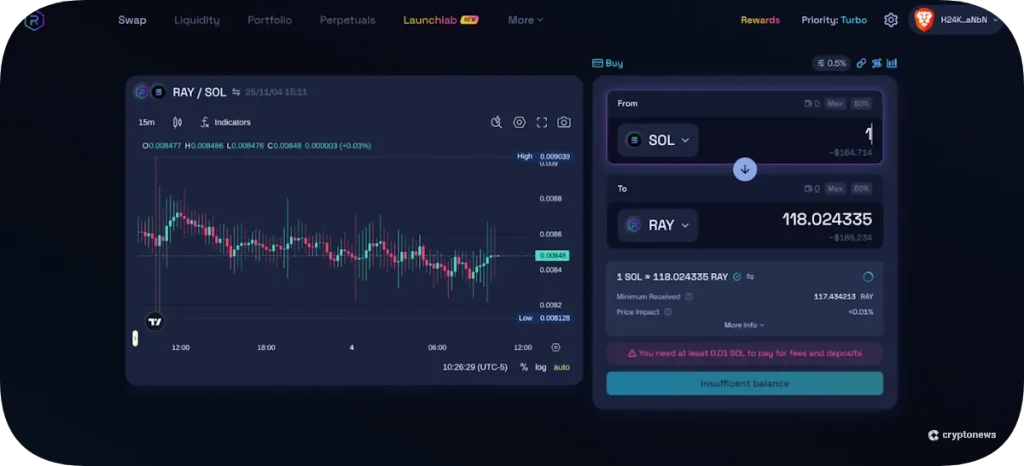
Set an amount for your swap. You can set a spend amount (FROM) or a purchase amount (TO). Raydium automatically calculates the needed values for each.
3. Set Your Gas and Slippage Settings
Optionally, you can set your Transaction Priority and maximum slippage for the swap.

- Slippage tolerance refers to the maximum price difference allowed for a transaction. This can be important during market volatility, when making larger swaps, or when the assets have limited liquidity.
- Transaction Priority refers to the speed with which the transaction completes. The gas fees (SOL) for the transaction drive this, with higher-priority transactions getting faster processing by Solana validator nodes. This setting may be necessary for time-sensitive transactions.
4. Complete Your Swap
Verify your swap settings. If everything looks correct, click the SWAP button. This action passes the transaction back to your crypto wallet so you can approve (or reject) the transaction. Once you approve the transaction, the swap occurs, removing the FROM token from your crypto wallet and delivering the TO token.
Verify your swap settings. If everything looks correct, click the SWAP button. This action passes the transaction back to your crypto wallet so you can approve (or reject) the transaction. Once you approve the transaction, the swap occurs, removing the FROM token from your crypto wallet and delivering the TO token.
Raydium Review Conclusion: Is it the Best Solana Ecosystem DEX?
Raydium offers an easy-to-use platform for simple swaps and provides access to new tokens through two launch platforms: AcceleRaytor and Launchlab. Advanced users may also appreciate the platform’s perpetual futures platform, which offers leverage of up to 100x but may be intimidating for newer traders.
The platform is among the easiest we’ve used for simple swaps and offers access to popular tokens in the Solana space. Wallet connections only take a moment, and the project’s help pages can guide users with questions. Other aspects of the platform, such as perpetuals, are better suited to seasoned traders.
Our Methodology: How We Tested and Reviewed Raydium
To evaluate the Raydium exchange, we performed a series of real-world transactions, connecting a crypto wallet to complete swaps, buy crypto with USD, and trade on the platform’s perpetual futures markets.
We evaluated the current audit status as well as any mitigations the platform enacted to address past security incidents. We also evaluated ease of use, including desktop and mobile support, as well as wallet connectivity.
In all our testing, we looked for features that made the platform more or less accessible to newer traders, finding a mix of both.
FAQs
Is Raydium a good exchange?
Is Raydium legal in the US?
Does Raydium exchange have an app?
What is a buy limit on Raydium?
Is Raydium a wallet or an exchange?
What network does Raydium use?
References
- Solana, FTT and Serum prices plummet on back of FTX collapse (The Block)
- What Are Perpetual Futures (Perps)? (Raydium)
- Solana-based exchange Raydium suffers $4.4 million exploit (The Block)
- Kudelski Q2 2021/Raydium Audit (GitHub)
- raydium-docs/audit/ (GitHub)
- Halborn Q2 2025 (GitHub)
- Raydium Exchange (CoinGecko)
- Raydium (RAY) (DefiLlama)
- Docs – Raydium Perps (Raydium)
- Orderly Orderbook Design (Orderly Network)
- What is MPC (Multi-Party Computation)? (Fireblocks)
- Guidance on the Protection of Personally Identifiable Information (PII) (U.S. Department of Labor)