

Hyperliquid DEX Review 2026
- Trade almost 200 perpetual futures markets in a decentralized ecosystem.
- The on/off-chain hybrid model combines order books with non-custodial access.
- Trade cryptocurrencies without KYC requirements.
- Liquidity providers earn passive rewards in a sustainable environment.
Hyperliquid is a decentralized exchange (DEX) that operates on a native Layer 1 blockchain. While the platform also offers spot trading and liquidity provision yields, leveraged perpetual futures are the flagship product. This Hyperliquid DEX review explores the exchange in great detail.
We tested Hyperliquid with real funded wallets to evaluate the trading experience, available markets, and platform fees. Discover how Hyperliquid compares to other decentralized trading platforms, and learn how to use the exchange with the best safety practices.
Hyperliquid Review Verdict: Pros and Cons
Hyperliquid’s hybrid model revolutionizes the crypto trading sector. While the DEX leverages off-chain order books for premium execution speed, its native Layer 1 blockchain settles positions on-chain for enhanced transparency.
Platform traders go long or short on perpetual futures with leverage of up to 40x. The maker-taker commission structure offers competitive fees, even for entry-level users with minimal 14-day volumes.
We found that Hyperliquid falls short for mobile compatibility, as traders rely on smartphone browsers over a mobile app. Other exchanges offer much higher leverage multipliers and listed assets, and the exchange’s spot trading markets attract limited liquidity.
In our view, beginners may find several exchange features intimidating, particularly the on-chain derivatives process and non-protocol Vaults.
- Trade leveraged perpetual futures in both market directions
- Avoid centralized exchange risks and KYC requirements
- The platform caps futures trading commissions at 0.045%
- Merge traditional order books with on-chain settlement
- Liquidity providers earn a share of platform revenues
- The highest 40x leverage multiplier is available on BTC only
- Most altcoin markets offer a maximum leverage of just 3x
- Some exchange competitors support significantly more markets
- Funding rates of up to 2.47% on non-major perpetuals
- Spot trading volumes rarely exceed $300 million daily
What is Hyperliquid?
Launched in 2023, Hyperliquid is a DEX that primarily offers perpetual futures markets. Unlike most DEX platforms, which operate on existing network ecosystems, Hyperliquid runs on a p/roprietary Layer 1 blockchain. This framework provides futures traders with a transparent, secure, and low-fee trading experience without relying on secondary blockchains.
Hyperliquid, which is the largest DEX for crypto derivative volume, lists nearly 200 perpetual markets. Platform users access leverage multipliers up to 40x on top cryptocurrencies like Bitcoin (BTC), Ethereum (ETH), and Solana (SOL). Although the DEX also offers traditional spot markets, trading volumes remain small compared with many exchanges.

To trade on Hyperliquid, users connect a non-custodial wallet such as Best Wallet or MetaMask, and use USDC (USDC) to post margin. Traders avoid know-your-customer (KYC) requirements and enjoy an anonymous experience. As such, Hyperliquid works globally without jurisdictional restrictions.
On January 26, 2026, Hyperliquid surpassed Binance in liquidity, achieving tighter BTC perpetual spreads ($1 vs $5.5) and a larger cumulative Bitcoin ask size (140 BTC vs 80 BTC). This makes Hyperliquid the world’s most liquid exchange.
What Type of Exchange is Hyperliquid?
While Hyperliquid is one of the top decentralized exchanges for trading volume, it leverages a unique on/off-chain hybrid model.
Anyone can provide platform liquidity to earn passive income, yet unlike Uniswap and other popular DEXs, Hyperliquid does not rely on the automated market maker (AMM) system. Instead, it uses an off-chain order book framework, while positions settle on-chain for superior performance metrics.
As a decentralized initiative, Hyperliquid ensures a self-custodial experience without third-party risks. The platform retains no user funds, since smart contracts handle posted margin and settled trades. Users withdraw their derivative trading balances at any time, and smart contracts transfer account funds to the linked wallet address.
Is Hyperliquid Exchange Safe?
Our Hyperliquid DEX review confirms that the platform is safe and reliable. It eliminates counterparty risks found on centralized crypto exchanges (CEXs), as users always retain control of their assets and private keys. Because the DEX lacks access to client-owned funds, it cannot mismanage assets, freeze balances, or deny withdrawals.
Hyperliquid offers transparency with on-chain order books. It records all transactions on its public blockchain, which includes trading positions and liquidations. This safeguard establishes a credible trading ecosystem, as Hyperliquid cannot manipulate markets.
However, due to Hyperliquid’s non-custodial structure, the platform lacks traditional account security controls like two-factor authentication and biometrics. Traders are responsible for wallet security, and the DEX offers no recovery assistance if they fall victim to cybersecurity hacks.
DEX traders must also consider smart contract risks. Zellic audited Hyperliquid and found no vulnerabilities, and the active bug bounty program rewards developers who discover potential threats. However, as seen with the recent Balancer exploit, which enabled hackers to steal over $128 million in ecosystem assets, no decentralized platform is 100% safe.
Hyperliquid Supported Coins and Markets
Hyperliquid supports almost 200 trading markets, and the majority of pairs contain the USDC stablecoin. Besides BTC, the DEX lists top altcoins such as ETH, SOL, XRP (XRP), Litecoin (LTC), and BNB (BNB).
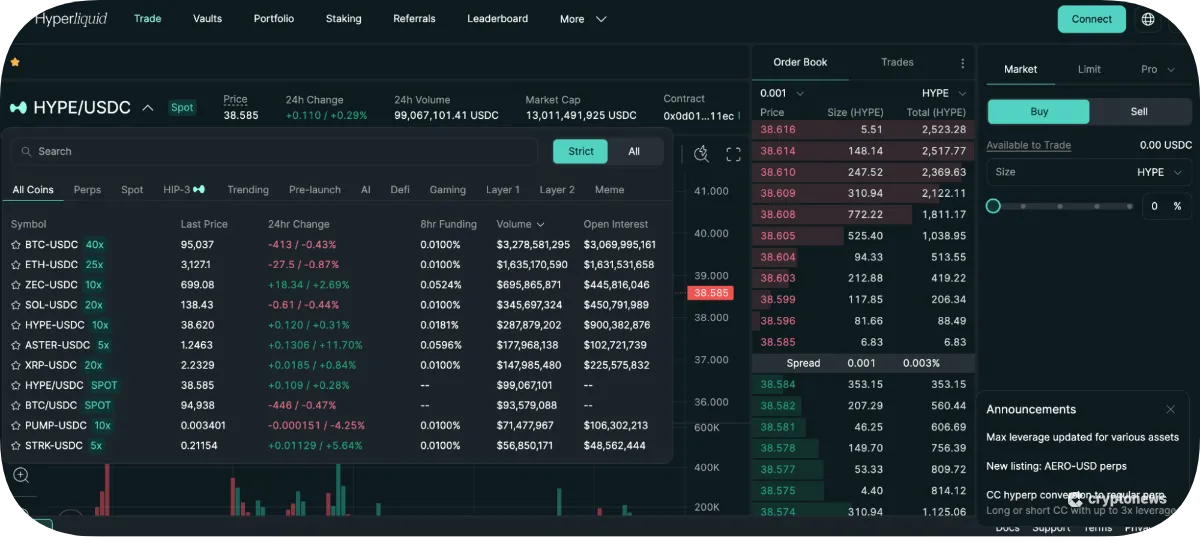
A wide selection of meme coins is available, too. Popular meme markets range from Dogecoin (DOGE) and OFFICIAL TRUMP (TRUMP) to Bonk (BONK), Brett (BRETT), and dogwifhat (WIF). On the trading dashboard, users find cryptocurrencies by the ticker or investment category, such as Layer 2, artificial intelligence (AI), or decentralized finance (DeFi).
The exchange regularly adds new trading pairs based on its Hyperliquid Improvement Proposals (HIPs) model. Those who hold the native governance token, HYPE, cast votes on new pair proposals, and the DEX adds those markets when the community reaches consensus.
Hyperliquid Stocks and Commodities
Hyperliquid soon launches tokenized stocks with 10x leverage on popular companies like Apple, Google, Meta Platforms, and Microsoft. These markets trade via perpetual futures, so they support long and short trading.
The platform will also offer tokenized gold markets with 20x leverage. Follow Hyperliquid on X to receive updates on product launch dates.
Hyperliquid DEX Key Features
Hyperliquid offers a wide range of products. Decentralized trading markets include spot and futures pairs, and yield opportunities cover liquidity provision and staking. This section of our Hyperliquid DEX review explores these investment features in more detail.
Spot Trading
Hyperliquid’s spot trading exchange lets users trade cryptocurrencies in the traditional sense. Traders swap USDC or Hyperliquid’s native USDH (USDH) for their preferred digital asset to secure real ownership.
The smart contract system automatically transfers purchased cryptocurrencies to the user’s non-custodial wallet. The spot exchange lists 54 pairs covering a broad mix of small and large-cap assets. Lesser-known markets include Unit Plasma (UXPL), Catbal (CATBAL), and Hypurr Fun (HFUN).
In contrast to its perpetual futures ecosystem, Hyperliquid’s spot exchange attracts minimal activity. Exchange data shows that daily trading volumes average several hundred million dollars, which causes modest liquidity and wider slippage.
Futures (Perpetuals)
Hyperliquid is the sector’s largest DEX for perpetual trading volume. It frequently hits $7–10 billion per 24 hours, and open interest often exceeds $7 billion.
Our research shows that short-term traders use Hyperliquid futures to access leverage. The platform offers a maximum leverage multiplier of 40x on BTC/USDC, which reflects a small 2.5% margin requirement. ETH and XRP offer 25x and 20x leverage, respectively, while most meme coins and small-cap assets provide 3–5x.
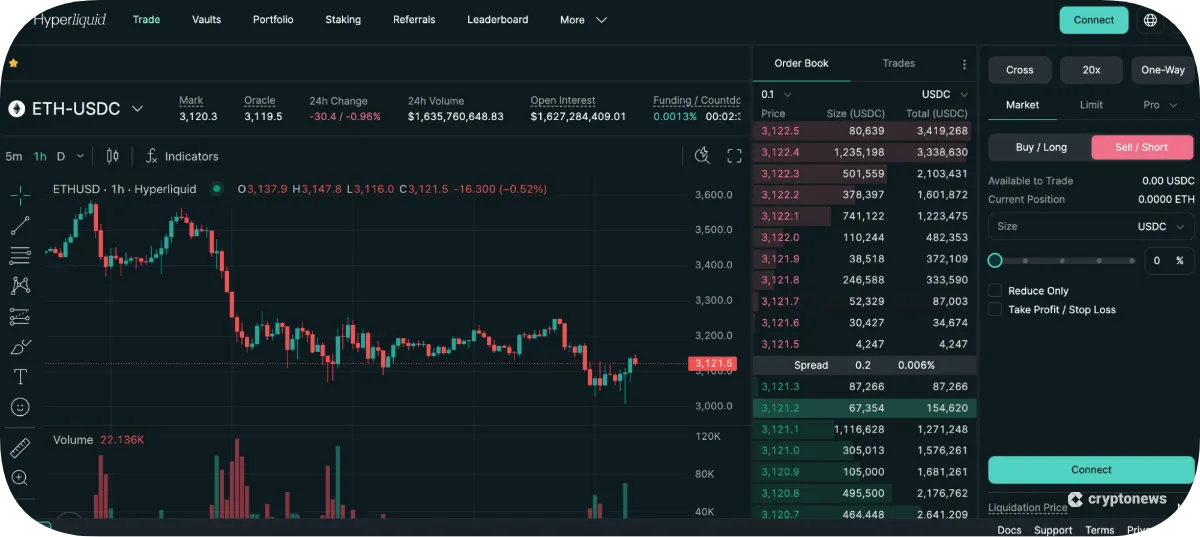
While these leverage limits enable users to magnify market exposure, many platforms offer much higher multipliers. One example is CoinFutures, which supports 1000x leverage on all listed markets. MEXC users get 500x leverage on BTC and major altcoins, while Binance offers a maximum limit of 125x.
Hyperliquid futures also appeal to market bears. DEX traders open positions with sell orders to capitalize on falling prices.
In December 2025, the exchange introduced a Portfolio Margin feature, which combines spot and perpetual accounts into a single view and allows you to collaterize your positions using all of your funds on the DEX.
Staking
As a Layer 1 blockchain that uses the proof-of-stake mechanism, Hyperliquid users stake HYPE to earn passive yields. Users select an approved staking validator based on APY, uptime, and commission fees.
Staking APYs are modest, ranging from 0.83% to 2.26%. The blockchain offers a sustainable model to generate HYPE rewards, as platform revenues cover most distributions. This framework protects long-term holders from inflationary pressures.
Although validators require a minimum lock-up period of just one day, users wait one week before they receive unstaked tokens.
HYPE stakers also earn governance rights, so they can vote on proposals linked to protocol upgrades, new trading markets, and treasury management.
Hyperliquid Vaults
Hyperliquid Vaults differ from traditional DEX models, which rely on paired liquidity pools and an AMM mechanism.
On Hyperliquid, users deposit USDC into Vaults, and smart contracts allocate funds to bid-ask quotes. The system ensures perpetual futures markets hold sufficient liquidity and competitive spreads.
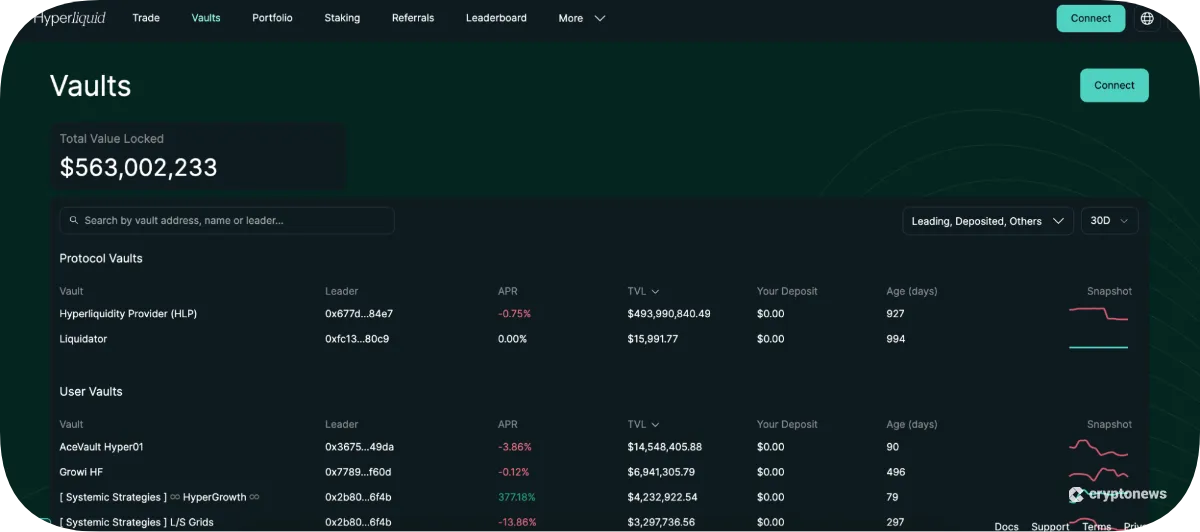
To incentivize liquidity provision, Vaults offer passive yields. APYs depend on spread profits, trading commissions (which vary by tier and order type), liquidation earnings, and funding payments. Vaults incorporate each revenue category in the APY to ensure sustainability.
In December 2025, Hyperliquid also introduced BLP Earn Vaults – a new feature where you can earn yield on stablecoins and borrow assets, using $HYPE as collateral.
Note that non-protocol Vaults provide alternative yield strategies, and each offers various risk-reward opportunities. APYs range from -13.86% to 377.18%.
Hyperliquid (HYPE) Token
The ecosystem token, HYPE, is one of the top cryptocurrencies with the highest returns. The project launched HYPE on public exchanges in late 2024 at $3.20 per token. Despite early adopters receiving free HYPE airdrops, the token price rose steadily.
According to exchange data, HYPE reached an all-time high of $59.39 in September 2025, which represents a 1,700% rise from initial prices.
One drawback to consider is Hyperliquid’s market capitalization of over Coin data not available. While its substantial valuation provides reduced upside for new investors, analysts also cite Hyperliquid’s supply dynamics.
Approximately 31% of the total supply circulates, so HYPE’s fully diluted valuation is over three times higher than the current market capitalization. Future token unlocks dilute existing holders, which could harm the HYPE price.
Regarding use cases, HYPE tokens allow holders to pay network fees, earn staking rewards, and cast governance votes. Holders also receive DEX fee discounts of up to 40% depending on how many tokens they stake.
HYPE is currently trading at ~$27, up over 30% from its January 20 lows.
What is the Best Wallet to Use With Hyperliquid?
Hyperliquid users connect non-custodial wallets to the DEX and trade cryptocurrencies on-chain. While the platform operates a native blockchain, it accepts Ethereum-compatible wallets to increase accessibility.
We researched the best crypto wallets for Hyperliquid and found that Best Wallet is the top choice for DEX traders. The mobile app offers non-custodial storage on over 60 blockchain standards, and security features include encrypted private keys, biometrics, and two-factor authentication.

Best Wallet connects with fiat on-ramp providers like MoonPay, so users can purchase USDC with a debit card, credit card, or e-wallet. Users then connect Best Wallet to Hyperliquid’s mobile website and use USDC to trade perpetual futures. Those who prefer Hyperliquid’s desktop platform connect via WalletConnect for a more seamless trading experience.
Visit Best WalletHyperliquid Fees
Hyperliquid charges trading commissions per side. Traders pay variable commissions depending on 14-day trading volumes, order type, and whether they trade spot cryptocurrencies or perpetual futures. The DEX also offers reduced trading fees when users stake HYPE.
Our Hyperliquid DEX review breaks down the platform’s fee structure in the following sections.
Spot Trading Fees
Spot traders initially pay trading commissions of 0.04% and 0.07% on limit and market orders, respectively. These commission rates are more competitive than CEXs like Binance and OKX, which charge entry-level fees of 0.1% on both order types.
Users increase their VIP tier to reduce trading fees. The first VIP tier requires 14-day trading volumes of over $5 million, and it lowers maker-taker commissions to 0.03% and 0.06%. While the VIP threshold demands significant activity, Hyperliquid calculates volume by the total leveraged position size rather than the margin posted.
Makers who achieve the highest VIP level, which requires $7 billion in 14-day volume, secure commission-free spot trading. Takers get a minimum commission of 0.025% per side, which is attractive to both retail and institutional traders.
HYPE Trading Discounts
Hyperliquid users who stake HYPE tokens receive the following trading commission discounts:
| Staked Hype | All-Time High Value | Fee Reduction |
| 10 | $593.90 | 5% |
| 100 | $5,939 | 10% |
| 1000 | $59,390 | 15% |
| 10000 | $593,900 | 20% |
| 100000 | $5,939,000 | 30% |
| 500000 | $29,695,000 | 40% |
Derivative Trading Fees
Hyperliquid uses a similar maker-taker and volume model for perpetual futures markets. Most traders pay 0.045% or 0.015% on limit and market orders. Similar to spot trading commissions, these rates reflect competitive fees. Bybit, for instance, charges makers and takers 0.02% and 0.055%.
In addition to HYPE staking discounts, derivative traders get lower commissions as they increase trading volumes. The maker/taker rate for top-tier clients is 0% and 0.024%.
Other Fees to Consider
DEX traders cover network fees when they transfer USDC to their margin account. The blockchain determines these fees, and Hyperliquid adds no markups. Traders also pay network fees when they withdraw assets to a non-custodial wallet.
Hyperliquid uses the funding rate system like other perpetual futures platforms. Depending on market dynamics, each funding cycle applies to long or short traders only. If longs incur funding, they pay shorts, and vice versa.
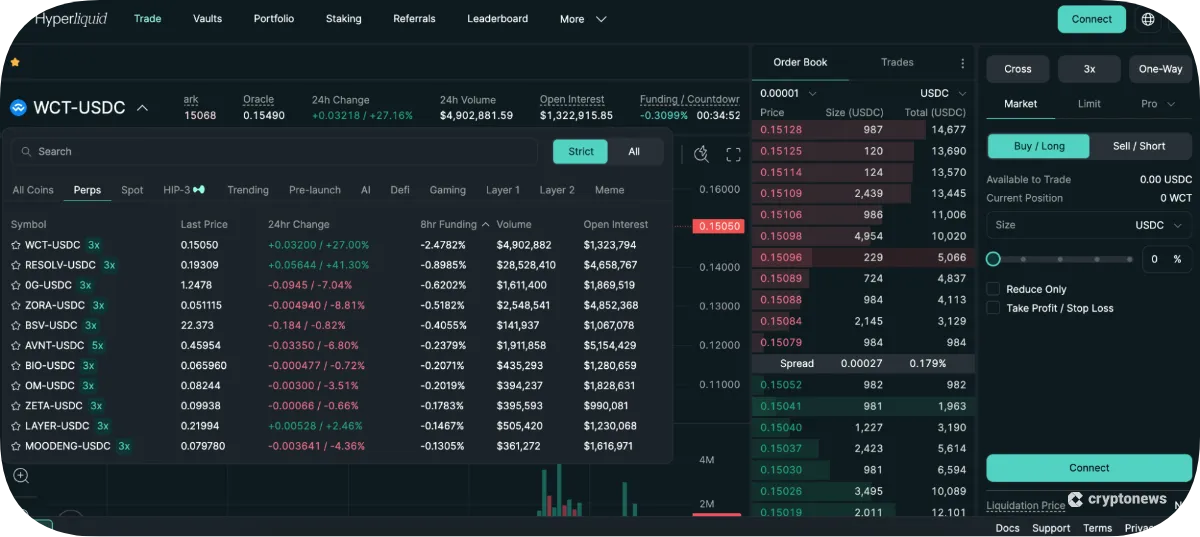
In terms of funding rates, most major markets charge 0.01%, which aligns with the industry average. Smaller-cap markets have higher rates, as they experience more volatile pricing swings. WCT/USDC, for example, has an eight-hour rate of 2.47%, which is over 247 times more expensive than BTC/USDC.
| Fee Type | Fee |
| Spot Makers | 0%–0.04% |
| Spot Takers | 0.025%–0.07% |
| Futures Makers | 0%–0.015% |
| Futures Takers | 0.045%–0.024% |
| HYPE Commission Discount | 5%–40% |
| Network Fees | Aligns with the real-time blockchain fee |
| Funding Cycles | 0.01%–2.47% |
Does Hyperliquid Support Fiat Deposits?
Since Hyperliquid operates a non-custodial infrastructure, DEX traders need funded crypto wallets. Users require USDC to trade perpetual futures, as Hyperliquid margins and settles trades in the stablecoin. Spot traders use USDC or USDH to buy cryptocurrencies, and Hyperliquid smart contracts transfer the purchased assets to the connected wallet.
Although Hyperliquid does not support fiat payments, many non-custodial wallets partner with fiat gateways. Reputable wallets like Best Wallet, MetaMask, and Exodus let users purchase USDC with traditional payment methods. Once they have USDC, they use the same wallet to connect to the Hyperliquid DEX.
Is Hyperliquid User-Friendly?
We found that Hyperliquid offers a user-friendly dashboard, yet traders require basic knowledge of DEX trading, non-custodial payments, and smart contract execution. Unlike CEXs, which offer traditional accounts that support fiat payments, Hyperliquid users need a compatible wallet that holds USDC.
Compared with Uniswap, Raydium, and other popular DEXs, Hyperliquid’s hybrid model requires a more moderate learning curve. Traders speculate on cryptocurrencies with conventional orders, so they skip the lesser-known AMM process.
To trade perpetual futures, users input the preferred order type, position size, and leverage multiplier, and Hyperliquid displays the liquidation price and margin requirement. It removes the posted margin from the trader’s non-custodial account and credits profitable trades to the same balance. As perpetuals trade in USDC, traders evaluate profit and loss figures easily.
The Vault feature demands a much steeper learning curve, as non-protocol strategies use complex systems. For example, as one strategy relies on the BTC/USDC moving average between longs and shorts, beginners likely find the feature intimidating.
Does Hyperliquid Exchange Require Kyc?
Hyperliquid’s decentralized infrastructure eliminates KYC requirements. As traders connect a personal wallet to the DEX, they remain anonymous at all times.
While Hyperliquid remains one of the top no-KYC crypto exchanges, it blocks access from several countries, including the U.S. and the UK.
Enforcement capabilities are questionable, though. Many traders use VPNs to bypass geoblocking restrictions, and margin accounts link to wallet addresses rather than real identities.
What are the Disadvantages of Hyperliquid?
According to our research, Hyperliquid falls short in the following areas:
Best Hyperliquid Alternatives
Hyperliquid’s core strengths include competitive fees, non-custodial trading, and deep liquidity for perpetual futures traders. Several platforms outperform the DEX in other areas, such as leverage multipliers, usability, and spot liquidity.
Here are some top-rated Hyperliquid alternatives for crypto enthusiasts to start trading with today.
Best DEX
Best DEX is a decentralized exchange aggregator built into the Best Wallet app. It provides access to millions of tokens from major blockchain ecosystems like Solana, BNB Chain, Base, and Ethereum. As the DEX connects with hundreds of liquidity providers, Best Wallet users secure real asset ownership at market-leading rates.

Although Best Wallet is a non-custodial ecosystem, unlike Hyperliquid, it supports on-ramp services. Users buy over 1,000 coins and tokens with PayPal, Visa, MasterCard, Google/Apple Pay, and more. Partnered gateways transfer purchased cryptocurrencies to the user’s non-custodial balance in minutes.
Coinfutures
CoinFutures is the best Hyperliquid alternative for perpetual futures trading. Its simplified dashboard appeals to derivative beginners, and users trade on consumer-friendly desktop software or a mobile app. Although CoinFutures is a centralized platform, the licensed provider offers a no-KYC experience.
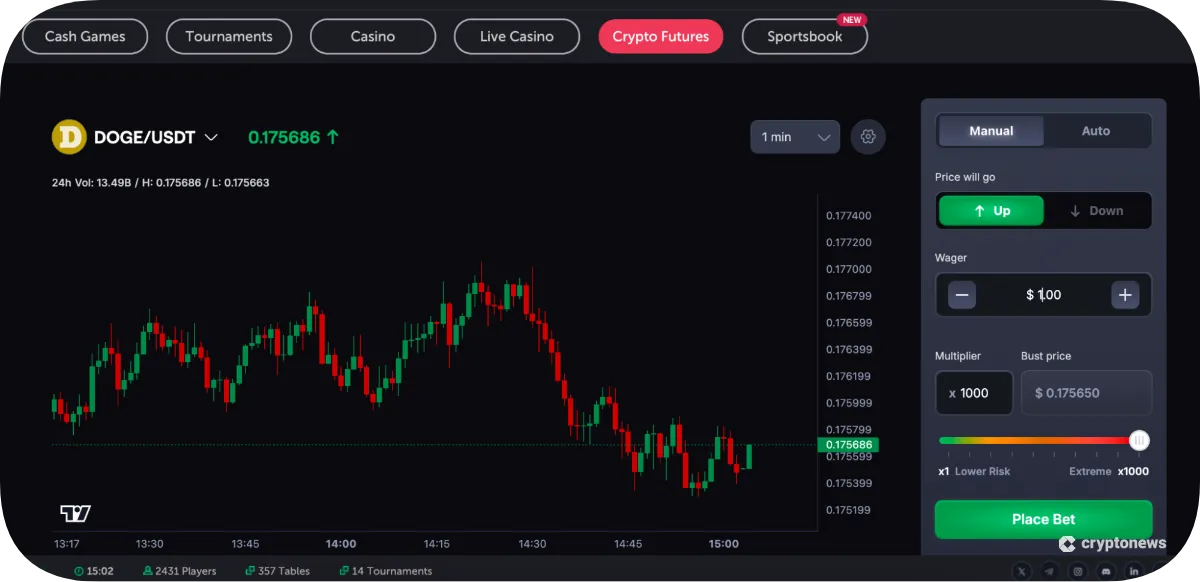
Traders deposit funds with traditional money or popular cryptocurrencies without meeting minimum requirements. CoinFutures also offers higher leverage than Hyperliquid. It allows 1000x on all markets, while Hyperliquid limits positions to just 40x. To ensure client-fund safety, CoinFutures segregates assets in Fireblocks vaults, and it publishes proof of reserves daily.
Aster DEX
Launched in September 2025, Aster is a DEX platform that operates on a proprietary blockchain. Thanks to its strong links to Binance founder Changpeng Zhao, Aster became the second-largest DEX for perpetual futures volume.

Aster lists fewer trading pairs than Hyperliquid, yet at 1001x, it offers substantially higher leverage limits. The trading platform also provides access to new cryptocurrencies via its Rocket Launch feature. Users must hold the exchange’s native token, ASTER, to participate in launch events.
How to Get Started With Hyperliquid
This step-by-step guide helps beginners navigate the Hyperliquid DEX. We explain how to set up a non-custodial wallet and fund it with USDC, connect to Hyperliquid, and trade perpetual futures.
Step 1: Set up a Non-Custodial Wallet
We recommend the Best Wallet app when trading on Hyperliquid. The wallet provides a user-friendly and convenient way to trade on-chain, and users securely store assets in a self-custody environment.
Best Wallet also suits first-time Hyperliquid traders, as it enables users to buy USDC with common payment methods like Visa and MasterCard.
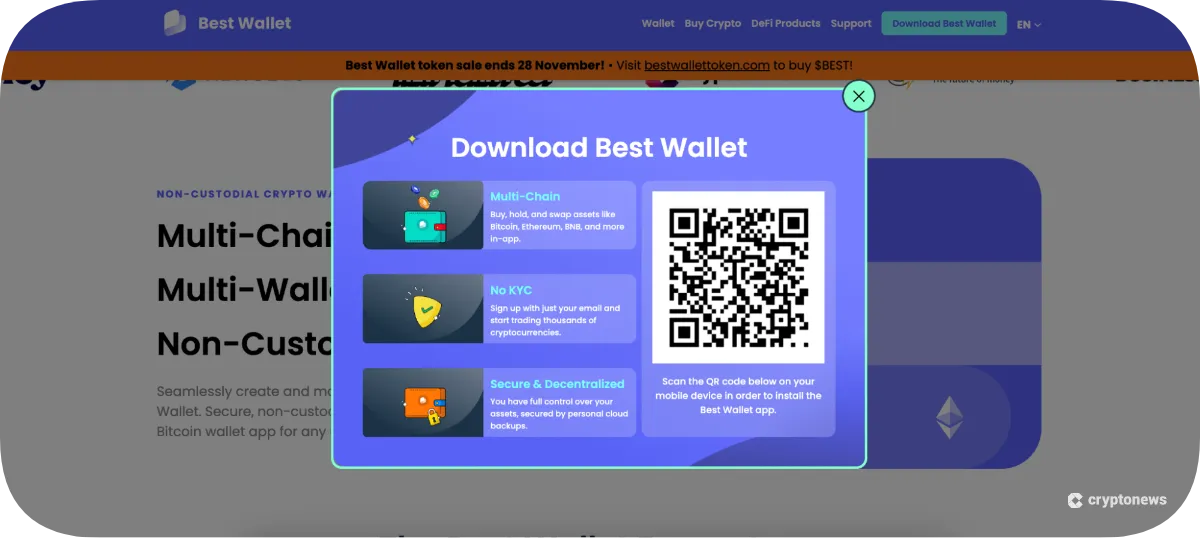
Visit the Best Wallet website and download the free iOS or Android app. Open the app and input an email address, then choose a four-digit PIN.
The app displays your seed phrase as a 12-word combination. Write the seed phrase down on a sheet of paper in the correct order. Never enter those credentials on a desktop or mobile device, since internet exposure creates cybersecurity threats.
We also suggest replacing PIN access with biometrics and activating two-factor authentication to enhance wallet security.
Step 2: Buy USDC
Hyperliquid users require USDC to trade perpetual futures. You can buy USDC instantly on the Best Wallet app.
Tap the “Trade” and “Buy” buttons, and select the fiat currency and purchase amount. Input USDC as the receiving asset, then choose a payment method. Best Wallet fetches prices from partnered gateways based on your parameters.
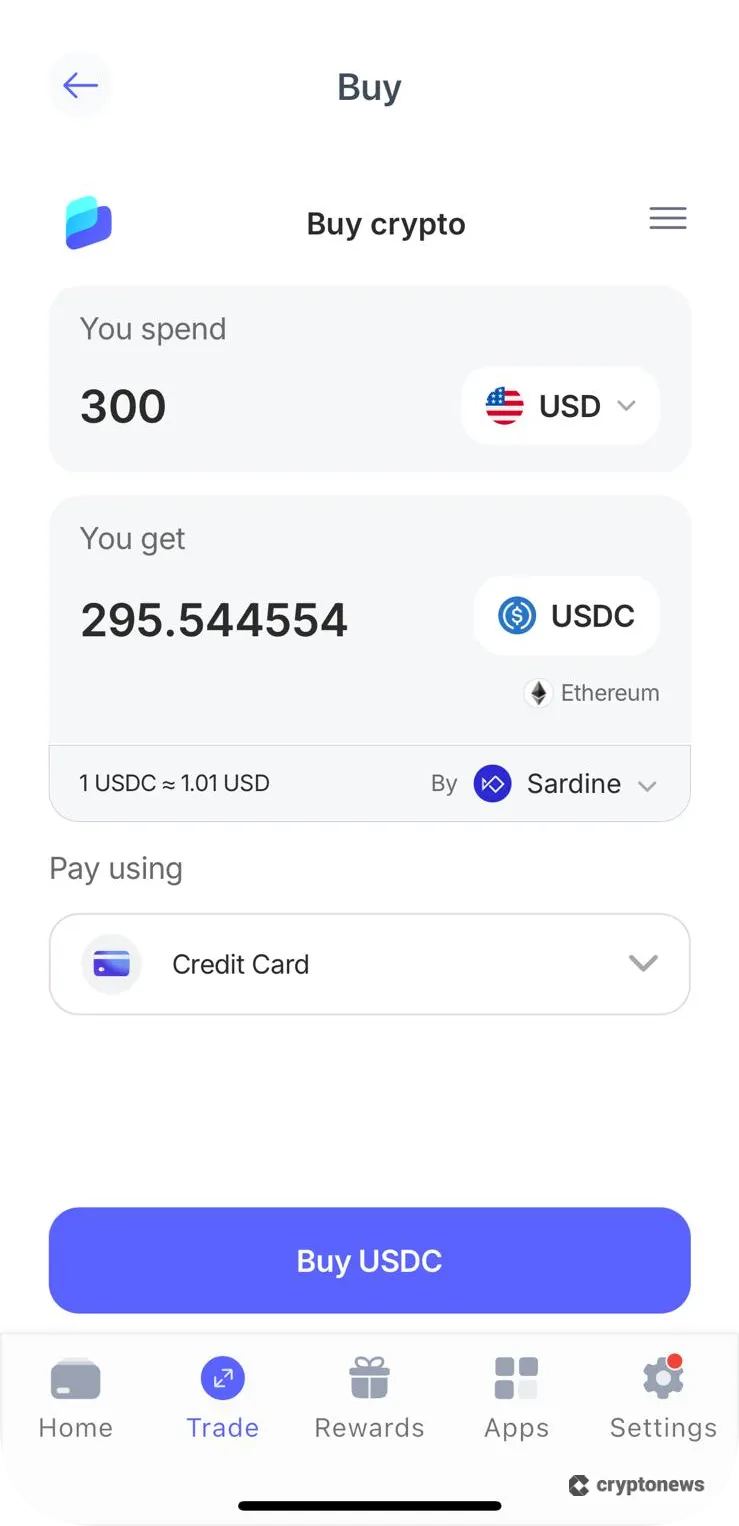
Review the exchange quote and complete the purchase with the on-ramp provider. The Best Wallet balance updates within minutes to reflect the USDC order.
Step 3: Connect the Wallet to Hyperliquid
We recommend using Hyperliquid on a desktop device, since the mobile website offers a subpar experience.
Visit the Hyperliquid website and click “Connect”. Select “WalletConnect”, and scan the displayed QR code from the Best Wallet app.
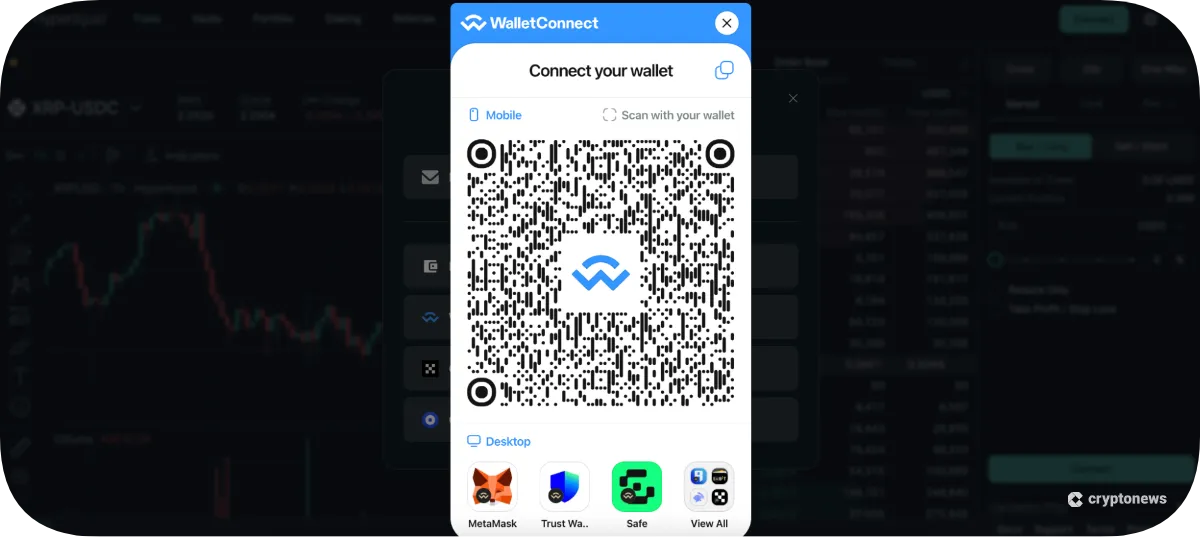
The wallet needs approval before it connects to Hyperliquid. Review the connection request and provide authorization.
Step 4: Deposit USDC to Hyperliquid
The Hyperliquid deposit process differs from most DEXs, as users fund trading accounts rather than swap assets via liquidity pools. Smart contracts govern these accounts, which ensures Hyperliquid cannot access client-owned balances.
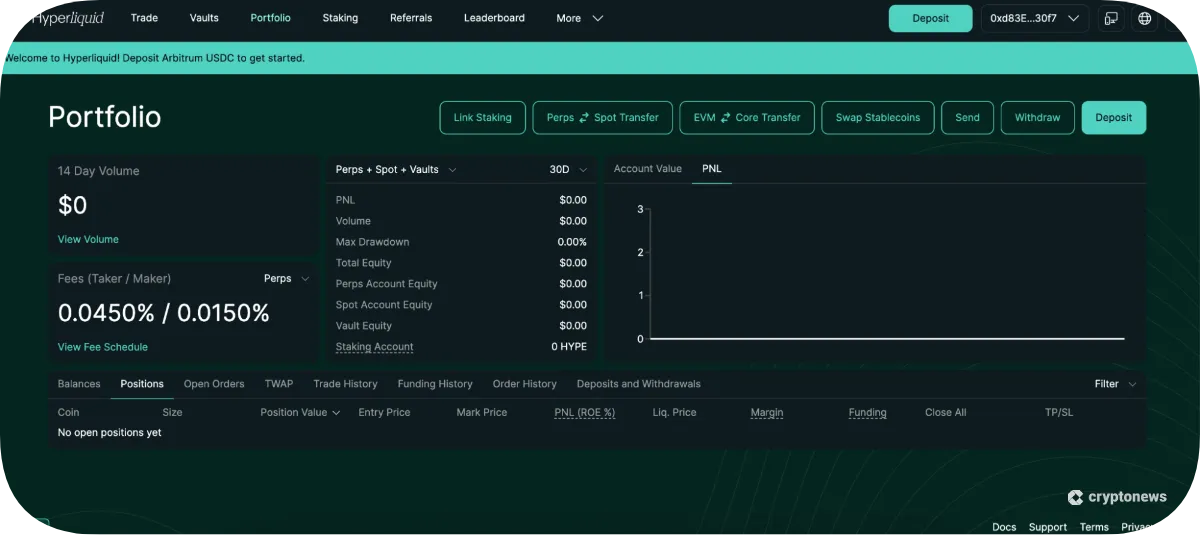
Click the “Portfolio” button from the top menu, followed by “Deposit”. Copy and paste the provided address, and send USDC from the Best Wallet app.
The Hyperliquid deposit should arrive in seconds.
Step 5: Trade Hyperliquid Futures
With a funded account, you can trade perpetual futures right away. Tap “Trade”, then the arrow icon in the top-left corner of the trading dashboard. Select “Perps” to explore available futures markets.
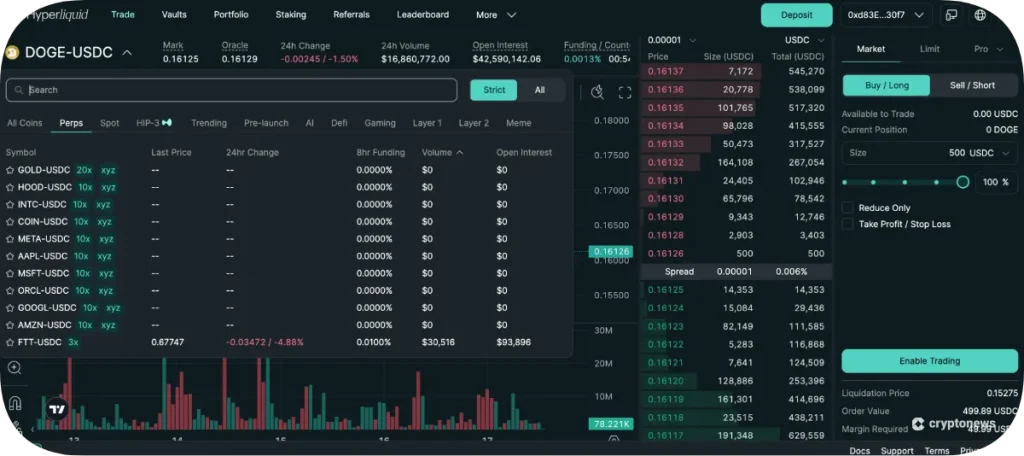
The order form is located on the right side of the trading screen. Select “Buy / Long” or “Sell / Short” depending on your market prediction. Choose between a market or limit order, and input the trade value in USDC.
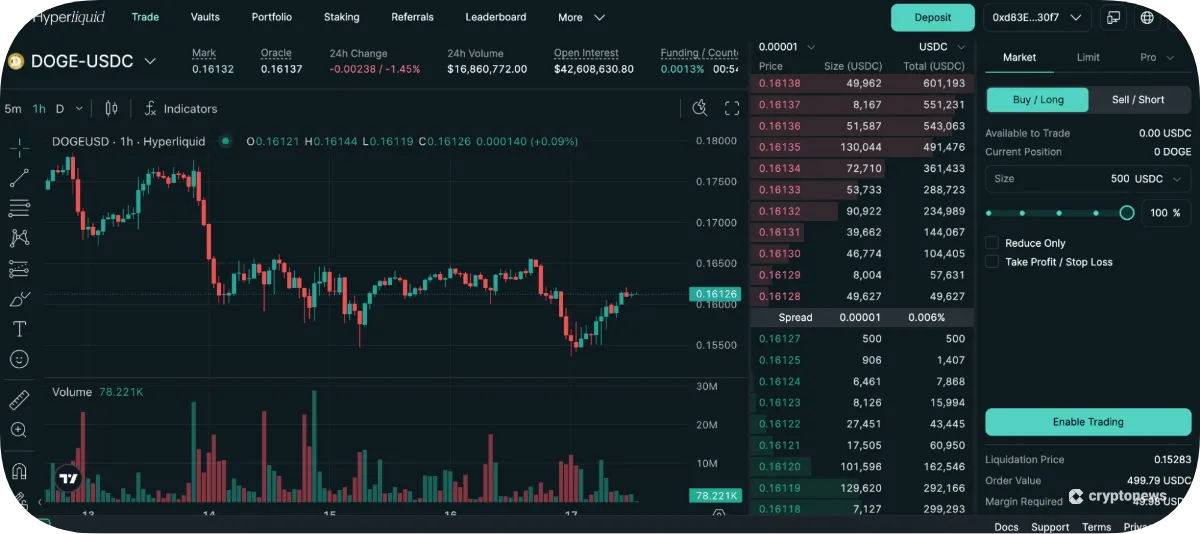
Adjust the leverage multiplier based on your risk tolerance, and review the liquidation price and margin requirement.
To reduce liquidation risk, trade with smaller leverage amounts. We also suggest setting stop-loss and take-profit orders. You can state exit levels in percentage or price formats.
Finally, confirm the order, and Hyperliquid executes the trade on-chain. It removes USDC from the account balance to cover margin. Unless you become liquidated, Hyperliquid also pays out trade proceeds in the stablecoin.
Our Methodology: How We Tested and Reviewed Hyperliquid
Our Hyperliquid DEX review uses primary sources to ensure accuracy and impartiality.
We funded a non-custodial wallet with USDC to access the platform’s decentralized markets and executed over 100 trades across a variety of spot and perpetual pairs. For each position, we analyzed liquidity depth, execution speeds, and average bid-ask spreads.
We also evaluated platform fees, security framework, and the user experience, and compared each metric with other reputable exchanges. Our review findings help readers decide whether Hyperliquid is right for their trading requirements or if better alternatives exist.
Hyperliquid Review Conclusion: Who is It Best For?
Hyperliquid is a safe and liquid perpetual futures platform that combines DEX principles with conventional order books. Traders access leverage of up to 40x on BTC, and between 3x and 25x on altcoins. While users hold platform balances, smart contracts ensure a non-custodial experience.
Our Hyperliquid DEX review also identified drawbacks. The DEX offers lower leverage multipliers and listed markets than many exchange competitors. Besides minimal spot trading volumes, Hyperliquid has no native app, so traders rely on mobile browsers to trade on the go.
FAQs
Is Hyperliquid Exchange Legit?
Where Can I Buy Hyperliquid Coin?
What Chain is Hyperliquid On?
Why is Hyperliquid so Popular?
Can US Residents Use Hyperliquid?
References
- What is a DEX? (Coinbase)
- What is Hyperliquid and How Does It Work? (MoonPay)
- Hyperliquid On-Chain Data (DeFiLlama)
- Hack Drains Over $100 Million From Crypto Protocol Balancer (Bloomberg)
- Hyperliquid Grows Into a Major Player in Crypto Derivatives (Bloomberg)