Why it Matters for Ethereum Health That Lido Thrives as a Censorship-Resistant Entity




With Ethereum’s Merge due to happen tomorrow, new research from analytics firm Nansen has revealed that 64% of all ETH staked in the platform’s Beacon Chain is controlled by only five entities. Of the big five, Lido leads the way with 31% of all staked ETH, while centralized exchanges Coinbase, Kraken and Binance control a combined total of 30%.
In the context of the US ban on the Tornado Cash mixing service, the concentration of staked ETH in the hands of a few centralized entities raises the very real specter of censorship. And with exchanges such as Coinbase and Kraken regularly complying with law enforcement requests, Ethereum’s move from proof-of-work and proof-of-stake potentially opens the blockchain’s door to greater governmental and regulatory control.
Ethereum’s Future Is Intertwining With Lido’s
Nansen’s research shows that staked ethereum — which currently totals 13.4 million ETH — can be broken down into ten categories.
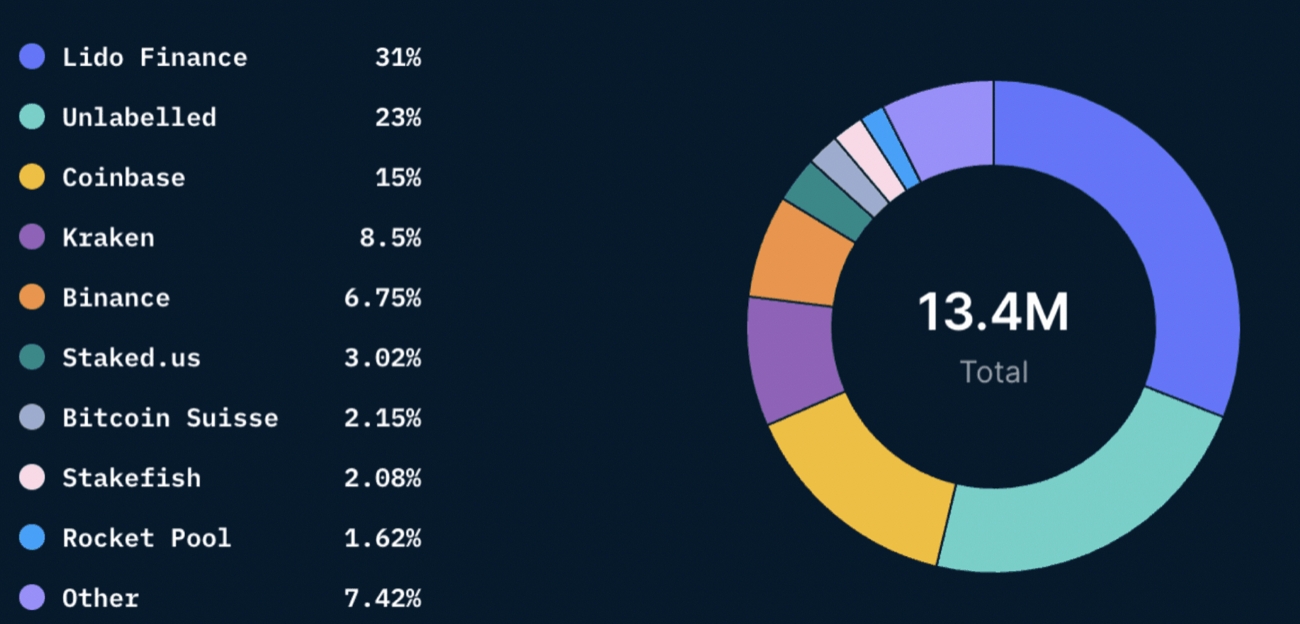
Lido clearly leads the way with 31%, although the existence of an ‘unlabelled’ category — as well as an ‘other’ — raises the (unconfirmed) hope that individuals are also staking independently of third-party pools and services.
Regardless, the fact that Lido comfortably leads the way in terms of the size of its share raises some uncomfortable questions, even if it is supposed to be a decentralised autonomous organization (DAO).
At the very least, recent events have shown that Lido now has interests that are not only independent of Ethereum’s own ends, but that can also be at odds with its host network. For example, June brought a governance vote in which Lido rejected a proposal to set a limit on its growth, a position which had been supported by Ethereum co-founder Vitalik Buterin.
Speculative controversial take: we should legitimize price gouging by top stake pool providers. Like, if a stake pool controls > 15%, it should be accepted and even *expected* for the pool to keep increasing its fee rate until it goes back below 15%. https://t.co/cOtuM7Occd
— vitalik.eth (@VitalikButerin) May 14, 2022
In addition, an analysis of Lido’s governance structure indicates that it may not be as decentralized as its classification as a DAO would have some believe.
In Nansen’s latest report on ETH staking, it notes that LDO tokens — which grant governance rights — exhibit a fairly concentrated ownership pattern. This is illustrated in the chart below, which shows that the top 9 addresses hold 46% of total voting power.
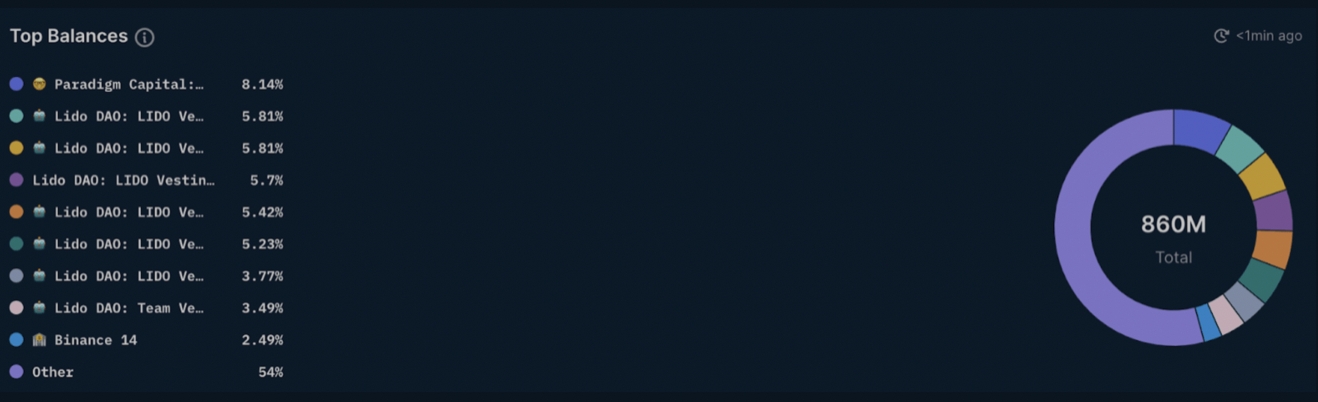
As Nansen’s authors write, “As the graph shows, overall LDO ownership is relatively concentrated, which could pose a centralization risk to Ethereum if Lido establishes a dominant share of staked ETH.” Nansen also points out that, for many votes on Lido, only a small minority of wallets actually participate, introducing even further centralization.
In fact, Nansen’s report paints an even bleaker picture than this, imagining a scenario in which Lido ends up holding a majority share in staked ethereum. In the analysis firm’s view, this “could allow Lido to take advantage of opportunities like multi-block MEV, carry out profitable block re-orgs, and in the worst case scenario censor certain transactions by enforcing or rewarding validators to operate in accordance with Lido’s wishes (via governance).”
Of course, this is the worst-case scenario, but with Ethereum now on the cusp of becoming a proof-of-stake network, it’s one that its developers and community need to think seriously about.
Centralized Exchanges
Nansen’s report then goes on to raise the possibility of a centralized exchange such as Binance or Coinbase capturing a majority share in Ethereum, which in its view is “a scenario that could be more straightforward to censor than attempting Lido governance capture.”
It’s because of such a risk that decentralized staking providers such as Lido and Rocket Pool were established in the first place. So on the face of it, the fact that Lido currently controls 31% of staked ETH is arguably a positive development.
Yet Lido needs to maintain a decentralized structure if it’s to help Ethereum’s move to proof-of-stake be a success. Because if it ever does transpire that Ethereum transactions are being censored in some way by a staking provider, that would provide a major blow to its future prospects.
- [LIVE] Fed Payments Innovation Conference: Real-Time Updates as Federal Reserve Discusses Crypto, Stablecoins, and AI with Industry Leaders
- Crypto Market Prospect: After the Washout, the Soil Looks Richer
- Bitcoin Price Prediction: Why $88,000 Could Be the Calm Before a $94,000 Push
- XRP Price Prediction: $1.9bn ETF Inflows Put $2.15 Breakout Back in Play
- Bitcoin May Not Have Bottomed Yet as Social Media Fear Remains Low: Analyst
2M+
250+
8
70





- [LIVE] Fed Payments Innovation Conference: Real-Time Updates as Federal Reserve Discusses Crypto, Stablecoins, and AI with Industry Leaders
- Crypto Market Prospect: After the Washout, the Soil Looks Richer
- Bitcoin Price Prediction: Why $88,000 Could Be the Calm Before a $94,000 Push
- XRP Price Prediction: $1.9bn ETF Inflows Put $2.15 Breakout Back in Play
- Bitcoin May Not Have Bottomed Yet as Social Media Fear Remains Low: Analyst
More Articles



 in numbers