Why Is Crypto Down Today? – January 8, 2026





The crypto market is down today, with the cryptocurrency market capitalisation falling by 3.1%, pulling back to $3.1 trillion. Currently, 95 of the top 100 coins have dropped over the past 24 hours. At the same time, the total crypto trading volume stands at $123 billion.
Crypto Winners & Losers
At the time of writing on Thursday morning, 9 of the top 10 coins per market capitalisation have seen their prices decrease over the past 24 hours.
Bitcoin (BTC) is down by 2.7% since this time yesterday, currently trading at $90,235.

Ethereum (ETH) fell by 4.1%, now changing hands at $3,120. This is the second-highest drop for the category.
Like yesterday, the biggest drop at the time of writing is recorded by XRP. It’s down 7.2%, currently standing at $2.12.
At the same time, Solana (SOL) posted the smallest drop: 2.6% to $135.
And once again, Tron (TRX) went against the category’s overall flow. It’s the only coin to have appreciated, rising by 0.6% to the price of $0.2962.
Among the top 100 coins, 5 recorded increases, and only 2 of these were above 1% each. Leo Token (LEO) is up 1.7% to $9.17, while Provenance Blockchain (HASH) went up 1.3% to $0.02603.
Of the red coins, Pump.fun (PUMP) and Zcash (ZEC) fell the most. The former is down 10.2% to $0.00224, and the latter fell 9.6% to $446.
Meanwhile, CryptoQuant chief executive Ki Young Ju expects BTC to trade sideways through the first quarter of 2026. “Capital inflows into Bitcoin have dried up,” Ju argued. The funds shifted toward equities and precious metals as gold and silver prices surged.
‘BTC Sits in a Fragile Range’
Linh Tran, Senior Market Analyst at multi-asset broker XS.com, commented that BTC is “currently trading in a choppy range just above the $90,000 level, reflecting a fragile balance between monetary policy expectations, liquidity conditions, and global risk appetite.”
The macro data environment from the US “provides a relatively supportive foundation,” Tran says. Still, given the ongoing downward pressure on BTC, “this support does not imply a strong upside breakout. Instead, it primarily helps limit the risk of a prolonged selling trend.”
Moreover, geopolitical developments lead investors to reduce leverage or push the US dollar and yields higher. Therefore, Bitcoin may face downside pressure, says Tran.
“Macroeconomic conditions currently support the view that Bitcoin is not being suffocated by interest rates, but they are still insufficient to generate a clear upside breakout,” according to the analyst.
“An uptrend would only be firmly confirmed if labor market data continue to cool consistently, reinforcing expectations of looser financial conditions, or if institutional capital returns with enough strength to break the current stalemate.”
However, the greatest risk to BTC “does not stem from any single geopolitical headline, but rather from the possibility that such shocks reignite inflation expectations, drive yields higher, and tighten financial conditions once again.”
Should this happen, the crypto “would struggle to maintain its role as a beneficiary of the macro environment and may instead need to seek a new equilibrium at lower price levels than those currently prevailing.”
Per Tran, “my personal view is that current data lean toward a scenario in which Bitcoin consolidates with a cautiously upward bias, rather than entering a deep bearish reversal. Bitcoin’s consolidation range for the remainder of January is likely to fluctuate between $88,000 and $95,000.”
Levels & Events to Watch Next
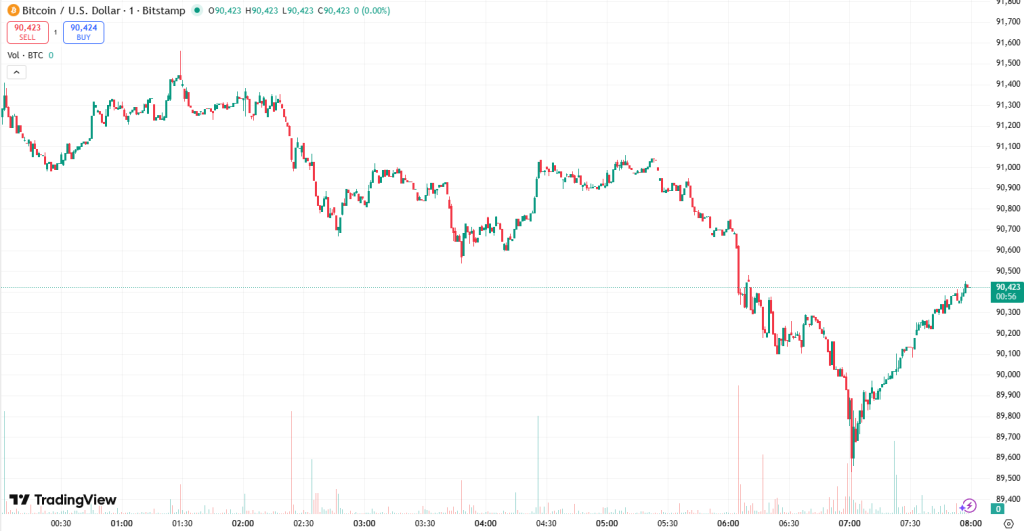
At the time of writing on Thursday morning, BTC stood at $90,235. The coin began the day with the intraday high of $92,847 before dipping below $90,000 to the intraday low of $89,797.
BTC remains green over the 7-day period, increasing 3.2%. It’s been trading in the $87,491-$94,420 range.
Now that the price had dipped to the $89,000 level, the doors opened for further pullbacks towards the $85,000 level. Yet, returning to $91,200 may give it a push towards $93,000.
Ethereum is currently changing hands at $3,120. Starting the day with $3,255, the price gradually decreased to $3,099.
Over the past week, ETH fell by 5.1%, moving between $3,292 and $2,973.
It already briefly dropped below $3,000, creating opportunities for further decreases towards the $2,800 level. Managing to climb back above $3,300 may give it a push upwards.

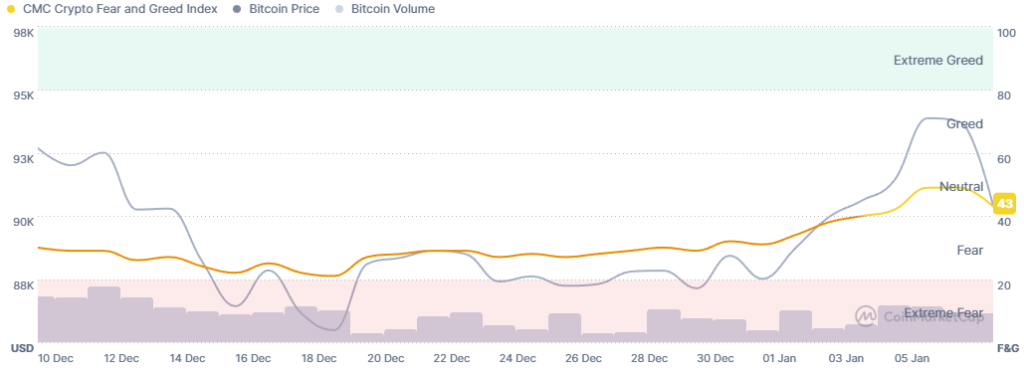
Meanwhile, the crypto market sentiment has moved lower, following a couple of days of unchanged levels.
The crypto fear and greed index currently stands at 43 today, compared to 49 yesterday. While it is still in the neutral territory, it’s worth noting that the metric now borders the fear zone.
As worry rises among market participants, it is possible we’ll see the index back in the fear zone in the near-term.
ETFs Turn Red
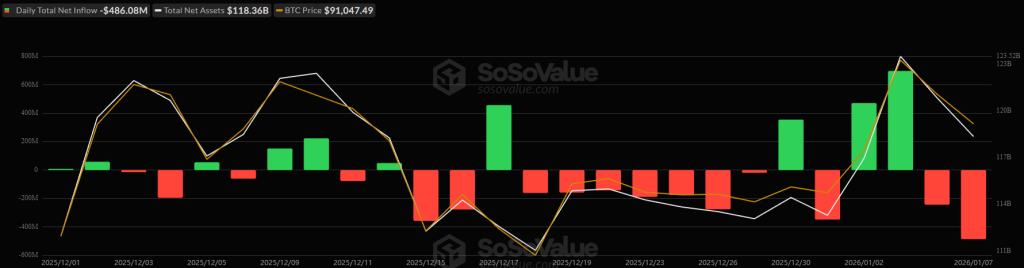
The US BTC spot exchange-traded funds (ETFs) recorded the highest amount of outflows since late November 2025. On Wednesday, they posted negative flows of $486.08 million. With this, the total net inflow pulled back to $57.05 billion.
Six of the twelve BTC ETFs posted outflows. Among these, Fidelity’s $247.62 million is the highest.
This is followed by BlackRock, which recorded outflows of $129.96 million.
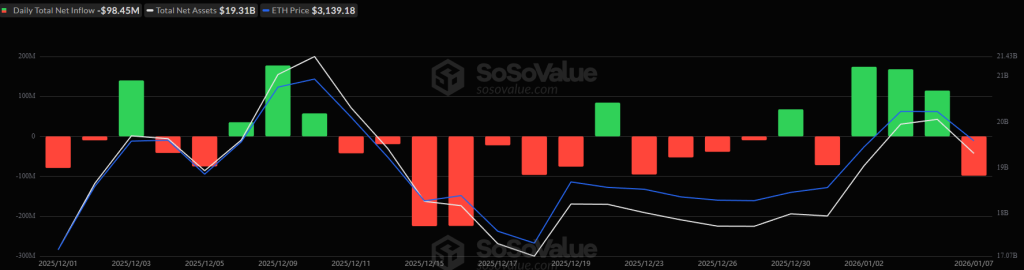
At the same time, the US ETH ETFs too saw negative flows on 7 January, breaking a brief green streak. The total outflows for the day amounted to $98.45 million. The total net inflow pulled back to $12.69 billion.
Of the nine funds, one recorded inflows, and six posted outflows. Franklin took in $2.38 million.
On the other side, Grayscale let go of $65.08 million in total on Wednesday. It’s followed by Grayscale’s $13.03 million in outflows.
Meanwhile, Morgan Stanley’s ETF filing signals a deeper push into crypto through ETRADE and institutional adoption channels.
“Morgan Stanley is making the bet that even if their ETF doesn’t scale to blockbuster success, there’s an intangible benefit that will help build their clout,” says ProCap chief investment officer Jeff Park.
Quick FAQ
- Did crypto move with stocks today?
The crypto market posted another loss over the past 24 hours. Meanwhile, the US stock market closed the Wednesday session largely lower, with some exceptions. By the closing time on 7 January, the S&P 500 was down 0.34%, the Nasdaq-100 increased by 0.055%, and the Dow Jones Industrial Average fell by 0.94%.
- Is this drop sustainable?
The decline may continue in the near term. Certain macroeconomic data can push it either way, but analysts argue that the prices could actually trade sideways for a while.
- FTX Founder Sam Bankman-Fried Takes Fraud Conviction to Supreme Court
- XRP Price Analysis: 3 Major Catalysts Set to Shape September
- Ripple News: XRP Uses AI Agents in $1 Billion Treasury Push
- Ethereum Price Faces a Reality Check as EIP-8288 Puts Its Technology to the Test
- Revised CLARITY Act Would Shift DeFi Compliance to Controllers


2M+
250+
8
70





- FTX Founder Sam Bankman-Fried Takes Fraud Conviction to Supreme Court
- XRP Price Analysis: 3 Major Catalysts Set to Shape September
- Ripple News: XRP Uses AI Agents in $1 Billion Treasury Push
- Ethereum Price Faces a Reality Check as EIP-8288 Puts Its Technology to the Test
- Revised CLARITY Act Would Shift DeFi Compliance to Controllers
More Articles


 in numbers