Pump.fun Transfers $16M SOL to Buy Back 3B PUMP Tokens – Can PUMP Recover?



Pump.fun has launched an aggressive buyback program, transferring 101,900 SOL worth approximately $16 million to purchase 3.04 billion PUMP tokens at an average price of $0.006, in a desperate bid to recover from the token’s catastrophic 75% crash following its $500 million presale launch.
The buyback initiative follows PUMP’s plummet from pre-market highs of $0.0072 to lows of $0.005 within 24 hours of its July 12 launch, triggering massive shorting by whales and investor panic.
The platform has allocated $30.6 million in fee revenue for the buyback program, with 118,351 SOL already spent on token purchases.
According to on-chain data, the buyback represents a significant strategic shift for Pump.fun, which previously sold approximately 4.1 million SOL worth $741 million at an average price of $180 since May 2024.
The platform had been systematically converting fee revenue through Kraken exchange rather than supporting its token price.
The buyback program allocates 25% of revenue to token holders, generating approximately $538,000 in daily buybacks based on 180-day trailing numbers.
This translates to $196.6 million annually flowing directly to token holders, with PUMP currently trading at a discount compared to competitors like Jupiter ($JUP) and Raydium ($RAY).
Strategic Buyback Initiative Aims to Restore Investor Confidence
The buyback program addresses concerns about the massive concentration of whales that contributed to the initial crash.
Approximately 340 wallets controlled over 60% of presale allocations, with 189 wallets hitting the $1 million investment cap during the public sale.
Multiple presale participants immediately cashed out for substantial profits, including one whale who purchased $1 million worth of PUMP and sold it for $1.5 million, generating a $500,000 profit.
Another investor bought $1 million worth and sold for $1.097 million immediately after launch.
The token’s structure created immediate sell pressure with 33-55% of the total supply unlocked at launch, representing billions in potential selling pressure.
At least $142 million in token allocations went directly to centralized exchanges for immediate liquidity, with most tokens unlocked within 72 hours.
Major exchanges prioritized the listing of perpetual futures over spot trading, enabling aggressive shorting before retail investors could access spot markets.
One identified whale opened an $8.5 million short position, while funding rates for shorting reached 1,100% annualized on decentralized platforms.
Market Dynamics Challenge Long-term Buyback Effectiveness
According to an analysis of Pump.fun’s buyback strategy, conducted by Simon, a researcher from Delphi Digital, reveals potential limitations as token prices increase.
Monthly revenue of $70 million with 50% allocated to buybacks could purchase approximately 5.25% of the total supply over 12 months, down from 8.4% if prices remained flat.
The current valuation stands at a fully diluted value of $6 billion, with a market capitalization of $2.12 billion, trading at a market cap-to-earnings ratio of 10.78x based on 180-day trailing numbers.
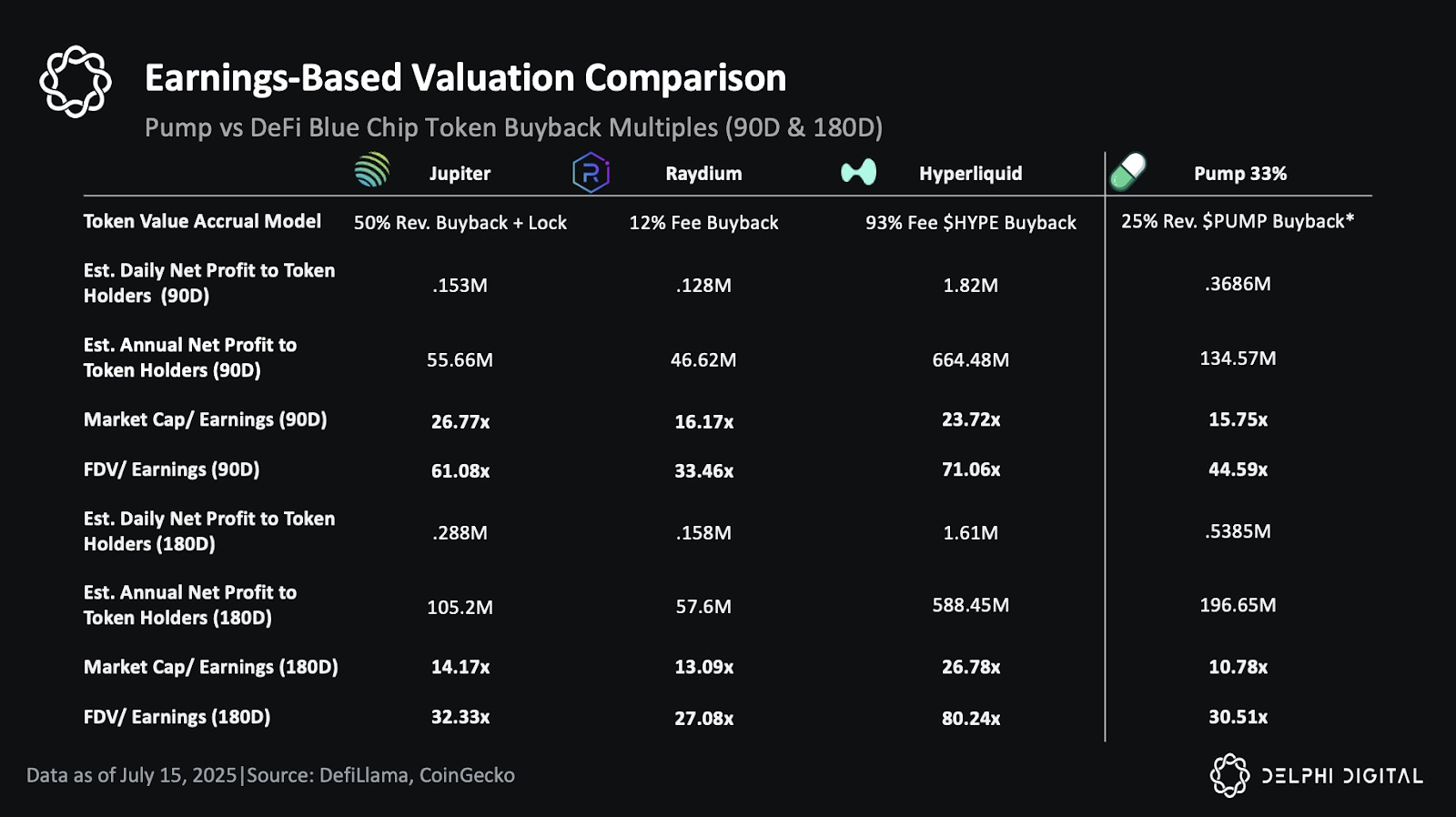
This compares favorably to competitors, with Jupiter trading at a 14.17x and Raydium at a 13.09x market cap-to-earnings ratio.
However, rising token prices significantly reduce the effectiveness of buybacks.
If PUMP appreciates 10% monthly while maintaining fixed $35 million monthly buybacks, the percentage of supply reclaimed drops sharply as prices increase, requiring either price stabilization or revenue growth to maintain buyback pressure.
Unfortunately, the recovery effort faces headwinds from LetsBonk’s superior performance metrics.
The competitor has launched a total of 363,541 tokens, with 4,031 graduating to full trading, generating a total market capitalization of $806 million.

LetsBonk’s average market cap per token stands at $32,450 compared to Pump.fun’s $34,070 for graduated tokens.
Pump.fun’s broader struggles include a 75% decline in trading volumes since January and an 80% reduction in daily volumes over six months.
The platform processes approximately $1.25 billion in daily meme coin volume across all platforms, with 34,110 coins launched and 398 graduating to full trading.
- Bitcoin Price Prediction: Bitcoin Is Stuck Inside a Triangle – And What Happens Next Could Shock the Market
- XRP Price Prediction: Ripple Has Been Invited to the White House — Is the US Government About to Back XRP?
- China’s Alibaba AI Predicts the Price of XRP, Shiba Inu and PEPE By the End of 2026
- New ChatGPT Predicts the Price of XRP, Dogecoin and Solana By the End of 2026
- Ripple CEO Predicts 90% Chance U.S. Crypto Bill Passes by April – What It Means for XRP Price

2M+
250+
8
70





- Bitcoin Price Prediction: Bitcoin Is Stuck Inside a Triangle – And What Happens Next Could Shock the Market
- XRP Price Prediction: Ripple Has Been Invited to the White House — Is the US Government About to Back XRP?
- China’s Alibaba AI Predicts the Price of XRP, Shiba Inu and PEPE By the End of 2026
- New ChatGPT Predicts the Price of XRP, Dogecoin and Solana By the End of 2026
- Ripple CEO Predicts 90% Chance U.S. Crypto Bill Passes by April – What It Means for XRP Price
More Articles



 in numbers