MIT-Incubated Optimum Raises $11M, Develops Memory Layer for Any Blockchain





Optimum, the first decentralized high-performance memory infrastructure for any blockchain, has announced the successful closure of its $11 million seed round.
According to the press release shared with Cryptonews, the round was led by crypto investment firm 1kx with participation from Robot Ventures, CMT Digital, Spartan, Finality Capital, Triton Capital, SNZ, Big Brain, CMS, Longhash, NGC, Animoca, GSR, Caladan, Reforge, and more.
The team says it will use the new funding for integration across major ecosystems, lowering costs, and boosting scalability for any L1 and L2 blockchain and performance for node operators.
Optimum is co-founded by MIT professor Muriel Médard, who invented the patented tech that powers this layer. It is now live on private testnet with the OptimumP2P flagship product.
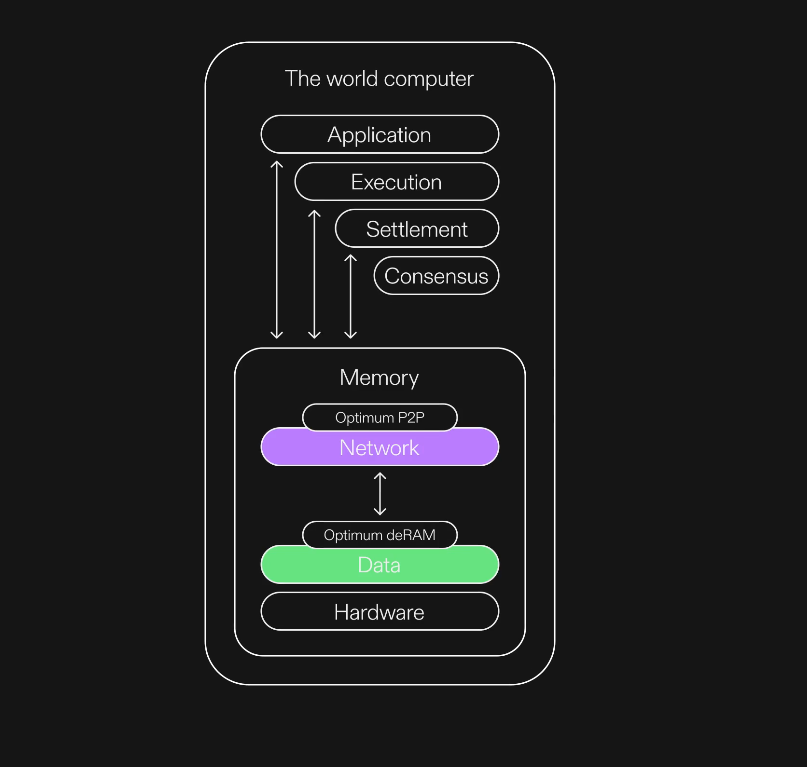
Per the announcement, blockchains are missing a memory layer, which is necessary for efficient computing. This is what Optimum is building. The team argues that this tech will alter the way data is stored, accessed, and disseminated. These processes will become decentralized, faster, and cheaper.
Furthermore, blockchains store all state data permanently. With time, this creates a number of interconnected issues. These include a growing burden on full nodes, congested mempools, unpredictable delays, and redundant data propagation, among others.
However, Optimum claims to have built a “provably optimal memory infrastructure that turns blockchains into high-speed, scalable computing networks” and solves the above-stated issues.
Médard commented that “high-performance memory has been the missing link in blockchain infrastructure.” Most innovation has focused on computation and execution, leaving data access and networking underexplored.
“A scalable memory layer provides the missing piece, optimizing data retrieval, reducing congestion, and unlocking the speed and efficiency needed for blockchain to serve as the backbone of the decentralized Internet,” she says.
New Encoding Tech
Optimum’s team consists of MIT, Harvard, and Meta alumni. Their novel memory layer leverages new technology called Random Linear Network Coding (RLNC), a coding scheme that encodes data into packets to transmit over a network efficiently.
Prof. Muriel Médard has developed RLNC, which is now at the core of Optimum. Per the website, RLNC is “an advanced form of erasure coding.” It transforms data into smaller chunks and encodes them into random linear combinations before transmission.
“This method significantly improves network efficiency and fault tolerance, ensuring data can be accurately reconstructed even if some pieces are lost along the way,” the team says.
Wei Dai, Research Partner at 1kx, commented that the technology around RLNC has “far-reaching potential.”
Additionally, Optimum is already live with the OptimumP2P product. This protocol functions as a memory bus, the team says. It complements outdated gossip networks with coding-based data propagation to decrease redundancy and increase throughput for any network.
Moreover, it plans to launch Optimum deRAM, a decentralized RAM layer. This product will ensure data atomicity, consistency, and durability to enable on-demand access, cheaper storage, and lower fees for L1/L2, validators, dapps, and end users.
Per the announcement, the team has “refined [RLNC] over two decades.” It received the IEEE Koji Kobayashi Computers and Communications Award in 2022. It also assisted its co-inventor Médard’s election to the US National Academy of Engineering and recognition as a Fellow of the National Academy of Inventors.
Médard is the NEC Chair at MIT EECS since 2005. Her CV includes membership in the US National Academy of Engineering, membership in the US National Academy of Inventors, leading Network Coding & Reliable Communications, and tenure as the former IEEE Information Theory Society President.
- XRP Price Prediction: Ripple Edges Bitcoin In South Korea
- Where Could XRP Price Go This September as CLARITY Act Nears?
- XRP Price Analysis: Wealth Managers Show Growing Interest in XRP
- Ethereum Price Holds as Tom Lee’s BitMine Makes Biggest ETH Buy Since June
- Polymarket CLARITY Act Odds Slashed to 15% of Being Passed in 2026


2M+
250+
8
70





- XRP Price Prediction: Ripple Edges Bitcoin In South Korea
- Where Could XRP Price Go This September as CLARITY Act Nears?
- XRP Price Analysis: Wealth Managers Show Growing Interest in XRP
- Ethereum Price Holds as Tom Lee’s BitMine Makes Biggest ETH Buy Since June
- Polymarket CLARITY Act Odds Slashed to 15% of Being Passed in 2026
More Articles


 in numbers