How Tether Co-Founder William Quigley Views Crypto Regulations in Trump’s Second Term

Donald Trump’s re-election has led to expectations of major changes in U.S. cryptocurrency regulations.

Recent executive orders suggest that regulatory changes could soon affect the cryptocurrency industry.

In an interview with Cryptonews, William Quigley, co-founder of Tether and WAX, shared his insights into what the next four years under Trump could mean for the industry.

Quigley explained that the administration’s pro-crypto stance, along with key appointments and legislative efforts, could lead to clearer regulations.

He also stressed the role of the private sector in shaping future of cryptocurrency regulations.

Trump’s Second Term and the Future of Crypto Regulation

Trump’s signals of potential changes in crypto regulations contrast sharply with previous administrations’ inconsistent approaches.

Under Trump, there could be an emphasis on installing pro-crypto figures and fostering private sector involvement in virtual assets.

Quigley remarked on the shift, “The Obama administration and the Biden administration in terms of how they thought about crypto, they were wary of it and Congress was not moving forward with any regulation. They didn’t seem to see it as important or terribly problematic either, with the exception of one federal agency, the SEC.”

“The Trump executive order is very positive towards crypto, the statement that Trump wants the U.S. to be a leader in the crypto industry,” Quigley added.

These changes are expected to create a more predictable regulatory environment, reducing uncertainty and supporting market stability.

As the administration moves forward, regulatory decisions will determine how the government interacts with the digital currency sector.

Establishing the Digital Asset Working Group

President Trump’s executive order led to the creation of the President’s Working Group on Digital Asset Markets within the National Economic Council.

This group is responsible for reviewing existing regulations and proposing clearer guidelines for the digital asset sector.

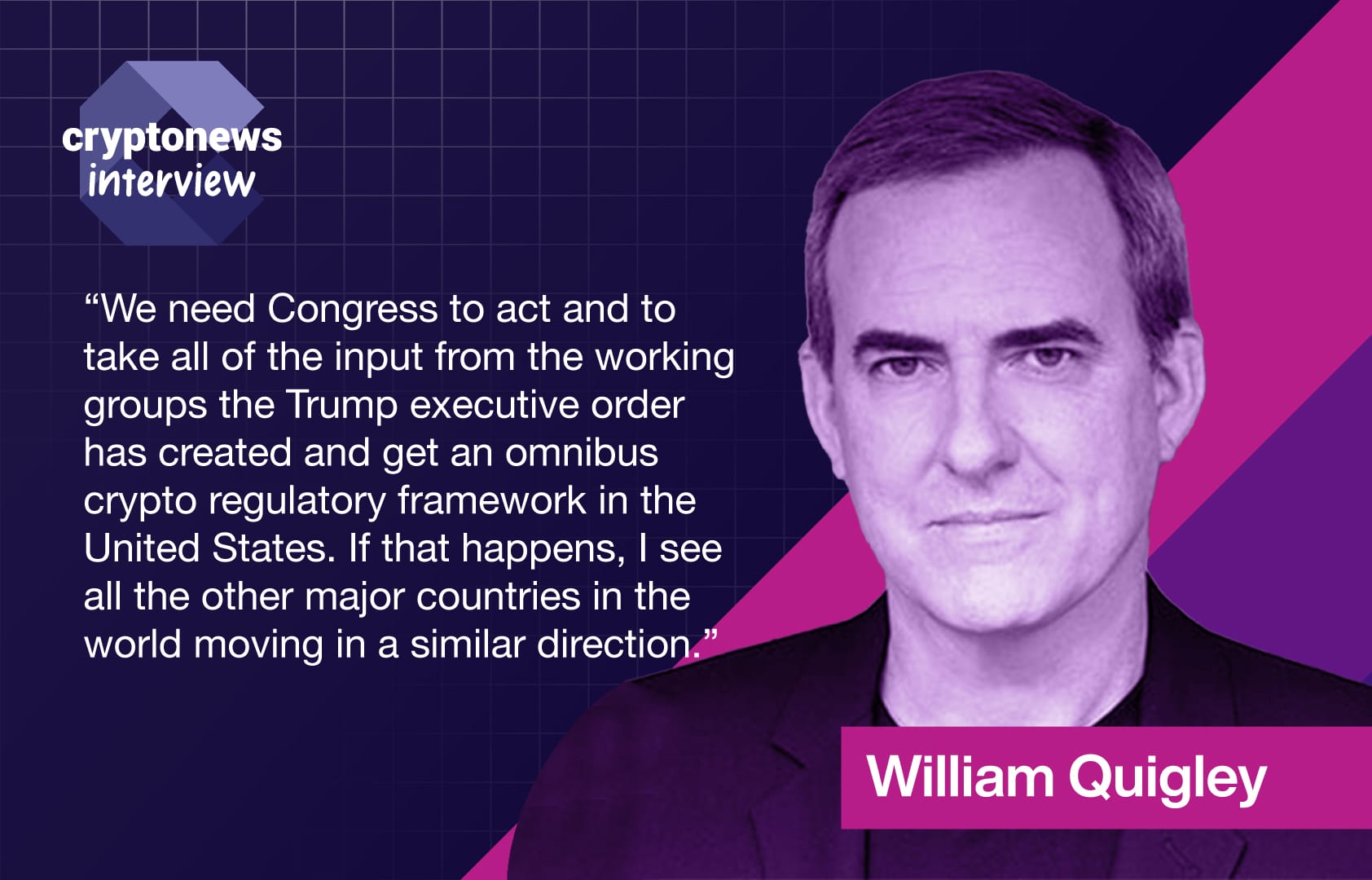
Quigley shared his views on the impact of these developments, “The Trump executive order has created and get an omnibus crypto regulatory framework in the United States. And if that happens, I see all the other major countries in the world moving in a similar direction.”

“To me, [the executive order] seems quite fast because there is so much to consider here, but I think before the Trump term ends, individuals will have ability to use stablecoins much more freely than they do now.,” said Quigley.

The working group is tasked with crafting a federal regulatory framework specifically for digital assets like stablecoins, which will involve detailed considerations on how these assets are issued and operated within the U.S.

The crypto industry awaits the Working Group’s report, due within 180 days, anticipating targeted legislative proposals that could redefine the regulatory environment and enhance market stability.

Quigley Discusses Bank Reluctance

The U.S. banking sector remains cautious about cryptocurrency due to unclear regulatory guidance and the potential for severe penalties.

This hesitancy persists despite more positive remarks from figures like Federal Reserve Chairman Powell, who recently commended banks for their handling of cryptos.

William Quigley highlighted the core issues, “Banks are still slow. This might be because they’ve gotten so much crosstalk over the years with what they’re allowed to do and not allowed to do.”

“Any positive messaging from the White House and from the Federal Reserve is very good for us,” Quigley further explained. “But for these institutions, I think they need black and white guidance.”

He also reflected on the broader implications of this reluctance, “In any major financial institution in the United States, there are thousands, maybe tens of thousands of employees who are primarily just compliance oriented people. There’s all these regulatory bodies at the federal level, and some similar ones at the state level, many of whom either give no guidance on crypto, or who give conflicting guidance.”

In traditional banking systems, clarity and compliance remain paramount. The banking sector’s cautious approach to crypto may change in the future, but currently, this wariness serves as a major obstacle to wider acceptance and integration of these technologies.

The Need for Congressional Action in Crypto Regulation

Cryptocurrency regulation in the U.S. suffers from inconsistencies due to multiple agencies managing different aspects without a unified approach.

This fragmented oversight has highlighted the need for a single regulatory body to provide clear and consistent governance.

Trump’s recent executive order is seen as a pivotal step that might prompt Congress to establish a unified regulator, which could help reduce confusion and solidify the U.S.’s position in the global crypto market.

“We can’t have the IRS calling it property, the CFTC saying, no, it’s a commodity, the SEC saying it’s a security, and then the U. S. Treasury forever saying, no, these are currencies, and that existed for years,” said Quigley.

Trump Appoints PayPal Veteran David Sacks as ‘White House AI and Crypto Czar’

President-elect Donald Trump on Thursday night named venture capitalist and ex-PayPal COO David Sacks as his administration’s “AI and crypto czar.”

“In this important role, David will guide policy for the Administration in Artificial Intelligence and Cryptocurrency, two areas critical to the future of American competitiveness,” Trump said in a Truth Social post. “David will focus on making America the clear global leader in both areas.”

Sacks will develop a legal framework to provide the clarity the crypto industry has been seeking, he added.

PayPal Mafia’s David Sacks Gains Spotlight in Trump’s Crypto and AI Agenda

Sacks belongs to Silicon Valley’s “PayPal Mafia,” a group of influential entrepreneurs and ex-PayPal employees like Elon Musk and Peter Thiel. Formed in the early 2000s, this group has shaped the tech industry through successful ventures and investments, leveraging their strong networks and collaboration.

He also gained prominence by founding Yammer, which he sold to Microsoft in 2012 for about $1.2b.

Reports earlier indicated that the incoming Trump administration considered Chris Giancarlo, former CFTC chair, for the “crypto czar” role.

Former Trump Critic Rises as Crypto Advocate and Administration Ally

Sacks’ appointment signals that the second Trump administration is rewarding Silicon Valley figures who supported his campaign. Moreover, it indicates that the administration will push for policies generally supported by crypto entrepreneurs.

Earlier this year, Sacks became a major Trump booster by hosting a fundraiser in San Francisco for the then-Republican nominee. At this event, tickets went for $50,000 each, with a $300,000 tier that offered perks like a photo with Trump.

This represented a stark change for Sacks, who had sharply criticized Trump following the Jan. 6, 2021, Capitol riot. Shortly after, on an episode of his All-In podcast, Sacks stated that Trump was “clearly” responsible for those events and had disqualified himself from national candidacy.

In recent years, Sacks has gained prominence as the host of the All-In podcast, co-hosting with investors Chamath Palihapitiya, Jason Calacanis and David Friedberg. In his post, Trump described it as the “top podcast in Tech,” where they discuss economic, political and social issues.

This week, Trump named Paul Atkins, a seasoned financial regulator and crypto advocate, to head the SEC. Explaining his choice, Trump called Atkins a “proven leader for commonsense regulations” and praised his stance against overregulating markets.

XRP Price Prediction: Billionaire Who Once Mocked XRP Now Praises It – Big Announcement Coming?

Michael Novogratz, founder of Galaxy Digital, recently applauded the Cardano and Ripple communities for staying strong through tough market conditions and legal challenges.

His comments come just as many investors are beginning to turn away from top altcoins, yet some are showing unexpected resilience.

In a recent podcast, Novogratz highlighted how tokens with deeply committed communities tend to survive even the worst market phases.

This could be a key factor to watch for the next XRP price prediction.

Although Novogratz once dismissed the XRP community as mostly retail traders unaware of the token’s flawed economics, his view has shifted.

He now credits the so-called “XRP Army” with playing a key role in keeping the token afloat through years of volatility, showing just how powerful a loyal holder base can be.

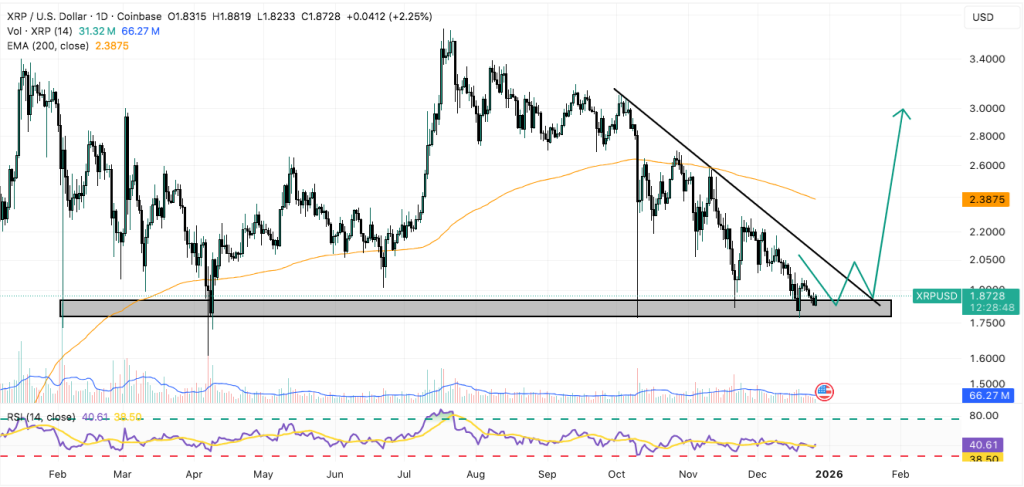
XRP Price Prediction: XRP Needs to Bounce From $1.80 to Target $3

XRP has shed 10% of its value this year, which makes it the 4th worst-performing token in the top 5.

However, in the past 7 days, the token has recovered slightly, posting gains of 0.5% during this period. Meanwhile, trading volumes have increased by 30% in the past 24 hours, and currently account for less than 2% of the asset’s circulating market cap.

xrp price chart
Source: TradingView

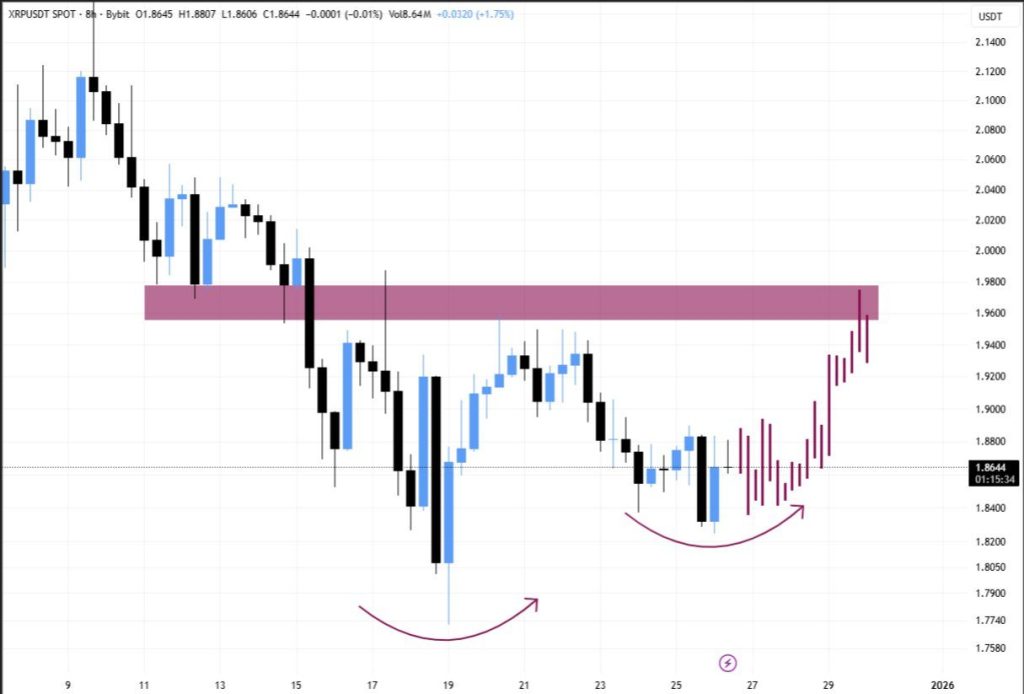
Once again, XRP has found strong support at $1.80. This price zone has acted as a strong bouncing pad four times already in the past.

Meanwhile, a descending triangle has formed as a result of the latest price action. This is a price compression pattern that tends to precede a big breakout.

If the price rises above $2.20, this would invalidate the token’s bearish price structure, and a bullish breakout of the triangle pattern would be confirmed.

XRP might be eyeing $3 in the near term, especially with big names like Michael Novogratz giving credibility to its long-term vision. But if you’re looking for the next breakout opportunity, a new project is quietly turning heads.

Bitcoin Hyper ($HYPER) is building something game-changing by bringing Solana-level speed and fees to Bitcoin’s blockchain.

The ongoing presale has raised close to $30 million as investors rally behind its mission.

Can Bitcoin’s Biggest Bottleneck Finally Be Solved? This New Project Thinks So

The Bitcoin OG blockchain has struggled with scalability issues since its launch, and this has prevented its ecosystem from further growing and reaching its full potential.

Bitcoin Hyper ($HYPER) changes this by introducing a Solana-powered layer-2 chain that will process transactions fast and at a low cost to allow the community to launch new DeFi apps, payment platforms, meme coins, and more.

bitcoin hyper crypto presale

The Hyper Bridge lets Bitcoin holders move their BTC into the Bitcoin Hyper network quickly and safely.

By sending BTC to a secure wallet, users receive the same amount on Hyper’s Layer 2, where they can use it in fast, low-cost apps, including trading, payments, and even meme coin creation.

As major wallets and exchanges begin to support the system, demand for $HYPER could surge, positioning it as one of the most exciting tokens in the market right now.

To buy $HYPER at its discounted presale price, simply head to the official Bitcoin Hyper website and link up a compatible wallet (e.g. Best Wallet).

You can swap existing crypto or use a bank card to complete the transaction in seconds.

Visit the Official Bitcoin Hyper Website Here

Dogecoin Price Prediction: Bearish Chart Meets Bullish On-Chain Moves – Which Side Wins Next?

Dogecoin has experienced a months-long downtrend as bearish chart signals reveal price has surrendered crucial $0.15-$0.20 support levels, resulting in DOGE declining over 60% year-to-date.

However, newly emerging on-chain activity suggests the Dogecoin price prediction is split between bullish reversal and bearish continuation scenarios.

Long-Term Holders Accumulate as Speculative Supply Contracts

According to Glassnode data, Dogecoin speculative supply is contracting while longer-term holders display early accumulation signals.

The 1-year to 2-year holder cohort has expanded its share of Dogecoin supply from approximately 21.84% to 22.34%. While the increase appears modest, the signal carries significance.

Dogecoin Price Prediction - Dogecoin Supply Chart
Source: Glassnode

These holders typically accumulate only when they believe downside risk is beginning to diminish.

Network coin activity, measured via the spent coins metric, reinforces this perspective.

The on-chain amount spent on coins has plummeted sharply.

The spent coins age band metric dropped from roughly 251.97 million DOGE to about 94.34 million DOGE, representing a decline exceeding 60% in coin movement.

Reduced coin activity potentially indicates fewer holders are rushing to transfer or liquidate tokens.

Historically, similar activity declines have preceded short-term relief rallies in Dogecoin.

Earlier in December, a comparable slowdown preceded a rally from near $0.132 to $0.151, a nearly 15% move within three days.

Dogecoin Price Prediction: 4-Hour Chart Shows Defined Downtrend Structure

The chart shows Dogecoin trading in a well-defined downtrend on the 4-hour timeframe, with price currently hovering around the $0.125 region.

Market structure remains bearish, characterized by lower highs and lower lows, and price continues to trade below all highlighted resistance zones. The most immediate level to watch is the $0.12 area, which has been marked as a critical support.

Dogecoin Price Prediction - Dogecoin Price Chart
Source: TradingView

This level is acting as a demand floor for now, but repeated tests weaken its strength, increasing the risk of a breakdown if sellers remain dominant.

On the upside, the $0.14 zone stands out as an important resistance, aligning with prior consolidation and multiple rejection points.

As long as Dogecoin remains below this level, upside attempts are likely to be corrective rather than trend-reversing. A more meaningful bullish confirmation would only emerge if price reclaims and holds above the broader $0.16 resistance band.

Such a move would signal a shift in momentum and could open the door for a recovery toward $0.18 first and potentially $0.20–$0.21, which aligns with the higher target levels marked on the chart.

Until then, rallies into resistance are likely to attract selling pressure.

Momentum indicators reinforce the cautious outlook.

The RSI is sitting near the low-40s, below the neutral 50 level, indicating weak momentum and a market that still favors sellers.

While RSI is not deeply oversold, suggesting room for short-term bounces, it does not yet show the strength typically associated with trend reversals.

Bitcoin Hyper ($HYPER) Presale Brings Solana’s Speed to Bitcoin for the First Time

As Dogecoin eyes a breakout, its chances improve if Bitcoin starts climbing toward $100,000 again, especially with gold and stocks hitting new highs.

In moments like this, early presales often see the biggest gains, and Bitcoin Hyper ($HYPER) is quickly becoming one to watch.

Already nearing $30 million raised, the project is building the first true Layer 2 for Bitcoin powered by Solana tech, combining lightning-fast speed and low fees with Bitcoin’s unmatched security.

It’s a bold move that could reshape how apps and users interact with the Bitcoin network.

Dogecoin Price Prediction - Bitcoin Hyper Banner

As more crypto wallets and exchanges begin adopting this technology, demand for $HYPER tokens is expected to increase substantially.

To purchase $HYPER at the discounted price before it lists on exchanges, visit the official Bitcoin Hyper website and connect a compatible wallet like Best Wallet.

You can use existing crypto or use a bank card to complete the transaction in seconds.

Visit the Official Bitcoin Hyper Website Here

Solana Price Prediction: Cardano + Solana Collaboration Announced – Will This Unlock Billions in Cross-Chain Value?

The long-running feud between Solana and Cardano might be coming to an unexpected end, and the timing could be critical for bullish Solana price predictions.

Founders from both chains are reportedly teaming up to launch a new bridge that connects their ecosystems, a move that could redirect major trading volume toward Solana.

For years, Solana and Cardano have battled for dominance as “Ethereum killers,” each taking a different approach.

Solana is known for its blazing speed and low fees, while Cardano has focused on security and a careful, research-driven development process.

Now, instead of competing for attention, the two may be aligning, and that shift toward collaboration could reshape the entire Layer 1 landscape.

In a series of X posts, both Charles Hoskinson (Cardano’s founder) and Anatoly Yakovenko (Solana) agreed to start working on a bridge.

This is a sign that the crypto space is maturing. Founders are recognizing that the next era of growth will come from building alliances through interoperability.

This bridge could tap into the strengths of each network, allowing $SOL holders and users to take advantage of its privacy and security features.

Meanwhile, Cardano’s users would benefit from getting access to a thriving DeFi market.

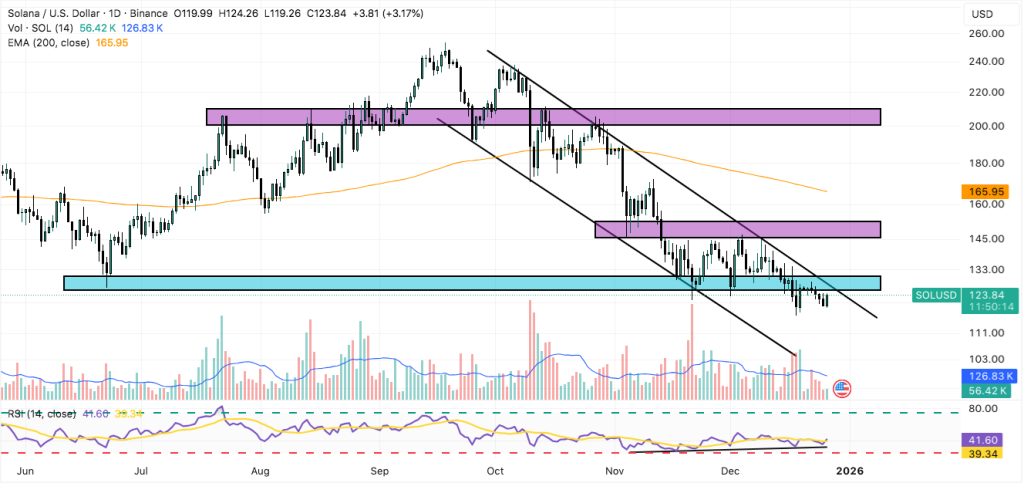
Solana Price Prediction: SOL Needs to Move Above $125 to Reverse Its Downtrend

Solana has broken below its long-held support at $127 and is now fighting to stay above $120, with trading activity and transaction volumes declining steadily over recent months.

This bearish breakdown leaves SOL vulnerable to a deeper correction toward the $100 mark, a sharp contrast to just a few months ago when it was trading near $230.

A move back above $125 would be a critical shift, potentially invalidating the current downtrend and opening the door to a short-term recovery.

solana price chart
Source: TradingView

The Relative Strength Index (RSI) suggests that SOL is consolidating.

Interestingly, RSI has formed a mild bullish divergence, failing to make a lower low even as the price continued to fall, which could hint at a momentum shift.

While Solana meme coins have been quiet this cycle, a new Ethereum-based project is starting to make noise.

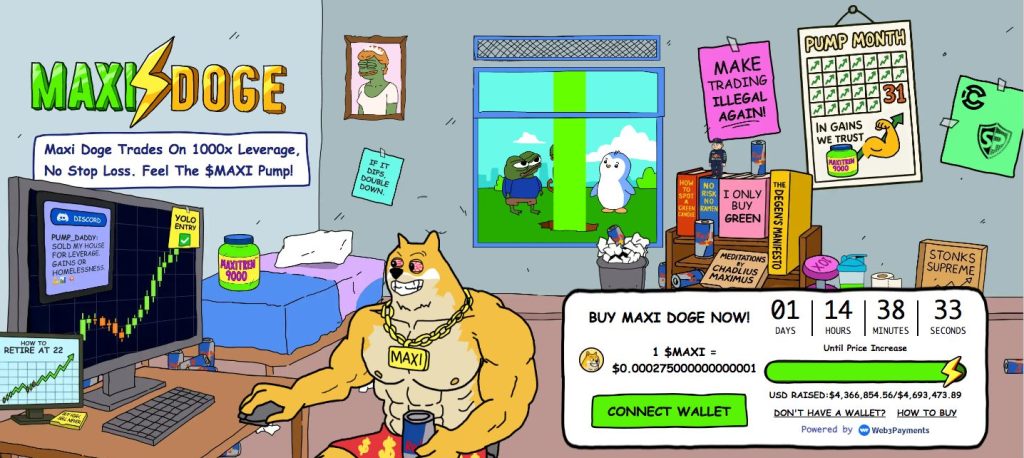
Maxi Doge ($MAXI) has already raised over $4 million, bringing meme energy and community-driven trading culture back to the forefront with a fresh approach built around staking, challenges, and shared alpha.

Maxi Doge ($MAXI) Is the Early Meme Coin Traders Are Piling Into Right Now

Maxi Doge ($MAXI) revives the same explosive energy that made Dogecoin a 1000x legend, but this time it’s tailored for traders chasing high-risk, high-reward setups.

Built on Ethereum, $MAXI is creating a real community of degens who share trading ideas, drop early setups, and hunt for the next big play together.

maxi doge crypto presale

On top of this, competitions like Maxi Ripped and Maxi Gains will reward top ROI producers, giving traders a shot at real prizes and the bragging rights to match.

With meme season heating up and $MAXI still in its early presale phase, this could be one of the best entry points before the crowd catches on.

To join the action, head to the official Maxi Doge website and connect a wallet like Best Wallet.

You can buy with USDT, ETH, or a simple bank card, all in just a few clicks.

Visit the Official Maxi Doge Website Here

Best Crypto to Buy Now 26 December – XRP, Solana, Cardano

As the holiday spirit settles in and many traders take time off from their investment portfolios, a rare opportunity has emerged on Christmas Eve, December 26, 2025.

A new hope is building that it will be the bullish year the market has been waiting for.

XRP, Solana, and Cardano are all sitting on clean pullbacks and have been consolidating within steady price ranges for some time. Their next move higher may be approaching for the following reasons.

Ripple (XRP): The OG Crypto That Could Still Be the Best Crypto Pick

XRP ETFs have been pulling in serious money even while the price action looks completely dead. As of December 23, spot XRP ETFs logged about $1.13B in net inflows, with steady buying pressure holding up for the past 33 days.

That performance actually puts them ahead of both Bitcoin and Ethereum ETFs, which have struggled to keep momentum during the same choppy market conditions.

When you stack that ETF demand on top of ongoing ecosystem upgrades, major milestones, and a technically solid chart, 2026 is starting to look like it could be a really interesting year for XRP.

Source: TradingView

To fully reverse its downtrend, XRP needs to climb above the $2.2 level. This would break the token’s bearish price structure. This could set the stage for a strong recovery to $3 at least.

Solana (SOL): The Coin of the Cycle Could Run It Back in 2026

Solana had an insane run starting in December 2024, topping out near $294 in January. Since then, it has been cut down hard and is now more than 50% off that peak.

That kind of move is not new for SOL. Historically, it tends to overcorrect on the way down and then massively outperform once risk appetite comes back.

Just look at the post-FTX collapse. SOL went from around $250 all the way down to about $8. A lot of people wrote it off for good, but it ended up ripping more than 30× after that.

Source: TradingView

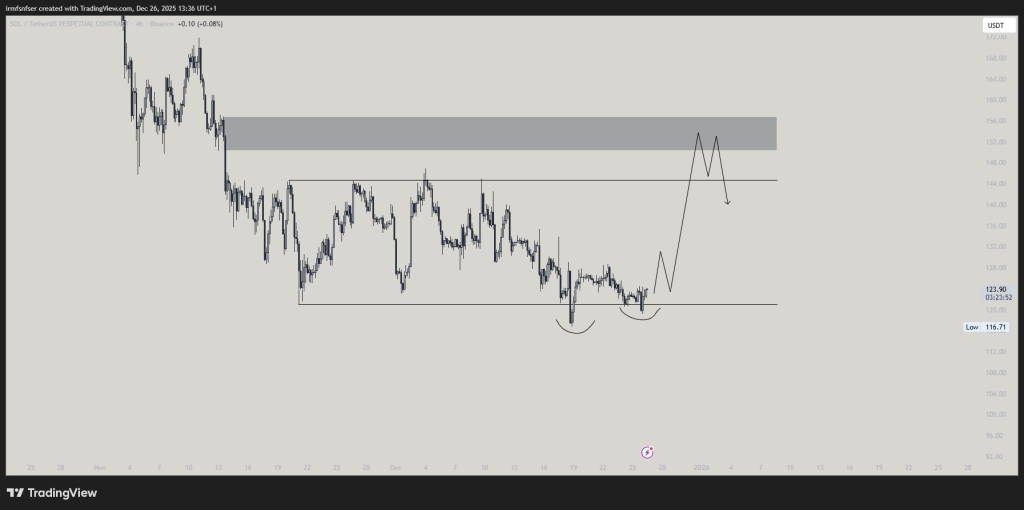
As long as Solana stays above $120, the bullish setup is still intact. The big thing missing right now is volume. Buying pressure is pretty light, which shows bulls are hesitant and not fully stepping in yet.

Without a real volume spike, any move above resistance risks turning into just another fake breakout. What would actually flip the script is a clean break above $144 with strong volume behind it. That kind of move would act like a trigger and could kick off the next leg higher.

Cardano (ADA): $1 Back in Play After a Brutal Correction

Cardano has taken a pretty hard hit lately, but it might be setting up for a bounce. Price is now drifting back toward an area where buyers have stepped in aggressively before, which could act as a base for a rebound.

Source: ADAUSD / TradingView

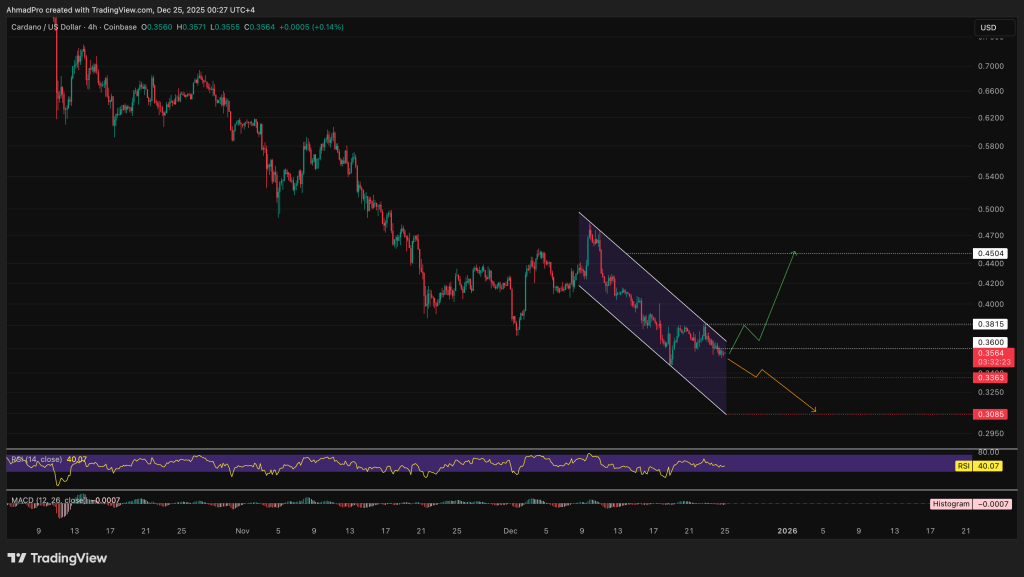
For ADA to really flip bullish, it needs to push above $0.36 and stay there. If that happens, the next hurdle is $0.38, a level it has already been rejected from twice in the past week.

If ADA cannot break through, a dip back toward the $0.30 area is still on the table. The RSI is sitting around 40 and is not oversold yet, which means there is still room for downside in the short term.

That said, as long as ADA holds above the previous low near $0.27, the bigger bullish setup stays intact going into the new year.

Bitcoin Hyper Could Be the Real Christmas Eve Sleeper

While most traders are checked out for the holidays and majors like XRP, SOL, and ADA grind through slow consolidations, Bitcoin Hyper is quietly doing the opposite and that is usually how early winners start.

Bitcoin Hyper is built around one clear idea: giving Bitcoin real speed and utility without sacrificing security. It runs as a Bitcoin Layer 2 powered by the Solana Virtual Machine. This means fast transactions, low fees, and full settlement back to Bitcoin. In a market where people are tired of bloated Layer 1 narratives, that combo is starting to stand out.

The numbers back it up. Bitcoin Hyper has already raised over $29M, even with sentiment still shaky and volumes thin across the market. That kind of capital does not show up by accident, especially during the holidays when most investors are sitting on their hands.

On top of that, staking rewards are sitting around 39% APY, which gives holders a reason to stay locked in rather than flip for short term noise. That is exactly how supply pressure quietly builds before bigger moves.

When the market finally wakes up in the new year and risk appetite rotates back in, the projects that were accumulated during boring, low-volume phases tend to move first. While everyone waits for XRP to break $2.20, SOL to reclaim $144, or ADA to flip $0.36, Bitcoin Hyper is already positioning itself ahead of that rotation.

Sometimes the best Christmas opportunity is the one no one is paying attention to yet.

Visit the Official Bitcoin Hyper Website Here

New ChatGPT Predicts the Price of XRP, Dogecoin, Shiba Inu by the End of 2025

I like ChatGPT, a powerful AI that can give you recipes, teach you tricks, and definitely can give you a price prediction. We asked the new version, GPT 5.2, to do price forecast for XRP, Dogecoin, and Shiba Inu, and it delivered a quite interesting AI price outlook.

Below are ChatGPT’s dual-scenario predictions outlining monumental potential gains and the downside hazards for each asset throughout December and going into 2026.

Ripple (XRP): ChatGPT Predicts a Potential Rally To $4.20

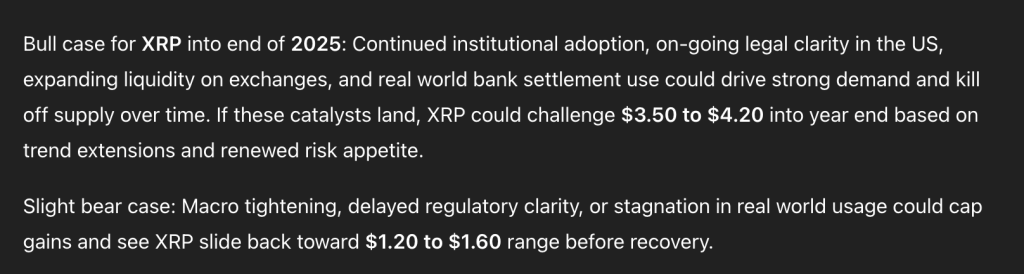
If adoption for XRP declines and macro liquidity tightens, keeping XRP stuck below major resistance, ChatGPT AI predicts a total collapse for XRP to $1.20.

That kind of drop would be completely out of character for XRP this year. After Ripple scored a major legal win against the SEC, XRP went on to hit a new all-time high around $3.65 in July.

Most analysts think that momentum is not done yet. Even ChatGPT-based models are pointing to a possible move back into the $3.50 to $4.20 range as we head toward 2026.

Between the RLUSD stablecoin launch, ongoing integrations, and growing adoption especially across Asia and Japan, plus steady ETF inflows, the setup is there. If the bull market keeps running, XRP breaking into fresh all-time highs in 2026 is very much on the table.

Source: TradingView

To fully reverse its downtrend, XRP needs to climb above the $2.2 level. This would break the token’s bearish price structure. This could set the stage for a strong recovery to $3 at least.

A New Memecoins Cycle Could Be Led By Dogecoin And Shiba Inu

Google Trends data shows that interest in memecoins has dropped to a five-year low. That loss of attention is showing up in the price too, with the memecoin sector down roughly 60% this year overall.

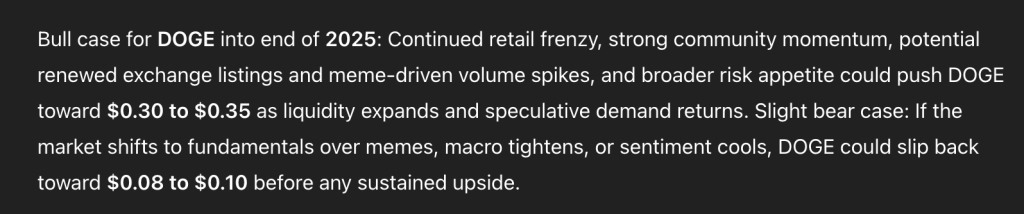
For the Dogecoin bull case, ChatGPT sees momentum coming back in a big way, with DOGE potentially pushing into the $0.30 to $0.35 range heading into 2026. That outlook is built on the idea of a fresh memecoin cycle combined with a broader risk-on shift across the market.

That is also why Bitcoin matters so much here. When BTC breaks out, capital usually rotates into memecoins, and as the leaders of the pack, Dogecoin and Shiba Inu tend to feel that move almost right away.

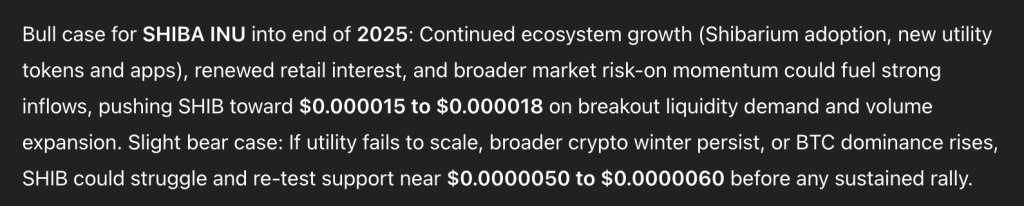
The same story applies to Shiba Inu. It launched back in 2020 as a Dogecoin challenger and has since grown into a heavyweight, with a market cap sitting around $4.83 billion.

Unlike Dogecoin, SHIB also has a major network upgrade planned for 2026. The upgrade is expected to add a privacy layer, which could end up being the key catalyst that helps the token regain momentum when interest in memecoins picks back up.

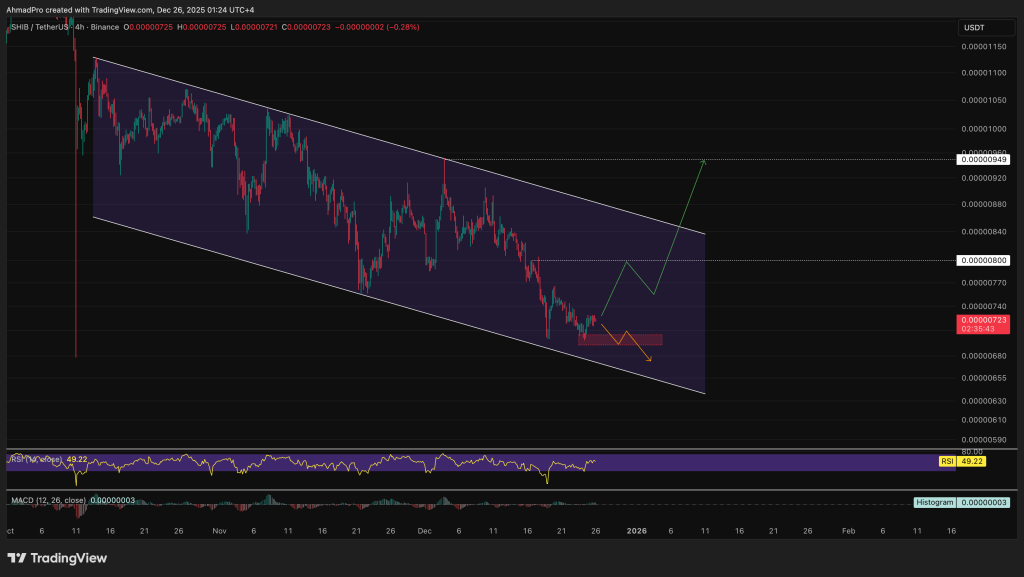
Source: SHIBUSD / TradingView

Shiba Inu is having a hard time finding any real momentum heading into Christmas, and the mood around it feels pretty undecided.

SHIB is down roughly 1.7% over the last 24 hours. It has been stuck chopping in a tight range between $0.00000697 and $0.00000717. That kind of sideways action usually signals a sleepy market, and right now price is sitting closer to the bottom of that range.

For this bounce to actually matter, SHIB needs to push above $0.00000800 and stay there.

Maxi Doge Is Positioning For The Next Meme Rotation

While ChatGPT is laying out big upside and downside scenarios for XRP, Dogecoin, and Shiba Inu. Some traders are looking past the majors and focusing on where early momentum is quietly building. That is where Maxi Doge keeps popping up.

Maxi Doge is leaning fully into the high-risk, high-reward side of the next memecoin cycle. When attention is low and sentiment is washed out. That is usually when early meme winners start getting accumulated before the crowd shows up. Right now, memecoin interest is near multi-year lows, which historically has been the exact environment where explosive rotations begin.

The project has already raised over $4.28M, even while the broader memecoin sector looks completely dead. That kind of traction in a slow market suggests conviction, not hype chasing. On top of that, Maxi Doge is offering staking rewards up to 72% APY. This give holders a strong reason to lock in early and wait instead of flipping for short-term moves.

If ChatGPT is right and 2026 brings renewed risk appetite and a fresh memecoin cycle. The biggest gains usually do not come from the old names everyone already owns. They come from the aggressive new plays that were built quietly during boredom phases.

While Dogecoin and Shiba Inu wait for momentum to return, Maxi Doge is already setting its base. When the rotation hits, that difference tends to matter fast.

Maxi Doge is available through its presale using ETH, USDT, BNB, or a credit card directly on the official website.

Stay updated through Maxi Doge’s official X and Telegram pages.

Visit the Official Website Here

Is Bitcoin Price at Risk of a Deeper Reset? Whales Signal Caution | Research

Key Takeaways:

  • Large Bitcoin transactions above $20 million increasingly moved to exchange hot wallets between October and mid-December.
  • Around 65% of BTC across whales and institutional-linked flows was sent to exchanges, often seen as a preparatory step rather than immediate selling.
  • November marked the peak in outflows across whales, BlackRock-linked wallets, and Wintermute, coinciding with Bitcoin price weakness below $85,000.
  • The timing of these peaks suggests a broad liquidity redistribution during the correction, not targeted pressure from a single market participant.

Bitcoin (BTC) prices continue to trend lower. The market currently looks like a ping-pong match between buyers and sellers. Prices fall, but without a sharp collapse. This is followed by a rebound, but without strong upside momentum. Against this backdrop, speculation is growing that large players may be putting pressure on the market and could be interested in pushing prices lower. But does the data support this idea?

In this research, Cryptonews analyzed large Bitcoin transactions worth more than $20 million per transfer between Oct. 10 and Dec. 15. This timeframe allows us to observe market behavior after the October sell-off. Transactions linked to BlackRock and Wintermute were also reviewed, as both are among the most visible institutional participants.

Hot Wallets Are the Main Destination for Large BTC Transfers

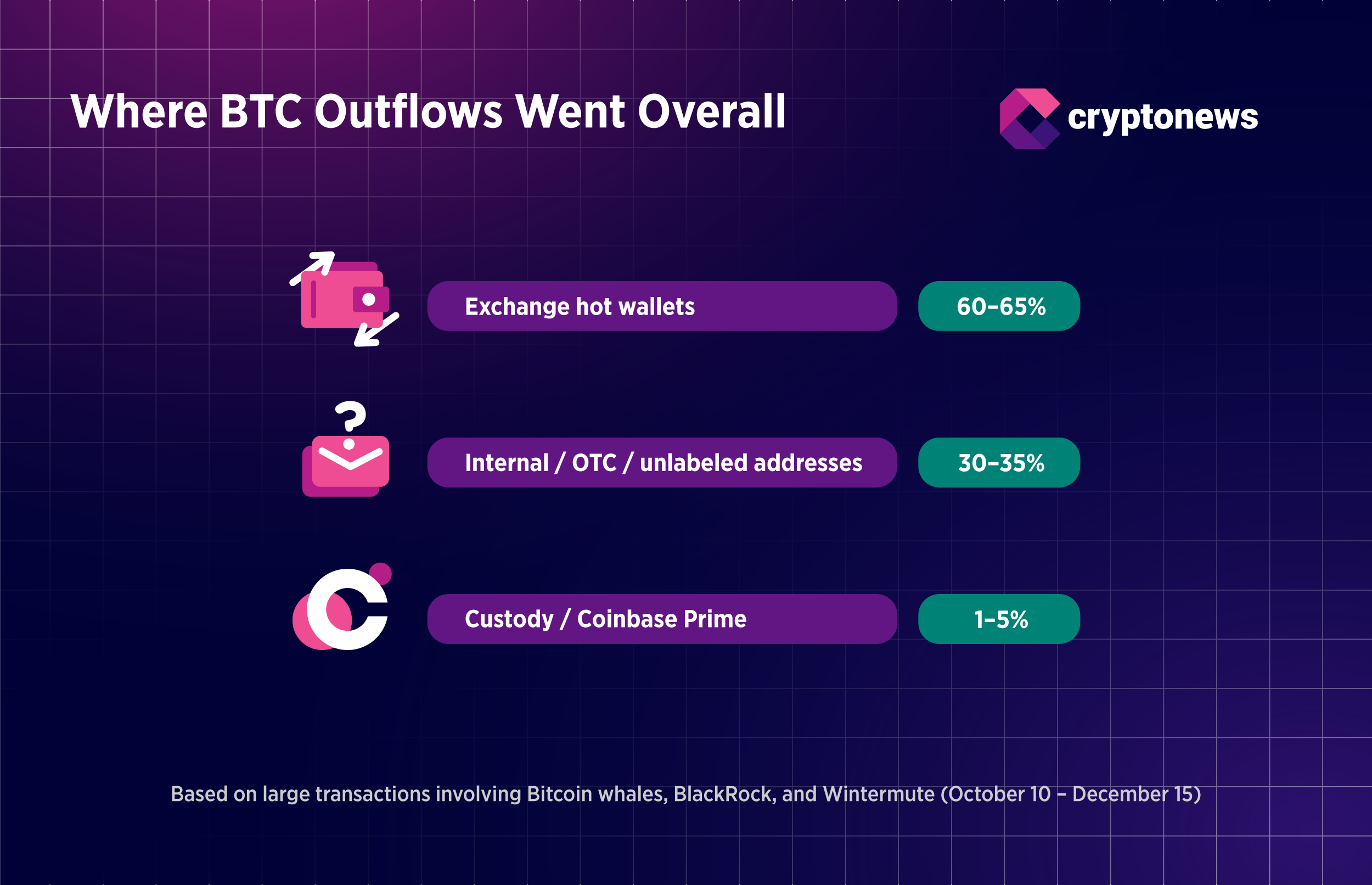
The analysis shows that around 65% of BTC across these groups was transferred to hot wallets, primarily exchanges. This was the most common destination.

Such transfers are usually seen as a preparatory step before selling. However, they do not imply immediate liquidation. Sales may happen later or may not happen at all. Even so, this type of activity often increases caution in the market and influences expectations.

The second most common category was internal transfers. These include Bitcoin moved from one cold wallet to another or to unlabelled addresses. The purpose of these transactions is harder to interpret. In some cases, they may reflect rebalancing, changes in custody structure, or preparation for over-the-counter deals. In current market conditions, these movements can also amplify uncertainty, especially when large BTC volumes regularly move between addresses without a clear explanation.

November Marked the Peak in Large Outflows During Bitcoin Price Weakness

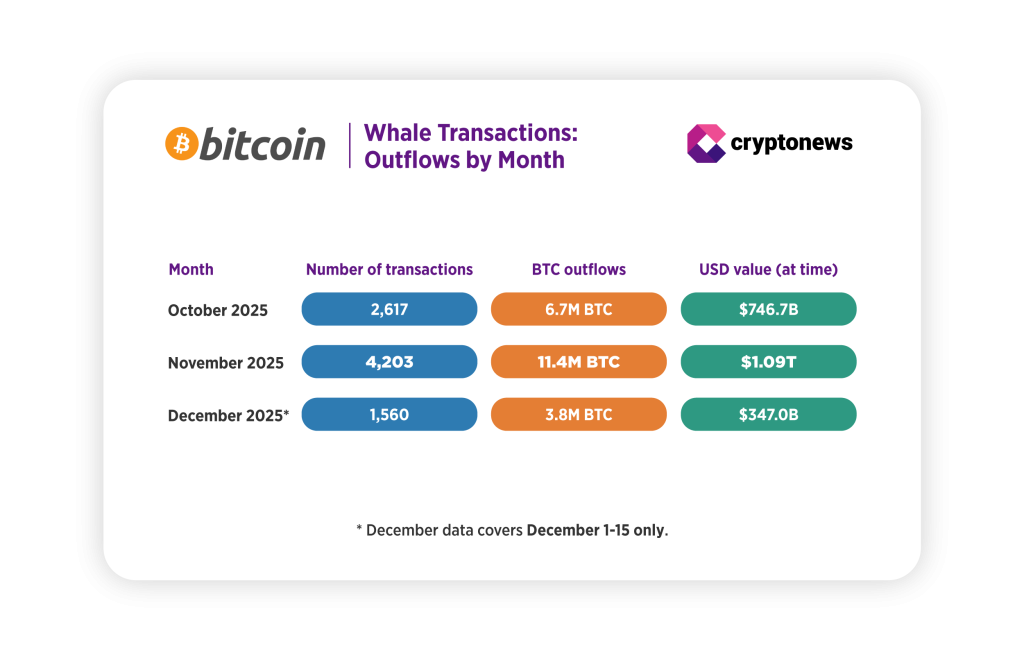
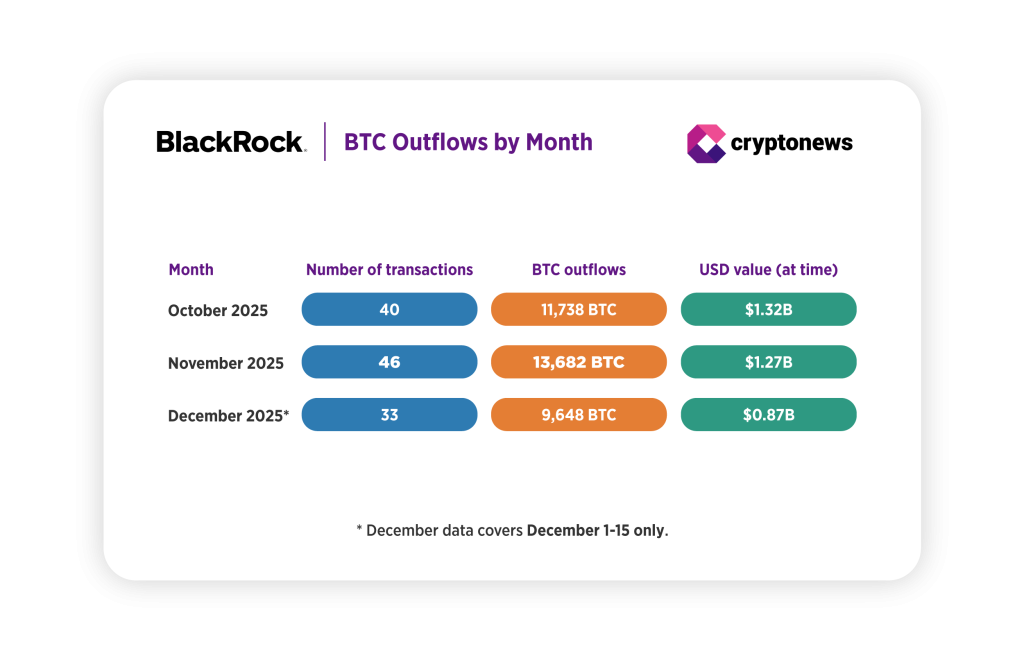
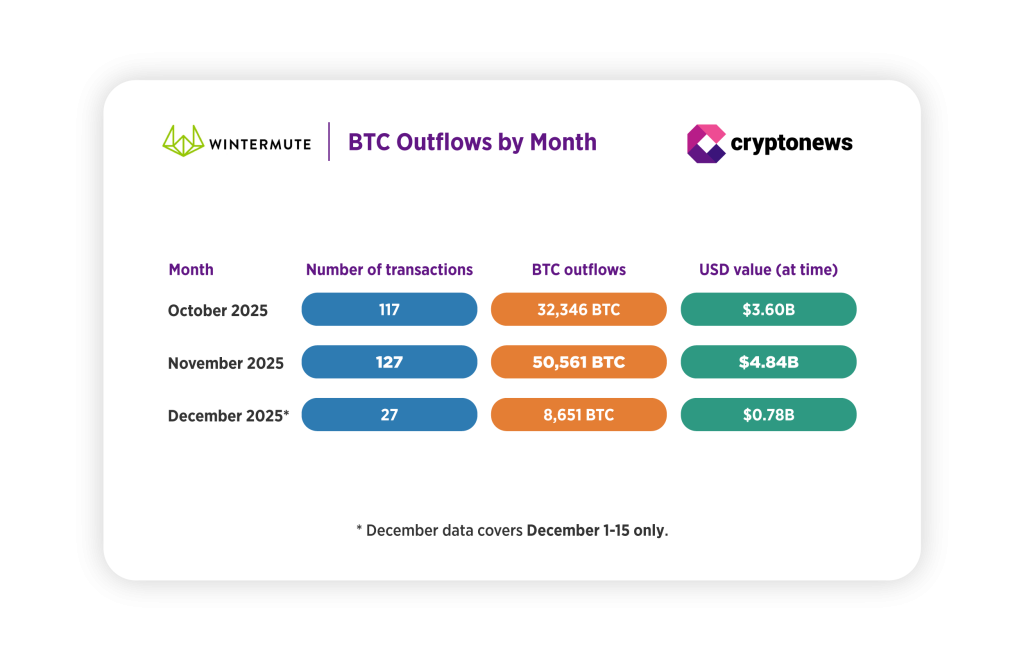
Across all three groups, Bitcoin whales as well as flows linked to BlackRock and Wintermute, activity peaked in November. This occurred after the October 10 sell-off and coincided with Bitcoin trading below $85,000, a period marked by elevated uncertainty.

The trend was most pronounced among Bitcoin whales. In November, their transaction volumes reached the highest levels both in the number of transfers and total BTC moved. Around 11.4 million BTC in outgoing transfers were recorded during the month. At prevailing prices, this represented more than $1 trillion in value. These figures were well above October levels and higher than activity seen in early December, when volumes began to decline.

Institutional flows showed a similar pattern. Bitcoin outflows linked to BlackRock also peaked in November. Estimates suggest around $1.3 billion worth of BTC was moved during the month, making it the most active period for this group in the analyzed timeframe.

Wintermute, one of the largest crypto market makers, also recorded its highest monthly volume of outgoing transfers during November. Given Wintermute’s role in providing liquidity, this increase likely reflects intensified trading activity and fund reallocation amid heightened volatility.

The fact that all three groups peaked at roughly the same time points to a broader redistribution of liquidity during a price correction rather than coordinated action by a single market participant.

Why Are They Doing This?

The rising share of BTC transfers to exchange wallets naturally raises questions. While these moves are often interpreted as preparation for selling, they do not automatically mean large players are ready to exit their positions.

During the correction, some market participants have suggested that falling prices could be used to test the resilience of major Bitcoin holders or even to trigger redistribution between them.

When Bitcoin price comes under prolonged pressure, large and highly visible corporate holders like Strategy inevitably draw closer scrutiny. The company is among the largest corporate Bitcoin holders and is closely associated with a strong long-term BTC thesis. This raises a logical question: could price pressure be a way to test how resilient such positions really are, and what would happen if one of the largest public holders changed its stance?

According to experts, drawing direct conclusions is premature. David Dobrovitsky, CEO of Wowduck, says Cryptonews that it would be an oversimplification to single out one company as a key driver of Bitcoin price movements:

It’s hard to single out a private entity as a reason why BTC is going up or down. BlackRock, for example, holds more Bitcoin than Strategy, not to mention various governments. Strategy is a very visible holder, but overall BTC ownership remains sufficiently distributed, meaning one private company should not be able to move the market on its own.

Even so, the idea of a “stress test” for corporate holders is increasingly discussed in the context of current market dynamics.

Dobrovitsky argues the market is not there yet:

Not yet. There is still enough distribution in Bitcoin holdings for price moves to be fully indicative of pressure on a specific corporate holder. What we are seeing instead is a broader downturn across tech markets. Jobs are scarcer, venture capital funding has declined, and there are fewer sectors delivering outsized returns, both for retail and institutional investors.

From this perspective, Bitcoin price decline appears more like part of a wider cooling in risk assets than targeted pressure on specific players.

That said, Michael Saylor’s role remains an important part of the market narrative, even if it is not decisive. “Positive sentiment around Saylor and Strategy certainly helps Bitcoin,” Dobrovitsky adds. “But it shouldn’t be viewed as the be-all and end-all when it comes to BTC price dynamics.”

Conclusion

Depending on interpretation, this activity can be explained in different ways. On one hand, the rise in BTC transfers to exchanges and the increase in internal movements may reflect a broader market cooldown and standard risk reallocation during a price correction and weaker macro conditions. On the other hand, some participants believe falling prices may act as a stress test for the largest Bitcoin holders, including corporate players like Strategy, whose commitment to BTC has become part of the market narrative.

At the same time, on-chain data does not point to targeted pressure on any single participant. Both explanations remain within the realm of market expectations rather than confirmed scenarios.

​​Disclaimer: Crypto is a high-risk asset class. This article is provided for informational purposes and does not constitute investment advice. You could lose all of your capital.

Weekly Crypto Regulation Roundup: Staking Taxes Under Fire as Fed Hints at New Crypto Banking Model

Key Takeaways:

  • Large Bitcoin transactions above $20 million increasingly moved to exchange hot wallets between October and mid-December.
  • Around 65% of BTC across whales and institutional-linked flows was sent to exchanges, often seen as a preparatory step rather than immediate selling.
  • November marked the peak in outflows across whales, BlackRock-linked wallets, and Wintermute, coinciding with Bitcoin price weakness below $85,000.
  • The timing of these peaks suggests a broad liquidity redistribution during the correction, not targeted pressure from a single market participant.

Bitcoin (BTC) prices continue to trend lower. The market currently looks like a ping-pong match between buyers and sellers. Prices fall, but without a sharp collapse. This is followed by a rebound, but without strong upside momentum. Against this backdrop, speculation is growing that large players may be putting pressure on the market and could be interested in pushing prices lower. But does the data support this idea?

In this research, Cryptonews analyzed large Bitcoin transactions worth more than $20 million per transfer between Oct. 10 and Dec. 15. This timeframe allows us to observe market behavior after the October sell-off. Transactions linked to BlackRock and Wintermute were also reviewed, as both are among the most visible institutional participants.

Hot Wallets Are the Main Destination for Large BTC Transfers

The analysis shows that around 65% of BTC across these groups was transferred to hot wallets, primarily exchanges. This was the most common destination.

Such transfers are usually seen as a preparatory step before selling. However, they do not imply immediate liquidation. Sales may happen later or may not happen at all. Even so, this type of activity often increases caution in the market and influences expectations.

The second most common category was internal transfers. These include Bitcoin moved from one cold wallet to another or to unlabelled addresses. The purpose of these transactions is harder to interpret. In some cases, they may reflect rebalancing, changes in custody structure, or preparation for over-the-counter deals. In current market conditions, these movements can also amplify uncertainty, especially when large BTC volumes regularly move between addresses without a clear explanation.

November Marked the Peak in Large Outflows During Bitcoin Price Weakness

Across all three groups, Bitcoin whales as well as flows linked to BlackRock and Wintermute, activity peaked in November. This occurred after the October 10 sell-off and coincided with Bitcoin trading below $85,000, a period marked by elevated uncertainty.

The trend was most pronounced among Bitcoin whales. In November, their transaction volumes reached the highest levels both in the number of transfers and total BTC moved. Around 11.4 million BTC in outgoing transfers were recorded during the month. At prevailing prices, this represented more than $1 trillion in value. These figures were well above October levels and higher than activity seen in early December, when volumes began to decline.

Institutional flows showed a similar pattern. Bitcoin outflows linked to BlackRock also peaked in November. Estimates suggest around $1.3 billion worth of BTC was moved during the month, making it the most active period for this group in the analyzed timeframe.

Wintermute, one of the largest crypto market makers, also recorded its highest monthly volume of outgoing transfers during November. Given Wintermute’s role in providing liquidity, this increase likely reflects intensified trading activity and fund reallocation amid heightened volatility.

The fact that all three groups peaked at roughly the same time points to a broader redistribution of liquidity during a price correction rather than coordinated action by a single market participant.

Why Are They Doing This?

The rising share of BTC transfers to exchange wallets naturally raises questions. While these moves are often interpreted as preparation for selling, they do not automatically mean large players are ready to exit their positions.

During the correction, some market participants have suggested that falling prices could be used to test the resilience of major Bitcoin holders or even to trigger redistribution between them.

When Bitcoin price comes under prolonged pressure, large and highly visible corporate holders like Strategy inevitably draw closer scrutiny. The company is among the largest corporate Bitcoin holders and is closely associated with a strong long-term BTC thesis. This raises a logical question: could price pressure be a way to test how resilient such positions really are, and what would happen if one of the largest public holders changed its stance?

According to experts, drawing direct conclusions is premature. David Dobrovitsky, CEO of Wowduck, says Cryptonews that it would be an oversimplification to single out one company as a key driver of Bitcoin price movements:

It’s hard to single out a private entity as a reason why BTC is going up or down. BlackRock, for example, holds more Bitcoin than Strategy, not to mention various governments. Strategy is a very visible holder, but overall BTC ownership remains sufficiently distributed, meaning one private company should not be able to move the market on its own.

Even so, the idea of a “stress test” for corporate holders is increasingly discussed in the context of current market dynamics.

Dobrovitsky argues the market is not there yet:

Not yet. There is still enough distribution in Bitcoin holdings for price moves to be fully indicative of pressure on a specific corporate holder. What we are seeing instead is a broader downturn across tech markets. Jobs are scarcer, venture capital funding has declined, and there are fewer sectors delivering outsized returns, both for retail and institutional investors.

From this perspective, Bitcoin price decline appears more like part of a wider cooling in risk assets than targeted pressure on specific players.

That said, Michael Saylor’s role remains an important part of the market narrative, even if it is not decisive. “Positive sentiment around Saylor and Strategy certainly helps Bitcoin,” Dobrovitsky adds. “But it shouldn’t be viewed as the be-all and end-all when it comes to BTC price dynamics.”

Conclusion

Depending on interpretation, this activity can be explained in different ways. On one hand, the rise in BTC transfers to exchanges and the increase in internal movements may reflect a broader market cooldown and standard risk reallocation during a price correction and weaker macro conditions. On the other hand, some participants believe falling prices may act as a stress test for the largest Bitcoin holders, including corporate players like Strategy, whose commitment to BTC has become part of the market narrative.

At the same time, on-chain data does not point to targeted pressure on any single participant. Both explanations remain within the realm of market expectations rather than confirmed scenarios.

​​Disclaimer: Crypto is a high-risk asset class. This article is provided for informational purposes and does not constitute investment advice. You could lose all of your capital.

Crypto’s Next Phase Is Utility Not Price Action: CoinShares

Key Takeaways:

  • Large Bitcoin transactions above $20 million increasingly moved to exchange hot wallets between October and mid-December.
  • Around 65% of BTC across whales and institutional-linked flows was sent to exchanges, often seen as a preparatory step rather than immediate selling.
  • November marked the peak in outflows across whales, BlackRock-linked wallets, and Wintermute, coinciding with Bitcoin price weakness below $85,000.
  • The timing of these peaks suggests a broad liquidity redistribution during the correction, not targeted pressure from a single market participant.

Bitcoin (BTC) prices continue to trend lower. The market currently looks like a ping-pong match between buyers and sellers. Prices fall, but without a sharp collapse. This is followed by a rebound, but without strong upside momentum. Against this backdrop, speculation is growing that large players may be putting pressure on the market and could be interested in pushing prices lower. But does the data support this idea?

In this research, Cryptonews analyzed large Bitcoin transactions worth more than $20 million per transfer between Oct. 10 and Dec. 15. This timeframe allows us to observe market behavior after the October sell-off. Transactions linked to BlackRock and Wintermute were also reviewed, as both are among the most visible institutional participants.

Hot Wallets Are the Main Destination for Large BTC Transfers

The analysis shows that around 65% of BTC across these groups was transferred to hot wallets, primarily exchanges. This was the most common destination.

Such transfers are usually seen as a preparatory step before selling. However, they do not imply immediate liquidation. Sales may happen later or may not happen at all. Even so, this type of activity often increases caution in the market and influences expectations.

The second most common category was internal transfers. These include Bitcoin moved from one cold wallet to another or to unlabelled addresses. The purpose of these transactions is harder to interpret. In some cases, they may reflect rebalancing, changes in custody structure, or preparation for over-the-counter deals. In current market conditions, these movements can also amplify uncertainty, especially when large BTC volumes regularly move between addresses without a clear explanation.

November Marked the Peak in Large Outflows During Bitcoin Price Weakness

Across all three groups, Bitcoin whales as well as flows linked to BlackRock and Wintermute, activity peaked in November. This occurred after the October 10 sell-off and coincided with Bitcoin trading below $85,000, a period marked by elevated uncertainty.

The trend was most pronounced among Bitcoin whales. In November, their transaction volumes reached the highest levels both in the number of transfers and total BTC moved. Around 11.4 million BTC in outgoing transfers were recorded during the month. At prevailing prices, this represented more than $1 trillion in value. These figures were well above October levels and higher than activity seen in early December, when volumes began to decline.

Institutional flows showed a similar pattern. Bitcoin outflows linked to BlackRock also peaked in November. Estimates suggest around $1.3 billion worth of BTC was moved during the month, making it the most active period for this group in the analyzed timeframe.

Wintermute, one of the largest crypto market makers, also recorded its highest monthly volume of outgoing transfers during November. Given Wintermute’s role in providing liquidity, this increase likely reflects intensified trading activity and fund reallocation amid heightened volatility.

The fact that all three groups peaked at roughly the same time points to a broader redistribution of liquidity during a price correction rather than coordinated action by a single market participant.

Why Are They Doing This?

The rising share of BTC transfers to exchange wallets naturally raises questions. While these moves are often interpreted as preparation for selling, they do not automatically mean large players are ready to exit their positions.

During the correction, some market participants have suggested that falling prices could be used to test the resilience of major Bitcoin holders or even to trigger redistribution between them.

When Bitcoin price comes under prolonged pressure, large and highly visible corporate holders like Strategy inevitably draw closer scrutiny. The company is among the largest corporate Bitcoin holders and is closely associated with a strong long-term BTC thesis. This raises a logical question: could price pressure be a way to test how resilient such positions really are, and what would happen if one of the largest public holders changed its stance?

According to experts, drawing direct conclusions is premature. David Dobrovitsky, CEO of Wowduck, says Cryptonews that it would be an oversimplification to single out one company as a key driver of Bitcoin price movements:

It’s hard to single out a private entity as a reason why BTC is going up or down. BlackRock, for example, holds more Bitcoin than Strategy, not to mention various governments. Strategy is a very visible holder, but overall BTC ownership remains sufficiently distributed, meaning one private company should not be able to move the market on its own.

Even so, the idea of a “stress test” for corporate holders is increasingly discussed in the context of current market dynamics.

Dobrovitsky argues the market is not there yet:

Not yet. There is still enough distribution in Bitcoin holdings for price moves to be fully indicative of pressure on a specific corporate holder. What we are seeing instead is a broader downturn across tech markets. Jobs are scarcer, venture capital funding has declined, and there are fewer sectors delivering outsized returns, both for retail and institutional investors.

From this perspective, Bitcoin price decline appears more like part of a wider cooling in risk assets than targeted pressure on specific players.

That said, Michael Saylor’s role remains an important part of the market narrative, even if it is not decisive. “Positive sentiment around Saylor and Strategy certainly helps Bitcoin,” Dobrovitsky adds. “But it shouldn’t be viewed as the be-all and end-all when it comes to BTC price dynamics.”

Conclusion

Depending on interpretation, this activity can be explained in different ways. On one hand, the rise in BTC transfers to exchanges and the increase in internal movements may reflect a broader market cooldown and standard risk reallocation during a price correction and weaker macro conditions. On the other hand, some participants believe falling prices may act as a stress test for the largest Bitcoin holders, including corporate players like Strategy, whose commitment to BTC has become part of the market narrative.

At the same time, on-chain data does not point to targeted pressure on any single participant. Both explanations remain within the realm of market expectations rather than confirmed scenarios.

​​Disclaimer: Crypto is a high-risk asset class. This article is provided for informational purposes and does not constitute investment advice. You could lose all of your capital.

Bitcoin Price Prediction: Record SEC Filings Signal Flood of Wall Street Money – Supercycle Starting in 2026?

Key Takeaways:

  • Large Bitcoin transactions above $20 million increasingly moved to exchange hot wallets between October and mid-December.
  • Around 65% of BTC across whales and institutional-linked flows was sent to exchanges, often seen as a preparatory step rather than immediate selling.
  • November marked the peak in outflows across whales, BlackRock-linked wallets, and Wintermute, coinciding with Bitcoin price weakness below $85,000.
  • The timing of these peaks suggests a broad liquidity redistribution during the correction, not targeted pressure from a single market participant.

Bitcoin (BTC) prices continue to trend lower. The market currently looks like a ping-pong match between buyers and sellers. Prices fall, but without a sharp collapse. This is followed by a rebound, but without strong upside momentum. Against this backdrop, speculation is growing that large players may be putting pressure on the market and could be interested in pushing prices lower. But does the data support this idea?

In this research, Cryptonews analyzed large Bitcoin transactions worth more than $20 million per transfer between Oct. 10 and Dec. 15. This timeframe allows us to observe market behavior after the October sell-off. Transactions linked to BlackRock and Wintermute were also reviewed, as both are among the most visible institutional participants.

Hot Wallets Are the Main Destination for Large BTC Transfers

The analysis shows that around 65% of BTC across these groups was transferred to hot wallets, primarily exchanges. This was the most common destination.

Such transfers are usually seen as a preparatory step before selling. However, they do not imply immediate liquidation. Sales may happen later or may not happen at all. Even so, this type of activity often increases caution in the market and influences expectations.

The second most common category was internal transfers. These include Bitcoin moved from one cold wallet to another or to unlabelled addresses. The purpose of these transactions is harder to interpret. In some cases, they may reflect rebalancing, changes in custody structure, or preparation for over-the-counter deals. In current market conditions, these movements can also amplify uncertainty, especially when large BTC volumes regularly move between addresses without a clear explanation.

November Marked the Peak in Large Outflows During Bitcoin Price Weakness

Across all three groups, Bitcoin whales as well as flows linked to BlackRock and Wintermute, activity peaked in November. This occurred after the October 10 sell-off and coincided with Bitcoin trading below $85,000, a period marked by elevated uncertainty.

The trend was most pronounced among Bitcoin whales. In November, their transaction volumes reached the highest levels both in the number of transfers and total BTC moved. Around 11.4 million BTC in outgoing transfers were recorded during the month. At prevailing prices, this represented more than $1 trillion in value. These figures were well above October levels and higher than activity seen in early December, when volumes began to decline.

Institutional flows showed a similar pattern. Bitcoin outflows linked to BlackRock also peaked in November. Estimates suggest around $1.3 billion worth of BTC was moved during the month, making it the most active period for this group in the analyzed timeframe.

Wintermute, one of the largest crypto market makers, also recorded its highest monthly volume of outgoing transfers during November. Given Wintermute’s role in providing liquidity, this increase likely reflects intensified trading activity and fund reallocation amid heightened volatility.

The fact that all three groups peaked at roughly the same time points to a broader redistribution of liquidity during a price correction rather than coordinated action by a single market participant.

Why Are They Doing This?

The rising share of BTC transfers to exchange wallets naturally raises questions. While these moves are often interpreted as preparation for selling, they do not automatically mean large players are ready to exit their positions.

During the correction, some market participants have suggested that falling prices could be used to test the resilience of major Bitcoin holders or even to trigger redistribution between them.

When Bitcoin price comes under prolonged pressure, large and highly visible corporate holders like Strategy inevitably draw closer scrutiny. The company is among the largest corporate Bitcoin holders and is closely associated with a strong long-term BTC thesis. This raises a logical question: could price pressure be a way to test how resilient such positions really are, and what would happen if one of the largest public holders changed its stance?

According to experts, drawing direct conclusions is premature. David Dobrovitsky, CEO of Wowduck, says Cryptonews that it would be an oversimplification to single out one company as a key driver of Bitcoin price movements:

It’s hard to single out a private entity as a reason why BTC is going up or down. BlackRock, for example, holds more Bitcoin than Strategy, not to mention various governments. Strategy is a very visible holder, but overall BTC ownership remains sufficiently distributed, meaning one private company should not be able to move the market on its own.

Even so, the idea of a “stress test” for corporate holders is increasingly discussed in the context of current market dynamics.

Dobrovitsky argues the market is not there yet:

Not yet. There is still enough distribution in Bitcoin holdings for price moves to be fully indicative of pressure on a specific corporate holder. What we are seeing instead is a broader downturn across tech markets. Jobs are scarcer, venture capital funding has declined, and there are fewer sectors delivering outsized returns, both for retail and institutional investors.

From this perspective, Bitcoin price decline appears more like part of a wider cooling in risk assets than targeted pressure on specific players.

That said, Michael Saylor’s role remains an important part of the market narrative, even if it is not decisive. “Positive sentiment around Saylor and Strategy certainly helps Bitcoin,” Dobrovitsky adds. “But it shouldn’t be viewed as the be-all and end-all when it comes to BTC price dynamics.”

Conclusion

Depending on interpretation, this activity can be explained in different ways. On one hand, the rise in BTC transfers to exchanges and the increase in internal movements may reflect a broader market cooldown and standard risk reallocation during a price correction and weaker macro conditions. On the other hand, some participants believe falling prices may act as a stress test for the largest Bitcoin holders, including corporate players like Strategy, whose commitment to BTC has become part of the market narrative.

At the same time, on-chain data does not point to targeted pressure on any single participant. Both explanations remain within the realm of market expectations rather than confirmed scenarios.

​​Disclaimer: Crypto is a high-risk asset class. This article is provided for informational purposes and does not constitute investment advice. You could lose all of your capital.

Japan’s 2026 Tax Reform Blueprint Maps Out New Framework for Crypto Assets: Report 

Key Takeaways:

  • Large Bitcoin transactions above $20 million increasingly moved to exchange hot wallets between October and mid-December.
  • Around 65% of BTC across whales and institutional-linked flows was sent to exchanges, often seen as a preparatory step rather than immediate selling.
  • November marked the peak in outflows across whales, BlackRock-linked wallets, and Wintermute, coinciding with Bitcoin price weakness below $85,000.
  • The timing of these peaks suggests a broad liquidity redistribution during the correction, not targeted pressure from a single market participant.

Bitcoin (BTC) prices continue to trend lower. The market currently looks like a ping-pong match between buyers and sellers. Prices fall, but without a sharp collapse. This is followed by a rebound, but without strong upside momentum. Against this backdrop, speculation is growing that large players may be putting pressure on the market and could be interested in pushing prices lower. But does the data support this idea?

In this research, Cryptonews analyzed large Bitcoin transactions worth more than $20 million per transfer between Oct. 10 and Dec. 15. This timeframe allows us to observe market behavior after the October sell-off. Transactions linked to BlackRock and Wintermute were also reviewed, as both are among the most visible institutional participants.

Hot Wallets Are the Main Destination for Large BTC Transfers

The analysis shows that around 65% of BTC across these groups was transferred to hot wallets, primarily exchanges. This was the most common destination.

Such transfers are usually seen as a preparatory step before selling. However, they do not imply immediate liquidation. Sales may happen later or may not happen at all. Even so, this type of activity often increases caution in the market and influences expectations.

The second most common category was internal transfers. These include Bitcoin moved from one cold wallet to another or to unlabelled addresses. The purpose of these transactions is harder to interpret. In some cases, they may reflect rebalancing, changes in custody structure, or preparation for over-the-counter deals. In current market conditions, these movements can also amplify uncertainty, especially when large BTC volumes regularly move between addresses without a clear explanation.

November Marked the Peak in Large Outflows During Bitcoin Price Weakness

Across all three groups, Bitcoin whales as well as flows linked to BlackRock and Wintermute, activity peaked in November. This occurred after the October 10 sell-off and coincided with Bitcoin trading below $85,000, a period marked by elevated uncertainty.

The trend was most pronounced among Bitcoin whales. In November, their transaction volumes reached the highest levels both in the number of transfers and total BTC moved. Around 11.4 million BTC in outgoing transfers were recorded during the month. At prevailing prices, this represented more than $1 trillion in value. These figures were well above October levels and higher than activity seen in early December, when volumes began to decline.

Institutional flows showed a similar pattern. Bitcoin outflows linked to BlackRock also peaked in November. Estimates suggest around $1.3 billion worth of BTC was moved during the month, making it the most active period for this group in the analyzed timeframe.

Wintermute, one of the largest crypto market makers, also recorded its highest monthly volume of outgoing transfers during November. Given Wintermute’s role in providing liquidity, this increase likely reflects intensified trading activity and fund reallocation amid heightened volatility.

The fact that all three groups peaked at roughly the same time points to a broader redistribution of liquidity during a price correction rather than coordinated action by a single market participant.

Why Are They Doing This?

The rising share of BTC transfers to exchange wallets naturally raises questions. While these moves are often interpreted as preparation for selling, they do not automatically mean large players are ready to exit their positions.

During the correction, some market participants have suggested that falling prices could be used to test the resilience of major Bitcoin holders or even to trigger redistribution between them.

When Bitcoin price comes under prolonged pressure, large and highly visible corporate holders like Strategy inevitably draw closer scrutiny. The company is among the largest corporate Bitcoin holders and is closely associated with a strong long-term BTC thesis. This raises a logical question: could price pressure be a way to test how resilient such positions really are, and what would happen if one of the largest public holders changed its stance?

According to experts, drawing direct conclusions is premature. David Dobrovitsky, CEO of Wowduck, says Cryptonews that it would be an oversimplification to single out one company as a key driver of Bitcoin price movements:

It’s hard to single out a private entity as a reason why BTC is going up or down. BlackRock, for example, holds more Bitcoin than Strategy, not to mention various governments. Strategy is a very visible holder, but overall BTC ownership remains sufficiently distributed, meaning one private company should not be able to move the market on its own.

Even so, the idea of a “stress test” for corporate holders is increasingly discussed in the context of current market dynamics.

Dobrovitsky argues the market is not there yet:

Not yet. There is still enough distribution in Bitcoin holdings for price moves to be fully indicative of pressure on a specific corporate holder. What we are seeing instead is a broader downturn across tech markets. Jobs are scarcer, venture capital funding has declined, and there are fewer sectors delivering outsized returns, both for retail and institutional investors.

From this perspective, Bitcoin price decline appears more like part of a wider cooling in risk assets than targeted pressure on specific players.

That said, Michael Saylor’s role remains an important part of the market narrative, even if it is not decisive. “Positive sentiment around Saylor and Strategy certainly helps Bitcoin,” Dobrovitsky adds. “But it shouldn’t be viewed as the be-all and end-all when it comes to BTC price dynamics.”

Conclusion

Depending on interpretation, this activity can be explained in different ways. On one hand, the rise in BTC transfers to exchanges and the increase in internal movements may reflect a broader market cooldown and standard risk reallocation during a price correction and weaker macro conditions. On the other hand, some participants believe falling prices may act as a stress test for the largest Bitcoin holders, including corporate players like Strategy, whose commitment to BTC has become part of the market narrative.

At the same time, on-chain data does not point to targeted pressure on any single participant. Both explanations remain within the realm of market expectations rather than confirmed scenarios.

​​Disclaimer: Crypto is a high-risk asset class. This article is provided for informational purposes and does not constitute investment advice. You could lose all of your capital.