How Tether Co-Founder William Quigley Views Crypto Regulations in Trump’s Second Term

Donald Trump’s re-election has led to expectations of major changes in U.S. cryptocurrency regulations.

Recent executive orders suggest that regulatory changes could soon affect the cryptocurrency industry.

In an interview with Cryptonews, William Quigley, co-founder of Tether and WAX, shared his insights into what the next four years under Trump could mean for the industry.

Quigley explained that the administration’s pro-crypto stance, along with key appointments and legislative efforts, could lead to clearer regulations.

He also stressed the role of the private sector in shaping future of cryptocurrency regulations.

Trump’s Second Term and the Future of Crypto Regulation

Trump’s signals of potential changes in crypto regulations contrast sharply with previous administrations’ inconsistent approaches.

Under Trump, there could be an emphasis on installing pro-crypto figures and fostering private sector involvement in virtual assets.

Quigley remarked on the shift, “The Obama administration and the Biden administration in terms of how they thought about crypto, they were wary of it and Congress was not moving forward with any regulation. They didn’t seem to see it as important or terribly problematic either, with the exception of one federal agency, the SEC.”

“The Trump executive order is very positive towards crypto, the statement that Trump wants the U.S. to be a leader in the crypto industry,” Quigley added.

These changes are expected to create a more predictable regulatory environment, reducing uncertainty and supporting market stability.

As the administration moves forward, regulatory decisions will determine how the government interacts with the digital currency sector.

Establishing the Digital Asset Working Group

President Trump’s executive order led to the creation of the President’s Working Group on Digital Asset Markets within the National Economic Council.

This group is responsible for reviewing existing regulations and proposing clearer guidelines for the digital asset sector.

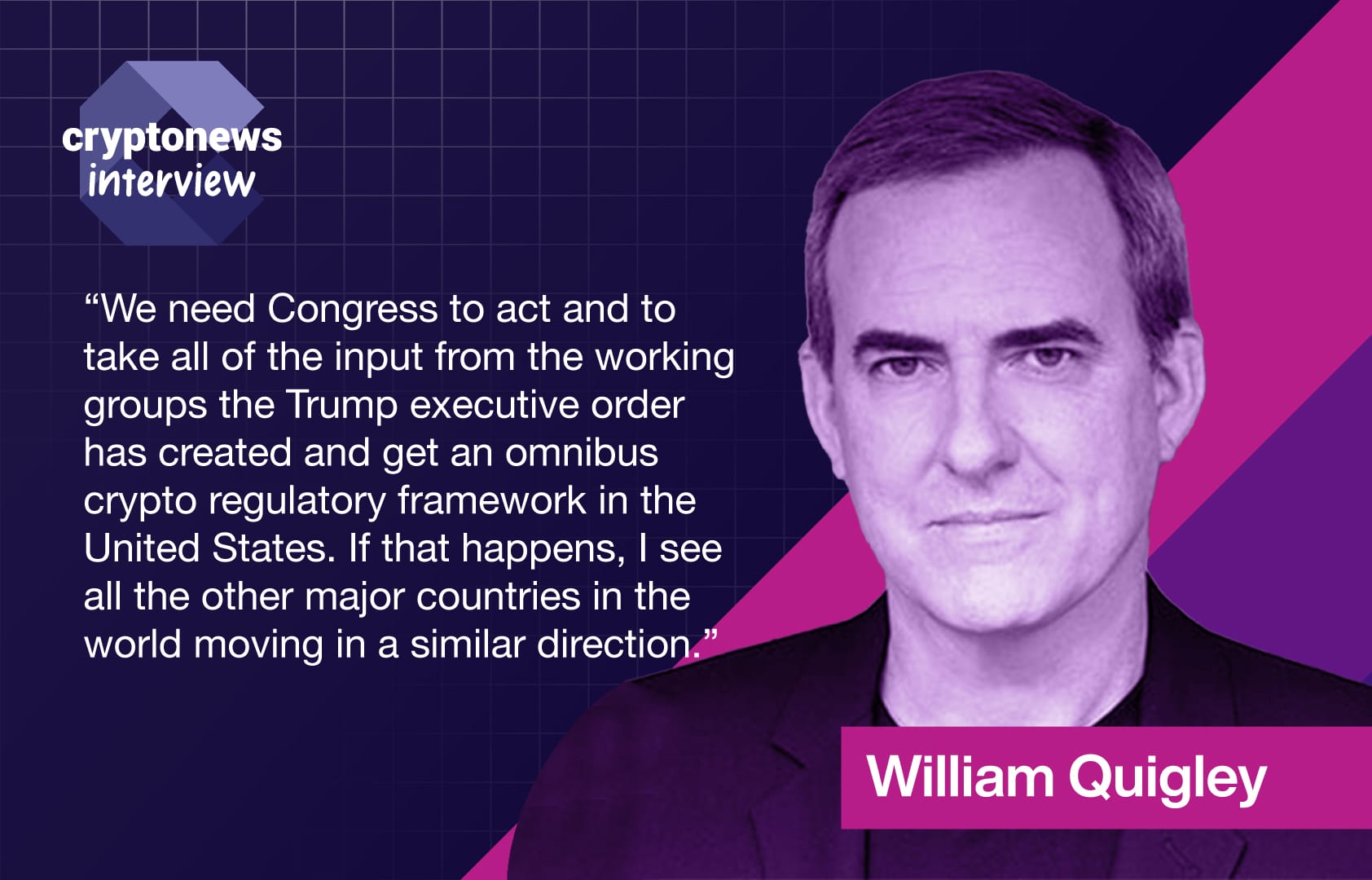
Quigley shared his views on the impact of these developments, “The Trump executive order has created and get an omnibus crypto regulatory framework in the United States. And if that happens, I see all the other major countries in the world moving in a similar direction.”

“To me, [the executive order] seems quite fast because there is so much to consider here, but I think before the Trump term ends, individuals will have ability to use stablecoins much more freely than they do now.,” said Quigley.

The working group is tasked with crafting a federal regulatory framework specifically for digital assets like stablecoins, which will involve detailed considerations on how these assets are issued and operated within the U.S.

The crypto industry awaits the Working Group’s report, due within 180 days, anticipating targeted legislative proposals that could redefine the regulatory environment and enhance market stability.

Quigley Discusses Bank Reluctance

The U.S. banking sector remains cautious about cryptocurrency due to unclear regulatory guidance and the potential for severe penalties.

This hesitancy persists despite more positive remarks from figures like Federal Reserve Chairman Powell, who recently commended banks for their handling of cryptos.

William Quigley highlighted the core issues, “Banks are still slow. This might be because they’ve gotten so much crosstalk over the years with what they’re allowed to do and not allowed to do.”

“Any positive messaging from the White House and from the Federal Reserve is very good for us,” Quigley further explained. “But for these institutions, I think they need black and white guidance.”

He also reflected on the broader implications of this reluctance, “In any major financial institution in the United States, there are thousands, maybe tens of thousands of employees who are primarily just compliance oriented people. There’s all these regulatory bodies at the federal level, and some similar ones at the state level, many of whom either give no guidance on crypto, or who give conflicting guidance.”

In traditional banking systems, clarity and compliance remain paramount. The banking sector’s cautious approach to crypto may change in the future, but currently, this wariness serves as a major obstacle to wider acceptance and integration of these technologies.

The Need for Congressional Action in Crypto Regulation

Cryptocurrency regulation in the U.S. suffers from inconsistencies due to multiple agencies managing different aspects without a unified approach.

This fragmented oversight has highlighted the need for a single regulatory body to provide clear and consistent governance.

Trump’s recent executive order is seen as a pivotal step that might prompt Congress to establish a unified regulator, which could help reduce confusion and solidify the U.S.’s position in the global crypto market.

“We can’t have the IRS calling it property, the CFTC saying, no, it’s a commodity, the SEC saying it’s a security, and then the U. S. Treasury forever saying, no, these are currencies, and that existed for years,” said Quigley.


Trump Appoints PayPal Veteran David Sacks as ‘White House AI and Crypto Czar’

President-elect Donald Trump on Thursday night named venture capitalist and ex-PayPal COO David Sacks as his administration’s “AI and crypto czar.”

“In this important role, David will guide policy for the Administration in Artificial Intelligence and Cryptocurrency, two areas critical to the future of American competitiveness,” Trump said in a Truth Social post. “David will focus on making America the clear global leader in both areas.”

Sacks will develop a legal framework to provide the clarity the crypto industry has been seeking, he added.

PayPal Mafia’s David Sacks Gains Spotlight in Trump’s Crypto and AI Agenda

Sacks belongs to Silicon Valley’s “PayPal Mafia,” a group of influential entrepreneurs and ex-PayPal employees like Elon Musk and Peter Thiel. Formed in the early 2000s, this group has shaped the tech industry through successful ventures and investments, leveraging their strong networks and collaboration.

He also gained prominence by founding Yammer, which he sold to Microsoft in 2012 for about $1.2b.

Reports earlier indicated that the incoming Trump administration considered Chris Giancarlo, former CFTC chair, for the “crypto czar” role.

Former Trump Critic Rises as Crypto Advocate and Administration Ally

Sacks’ appointment signals that the second Trump administration is rewarding Silicon Valley figures who supported his campaign. Moreover, it indicates that the administration will push for policies generally supported by crypto entrepreneurs.

Earlier this year, Sacks became a major Trump booster by hosting a fundraiser in San Francisco for the then-Republican nominee. At this event, tickets went for $50,000 each, with a $300,000 tier that offered perks like a photo with Trump.

This represented a stark change for Sacks, who had sharply criticized Trump following the Jan. 6, 2021, Capitol riot. Shortly after, on an episode of his All-In podcast, Sacks stated that Trump was “clearly” responsible for those events and had disqualified himself from national candidacy.

In recent years, Sacks has gained prominence as the host of the All-In podcast, co-hosting with investors Chamath Palihapitiya, Jason Calacanis and David Friedberg. In his post, Trump described it as the “top podcast in Tech,” where they discuss economic, political and social issues.

This week, Trump named Paul Atkins, a seasoned financial regulator and crypto advocate, to head the SEC. Explaining his choice, Trump called Atkins a “proven leader for commonsense regulations” and praised his stance against overregulating markets.

Ex-SWIFT CIO Tom Zschach Shuts Down XRP Partnership Claims in Two Words

Tom Zschach, who spent six years as SWIFT’s Chief Innovation Officer before recently leaving the company, pushed back against fresh Ripple rumors with a two-word reply on X: “Not happening.” That short response landed because he led SWIFT’s digital asset strategy, giving him firsthand knowledge of what the network was actually building.

The comments followed claims from several XRP influencer accounts that SWIFT planned to support public tokens like XRP instead of developing its own infrastructure. The posts quickly spread across social media, but none included an official statement or supporting document. That’s a little like citing “trust me, bro” as a source.

One widely shared post even claimed SWIFT had said it had no intention of competing with XRP and would instead collaborate with it. However, no official SWIFT announcement, press release, or public document contains that wording. The claim appears to have circulated without any verifiable evidence.

Zschach’s response effectively shut down the rumor before it gathered more steam. While SWIFT continues testing blockchain based settlement and tokenized asset infrastructure, there is still no indication the network plans to integrate XRP or endorse the token for its core services.

Tom Zschach, SWIFT's ex-Chief Innovation Officer, who recently left the company, pushed back against fresh Ripple rumors.

Zschach’s response left no interpretive room. The crypto rumor collapsed against a two-word rebuttal from the person who ran SWIFT’s digital asset function for half a decade – a cleaner debunk than any lengthy rebuttal could achieve.

This is the same pattern that has repeated across several years: a SWIFT executive or technical document references tokenization or interoperability, XRP communities interpret it as implicit adoption, influencer accounts amplify the interpretation as fact, and a correction follows. The XRP debunk cycle is well-worn at this point, but Zschach’s direct involvement gives this iteration unusual authority.

Discover: The Best Token Presales

Zschach’s Track Record on Ripple

The former SWIFT CIO’s rejection of XRP’s institutional narrative is not new. Zschach has previously compared Ripple technology to a “fax machine” in the modern internet era, and argued that Ripple surviving its long-running SEC lawsuit does not constitute actual institutional resilience.

After a three-decade career spanning Bank of America, Barclays, and Lehman Brothers, Zschach has left SWIFT to join a research team drawing from Oxford, Harvard, and Cambridge to build new financial infrastructure, a trajectory that signals where he believes institutional-grade digital finance is actually heading.

Don’t Miss Out on Our $1,000 USDT Airdrop on ByBit

What SWIFT Is Actually Building

SWIFT’s digital asset strategy is becoming clearer, and it has little to do with the latest XRP rumors. Its published work centers on secure messaging, interoperability, and tokenized assets for regulated financial institutions. Recent pilots also focus on tokenized deposits across permissioned networks, not public blockchains.

That matters because permissioned ledgers and public tokens solve different problems. SWIFT is building neutral infrastructure with shared governance, while XRP remains an independent public cryptocurrency. Put simply, expecting one to quietly morph into the other is like expecting a cargo ship to win a Formula One race.

SWIFT headquarters sign displayed on a marble wall in La Hulpe.

Discover: The Best Crypto to Diversify Your Portfolio

The rumor lost steam after analyst Jon Zschach publicly rejected claims that SWIFT was preparing XRP integration. No credible evidence has surfaced to support those claims. Instead, SWIFT continues emphasizing standards-based connectivity across multiple digital asset platforms rather than endorsing a single token.

Meanwhile, XRP has struggled to find momentum. The token recently traded around $1.08 to $1.10, slipping against Bitcoin as fresh institutional catalysts failed to appear. Traders hoping for a SWIFT surprise were left waiting, and the market rarely rewards wishful thinking for long.

That does not mean XRP’s long-term outlook is settled. However, tying its investment case to unverified partnership rumors only raises expectations that reality may not meet. For now, SWIFT and XRP appear to be moving on separate tracks, even if some investors keep hoping those rails eventually cross.

Don’t Miss Out on Our $1,000 USDT Airdrop on ByBit

Charles Hoskinson Denies Retirement Rumor That Reached London Cab Drivers

Cardano News: Charles Hoskinson has flatly denied rumors he is retiring from Cardano, calling the claims “categorically untrue” and “a complete fabrication” in a video posted July 10, a denial that became necessary after decontextualized clips circulated widely enough to reach well outside the crypto community.

The rumor spread so far that a London taxi driver relayed it to visiting Cardano supporters, and contacts at a partner firm had passed the same claim to their own chief executive.

Cardano (ADA)
24h7d30d1yAll time

Discover: The Best Token Presales

Cardano News: How the Misinformation Took Hold

The exit narrative accumulated over several months from a series of clips stripped of their surrounding context. A New Year 2026 stream in which Hoskinson said he had “outgrown X” and was handing the account to curators circulated without his explicit denial delivered in the same session.

A brief “I’m taking a break. TTYL” post on X was screenshotted and spread without the accompanying video. A 26-minute reform video in which he criticized the Cardano Foundation’s governance structure, calling elements of it the biggest mistake of his career, generated clips that left out the surrounding denial.

The pattern is consistent: each clip preserved the dramatic line and dropped the disavowal. Hoskinson has now posted a direct rebuttal and asked the community to share it with anyone still repeating the rumor.

“It is categorically untrue. It’s a complete lie. It’s a complete fabrication.”

Hoskinson said in the video, leaving no interpretive room on where he stands.

Discover: The Best Crypto to Diversify Your Portfolio

Governance Turbulence Feeding the Narrative

The denial lands against a backdrop that made the exit story plausible to outside observers. EMURGO exited Cardano’s Pentad governance body following a wallet exploit, removing one of the ecosystem’s three founding pillars from the formal structure.

Investor Justin Bons publicly called for Hoskinson’s removal, a move that drew significant community backlash but kept the founder’s position in the headlines.

A separate period of sharp public commentary from Hoskinson on Cardano’s governance failings added further ammunition to the out-of-context clip cycle.

Photo: Charles Hoskinson

Hoskinson has also been explicit about his formal position: he holds no governance keys, cannot initiate a hard fork or protocol parameter change, has no treasury access, and does not own the Cardano trademark.

The Plomin hard fork in January 2025 transferred key governance powers to ADA holders via DReps, meaning his influence is structural and reputational rather than executive. That distinction matters for traders trying to assess what his actual departure, hypothetical as it is, would change in protocol terms.

An active funding standoff between DReps and Input Output’s research budget remains unresolved. Hoskinson has warned that the ecosystem could lose scientists if IO’s research funding fails, a credible threat given Cardano’s academic-pipeline model is a core differentiator versus other L1s. He has floated a governance overhaul aimed at restoring confidence, though no specific proposal has been formally tabled.

Don’t Miss Out on Our $1,000 USDT Airdrop on ByBit

SWIFT Crypto Ledger Targets Settlement Dead Zones With 17-Bank Go-Live

SWIFT is taking its biggest step into crypto after confirming its blockchain-based shared ledger is ready for initial use. Built on Hyperledger Besu over nine months, the network will let 17 major banks, including HSBC, Citi, UBS, BNP Paribas, DBS, ANZ, and Standard Chartered, pilot live cross-border payments using tokenized deposits.

The rollout moves beyond closed sandbox testing into real banking operations. Rather than replacing existing payment rails, the ledger coordinates tokenized deposits between participating banks while final settlement stays on the current infrastructure. That could help banks process payments during nights, weekends, and across time zones, where delays have long been a problem.

Discover: The Best Token Presales

What the SWIFT Crypto Ledger Actually Does

The shared ledger sits above existing payment rails instead of replacing them. When a participating bank starts a transaction, the platform coordinates funding commitments across counterparties and gives every institution the same real-time view of payment status. Final settlement still runs through RTGS systems and Swift’s existing messaging network.

The pilot uses bank-issued tokenized deposits rather than stablecoins or public crypto assets. Each token is backed one-to-one by commercial bank deposits, giving it the same regulated status as money held in a traditional bank account. In practice, the blockchain improves how banks move and coordinate funds, while the underlying money and compliance framework remain unchanged.
SWIFT is taking its biggest step into crypto after confirming its blockchain-based shared ledger is ready for initial use. 17 Banks are in.

SWIFT already processes 75% of payments to beneficiary banks within 10 minutes on existing rails, often in seconds. The ledger’s specific contribution is removing the remaining constraint: the dependency on overlapping business hours between sender and receiver.

The result is 24/7 settlement availability, including overnight and weekend flows that current infrastructure cannot support, regardless of how fast the underlying messaging moves.

Don’t Miss Out on Our $1,000 USDT Airdrop on ByBit

Compliance Architecture Is the Strategic Signal

One reason the crypto project could gain traction is what Swift chose not to change. The shared ledger keeps the compliance, credit, risk, and control standards already used in today’s payment systems. Instead of creating a separate settlement network, it works within the existing regulatory framework.

That approach matters because regulators and major banks have been reluctant to adopt tokenized payment systems that weaken oversight. By keeping established safeguards in place, Swift is pitching blockchain as an upgrade to existing infrastructure rather than a replacement for it.

Thierry Chilosi, Swift’s Chief Business Officer, said the platform lets tokenized value move across borders with the speed modern commerce demands while maintaining the resilience, security, and compliance expected by global financial institutions.
SWIFT is taking its biggest step into crypto after confirming its blockchain-based shared ledger is ready for initial use. 17 Banks are in.

The pilot brings together 17 banks from six continents, including ANZ, BNP Paribas, BNY Mellon, Citi, DBS, First Abu Dhabi Bank, FirstRand Bank, HSBC, Itaú Unibanco, Lloyds Bank, Mashreq, MUFG Bank, OCBC, Standard Chartered, UBS, UOB, and Wells Fargo.

The lineup suggests this is more than a regional trial. These institutions play a central role in cross-border payments across the dollar, euro, and major Asian currency corridors. Their participation gives the project a broader international footprint from the outset and could provide an early test of blockchain-based settlement at global banking scale.

Discover: The Best Crypto to Diversify Your Portfolio

The Broader Institutional Tokenization Race

SWIFT is not operating in isolation. A separate consortium including JPMorgan Chase, Bank of America, Barclays, and BNY Mellon announced a US-focused tokenized deposit network via The Clearing House, targeting a first-half 2027 launch.

NYSE parent Intercontinental Exchange has outlined a 24/7 settlement venue for tokenized securities with stablecoin-based funding, while NYSE itself partnered with Securitize in March to build blockchain infrastructure for tokenized stocks and ETFs.
View of skyscrapers in a commercial banking district cityscape under a clear blue sky.

Payments, deposits, and securities are steadily moving toward a blockchain-based infrastructure that can operate around the clock. Swift’s pilot stands out because of its reach. Its existing network connects more than 11,500 financial institutions across over 200 countries, giving the shared ledger a potential user base that few blockchain payment networks can match.

If the pilot succeeds across 17 major banks and multiple currency corridors, it could make it easier for other institutions to join. The project is designed to work within existing banking rules, reducing one of the biggest barriers to institutional adoption.

Swift has already outlined the next phase. Future upgrades are expected to support foreign exchange payment versus payment, programmable corporate payments, and cash movements tied to securities transactions. The current rollout is an early milestone, while the next test is whether that global network can translate interest into meaningful transaction volume.

Don’t Miss Out on Our $1,000 USDT Airdrop on ByBit

New Memecoin CASHCAT Put Robinhood Chain Ahead of Hyperliquid in DEX Volume

Robinhood Chain recorded between $560 million and $570 million in 24-hour DEX volume on July 8, 2026, seven days after its mainnet went live, overtaking Hyperliquid as the top decentralized exchange by that metric.

The displacement is not a minor statistical quirk: Hyperliquid had posted $492.7 billion in quarterly volume and a record ~$161 million in net revenue in Q1 2026, the highest single-quarter figure ever recorded by a DeFi protocol, making it the benchmark every new chain was being measured against.

What actually drove the surge forces an immediate qualification. The catalyst was not a blue-chip lending market, a novel perpetuals mechanism, or an institutional RWA product.

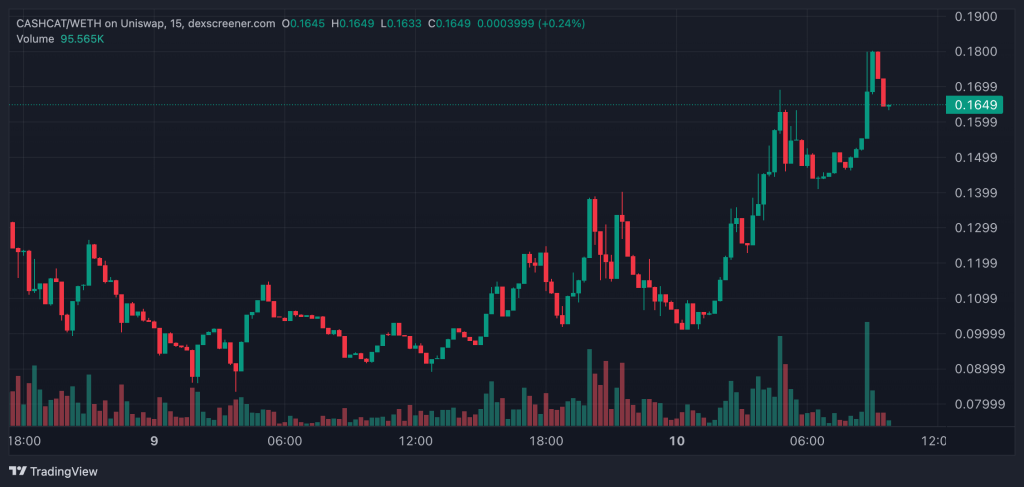
It was a memecoin called CASHCAT, a cat token that emerged organically on the new chain and alone accounted for roughly $98 million of the $560–$570 million total.

Discover: The Best Token Presales

A Cat Token Drives a Record-Breaking DEX Day

Robinhood Chain launched on July 1 as a permissionless Ethereum Layer-2 network built on the Arbitrum stack, integrating Uniswap for trading, Chainlink for price oracles, and Morpho for lending.

Because the chain is fully permissionless, anyone can deploy a token and spin up a trading pair, which is precisely how CASHCAT appeared, trading against WETH on Uniswap pairs with no corporate announcement behind it.

CASHCAT hit an all-time high above $0.17, with its market cap ballooning to somewhere between $100 million and $170 million in a single session.

Source: DexScreener

The token’s price action generated approximately $98 million in 24-hour volume on its own, about 17% of Robinhood Chain’s entire daily DEX figure. Strip that out, and the chain’s number drops significantly, though the remainder still represents substantial activity for a seven-day-old network.

Daily active addresses on Robinhood Chain approached 200,000 on July 8, with more than 140,000 of those being first-time users. That onboarding rate signals genuine demand pull, not just existing DeFi participants rotating between chains. Whether those users stay once the memecoin cycle fades is the operative question.

Discover: The Best Crypto to Diversify Your Portfolio

TVL Composition Is the More Durable Signal

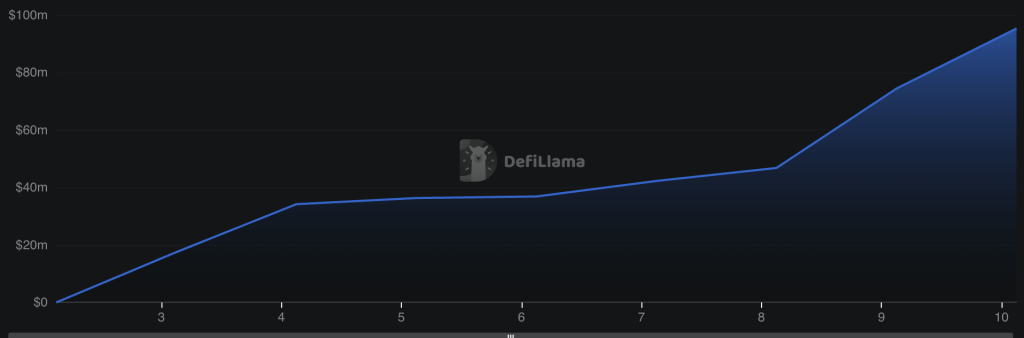
The chain’s TVL crossed $100 million within its first week, and the primary driver was Morpho lending activity, not speculative token positions.

That distinction matters. Lending TVL reflects users deploying capital for yield under structured terms, which carries different retention characteristics than liquidity posted purely to support a memecoin trading pair. It does not confirm long-term DeFi adoption, but it is a structurally different signal than raw trading volume.

Source: Robinhood Chain TVL / DefiLlama

Trading volumes have already begun stabilizing below the July 8 peak, according to the primary source. That is expected behavior after a memecoin-driven spike – the question is what the floor looks like once CASHCAT volatility normalizes.

The lending TVL figure suggests at least some portion of the user base arrived with yield-seeking intent rather than pure speculation, which gives Robinhood Chain a non-trivial base to build from.

For context on the scale of what Robinhood Chain briefly displaced: Hyperliquid had accumulated $330.8 billion in combined spot and perpetual trading volume by July 2025 and entered the top 10 global derivatives exchanges by volume, a first for any DEX.

Robinhood’s own crypto trading arm had sat at $237.8 billion over the same period, meaning Hyperliquid had been outpacing Robinhood’s crypto business for months before the chain launched. The reversal, even if partly memecoin-driven, is not a trivial data point.

Don’t Miss Out on Our $1,000 USDT Airdrop on ByBit

Ethereum Price Prediction: Tom Lee Predicts $5 Trillion Ethereum

Ethereum price prediction is back in focus after Fundstrat co-founder Tom Lee floated a $5 trillion network valuation. ETH trades near $1,740, leaving it valued at around $210 billion. That puts Lee’s target 24 times above today’s level. Big swing, small ask, right?

Speaking on the New Era Finance podcast, Lee argued Ethereum remains undervalued compared with the markets it could eventually support. He pointed to gold at roughly $22 trillion, global equities above $100 trillion, and real estate near $300 trillion. His view is that more of those assets will migrate on-chain over time.

Lee also tied that thesis to tokenization and AI infrastructure, where Ethereum could serve as the main settlement layer. The comments fit with BitMine’s growing Ethereum treasury strategy, a stance Lee has supported for some time. If ETH’s circulating supply stays near 121 million coins, a $5 trillion valuation implies a price close to $41,300.

Of course, reaching that level is another story entirely. Macro conditions, regulation, and institutional demand still drive Ethereum’s price in the near term. Until those pieces line up, traders may care more about the next resistance level than a target that belongs several zip codes away.

Don’t Miss Out on Our $1,000 USDT Airdrop on ByBit

Ethereum Price Prediction: Can it Even Break $2,000 Before the Next Macro?Catalyst?

Ethereum still well below $2,000, is putting the price prediction debate on a knife’s edge. Buyers have defended this area, although conviction still needs proof. Volume remains healthy, showing traders have not wandered off for coffee just yet.

The $1,750 to $1,770 zone remains the first level worth watching. If ETH reclaims and holds above it, momentum could build toward resistance between $1,845 and $1,865. Beyond that, the $1,975 to $2,000 range is the real test, where sellers have previously shown up in force.

The bullish case stays intact while Ethereum holds above roughly $1,725. A pickup in buying volume could send ETH back toward $1,865 over the coming sessions. Otherwise, the market may continue shuffling sideways between $1,730 and $1,850, waiting for a fresh catalyst instead of making the first move.

Ethereum (ETH)
24h7d30d1yAll time

If ETH closes decisively below $1,725, the technical picture weakens. That could expose support near $1,620, with $1,530 becoming possible if selling accelerates. On chain activity, including Ethereum supply trends and stablecoin flows, may influence which path the market ultimately takes.

Tom Lee’s implied $41,000 target remains a long term thesis rather than a near term trading call. The idea depends on tokenized real world assets driving greater demand across Ethereum’s network. Until that story plays out, investors may need patience because markets rarely sprint in a straight line.

Discover: The Best Token Presales

Bitcoin Hyper Targets Early-Mover Upside While Ethereum Consolidates

ETH at $1,740 is a long way from $41,000. Even the optimistic near-term target of $2,000 represents a 15% move from here. It’s real, but modest relative to where early-stage infrastructure can move.

Ethereum’s scale also means its market cap needs tens of billions in new inflows to move the needle meaningfully. For traders who believe in the on-chain infrastructure thesis but want asymmetric exposure, the math on a $210 billion asset is structurally different from an early-stage presale.

Bitcoin Hyper ($HYPER) is positioning as the first Bitcoin Layer 2 with Solana Virtual Machine (SVM) integration, a combination that targets Bitcoin’s core limitations: slow throughput, high fees, and minimal programmability.

The project has raised $33 million at a current token price of $0.0136829, with a staking mechanism offering high APY for early participants. The SVM integration is the technical differentiator, bringing smart contract performance comparable to Solana while settling on Bitcoin’s security layer.

If the on-chain infrastructure buildout Lee describes actually accelerates, the picks-and-shovels layer — fast, programmable, Bitcoin-secured, is where early capital tends to concentrate.

Research Bitcoin Hyper before the presale closes.

Discover: The Best Crypto to Diversify Your Portfolio

Bitcoin Price Prediction: Overlooked Indicator Gives the Bear Market 3 Months Left

Bitcoin is trading near $62,950 after gaining about 1.7% over the past 24 hours, but the latest price prediction is looking well beyond today’s bounce. Some traders are watching a recurring 91-day window that previously marked the final stage of several bear markets. If history rhymes again, the real fireworks may come later, not today.

The recent break below a multi-month symmetrical triangle triggered heavy liquidations before BTC clawed back above $61,500. That sharp flush shook out leveraged positions, yet buyers quickly stepped in. Sometimes the market loves scaring everyone before asking them back to the party.

Meanwhile, mining difficulty fell by roughly 10% during June, marking another notable downward adjustment this year. Similar moves have often appeared near major cycle turning points as weaker miners exit. On top of that, both linear regression and logarithmic Fibonacci analysis identify the $47,000 area as a possible downside target.

Even so, no model guarantees Bitcoin will revisit that level. Technical projections work best as probability maps, not crystal balls. If momentum strengthens and demand keeps improving, the market could ignore that target altogether.

For now, leverage has cooled while ETF flows have become steadier after earlier swings. At the same time, macro uncertainty continues to keep traders cautious. The next three months may decide whether Bitcoin builds a durable base or delivers one last shakeout before the trend changes.

Don’t Miss Out on Our $1,000 USDT Airdrop on ByBit

Bitcoin Price Prediction: Can it Recover From Here, or Is $47K Still on the Table?

Bitcoin is trading around $62,500, after bouncing between roughly $61,700 and $62,600 over the past day. Volume has cooled from the recent liquidation wave, suggesting traders are catching their breath rather than rushing back in.

Resistance remains clustered between $63,000 and $65,000, where recent rallies have repeatedly lost steam. Meanwhile, $60,000 continues to act as the line bulls would rather not cross. It has absorbed selling pressure before, and traders would like it to keep that reputation.

Ethereum (ETH)
24h7d30d1yAll time

The 91 day bear market framework still deserves attention. Historically, this final stretch has produced the sharpest declines before a lasting bottom forms. Bitcoin remains about 50% below its October 2025 all-time high near $126,000, putting the current drawdown in line with previous cycles. History does not repeat perfectly, but it certainly enjoys familiar plot twists.

If buyers reclaim $65,000 with convincing volume, the recent breakdown could prove to be another bear trap. Otherwise, the more likely path is continued trading between $58,000 and $65,000, with a possible final washout toward $47,000 to $52,000 later in the cycle. A sustained close below $58,000 would weaken that outlook and could bring the bottom forward sooner than expected.

Discover: The Best Token Presales

Bitcoin Hyper Eyes Early Positioning as BTC Navigates Its Most Punishing Quarter

When Bitcoin enters its historically most volatile quarterly window, experienced traders often look beyond spot BTC for asymmetric positioning, particularly in early-stage infrastructure plays tied directly to Bitcoin’s ecosystem. The logic isn’t complicated: if BTC ultimately confirms a cycle floor in this window, the projects building on top of it tend to reprice faster than the asset itself on the way back up.

For those watching broader bearish BTC market dynamics, the rotation argument is straightforward.

Bitcoin Hyper ($HYPER) is currently in presale at $0.0136829, having raised almost $33 million to date. The project positions itself as the first Bitcoin Layer 2 with Solana Virtual Machine (SVM) integration, targeting the transaction speed and smart contract functionality that Bitcoin’s base layer structurally cannot provide, while preserving Bitcoin’s security model.

A Decentralized Canonical Bridge handles BTC transfers natively, and staking is live with high APY for early participants. As with any presale, liquidity is absent until listing, and the token price is speculative.

Those who want to research Bitcoin Hyper further can review the full documentation before committing capital.

Discover: The Best Crypto to Diversify Your Portfolio

XRP Price Prediction: Judge in XRP Ruling Delivers Fresh Blow

Federal Judge Analisa Torres, the architect of XRP’s landmark 2023 securities ruling, has handed down another closely watched decision, leaving XRP price prediction debates wide open as the token trades at $1.09. The market is showing little urgency, with traders waiting for the legal dust to settle before making bigger moves.

Torres is best known for her July 2023 split ruling in the SEC’s case against Ripple. She found that programmatic XRP sales on exchanges were not securities, while institutional sales qualified as investment contracts. That decision became one of crypto’s most cited legal precedents. Even after the SEC and Ripple settled in 2025, her opinions still carry weight.

Her latest ruling comes from a different case, yet traders are reading between the lines anyway. Crypto markets have a habit of connecting dots, sometimes before the ink dries. Whether that reaction sticks depends on how regulators and courts interpret the decision in the months ahead.

For now, XRP continues to hold its chart structure despite the legal headlines. Price action remains relatively steady, but conviction is still in short supply. As always, the market loves certainty, and right now it is getting another legal puzzle instead of a clear answer.

Discover: The Best Token Presales

XRP Price Prediction: Recover Above $1.2 This Week?

XRP has been holding between $1.07 and $1.10 over the past 24 hours, reflecting a market that still lacks a clear winner. The past week’s range stretches from roughly $1.05 to $1.16, leaving support and resistance well defined. Traders are waiting for a catalyst, and so far, the chart has offered little more than a shrug.

Recent Ripple partnership headlines have done little to shake XRP out of that range. Sometimes good news knocks politely instead of kicking the door down. Even so, the series of higher lows remains intact, keeping buyers interested while preventing sellers from taking full control.

Xrp (XRP)
24h7d30d1yAll time

A bullish scenario starts with XRP defending the $1.05 to $1.07 support zone before reclaiming $1.16. A convincing breakout could then open the door to $1.25, where previous selling pressure emerged. That would finally give bulls something more exciting than another day of sideways candles.

The base case remains continued consolidation between $1.07 and $1.16 until a legal or macro catalyst tips the balance. On the flip side, a decisive close below $1.05 would weaken the current structure. If that happens, traders could begin watching the $1.00 area as the next meaningful support.

Don’t Miss Out on Our $1,000 USDT Airdrop on ByBit

LiquidChain Targets Early-Mover Upside as XRP Tests Key Levels

XRP trading sideways around $1.10, after a multi-year legal saga and a settlement that already priced in the good news, raises a fair question: where does the asymmetric upside actually come from here? Established large-caps with resolved regulatory overhangs tend to grind, not explode.

Traders looking for early-stage exposure with a different risk/reward profile are rotating attention toward infrastructure presales.

LiquidChain ($LIQUID) is a Layer 3 infrastructure project built around a single thesis: fragmented liquidity across Bitcoin, Ethereum, and Solana is the primary friction point in cross-chain DeFi.

Its Unified Liquidity Layer fuses all three ecosystems into a single execution environment, with Single-Step Execution, Verifiable Settlement, and a Deploy-Once Architecture that lets developers access BTC, ETH, and SOL liquidity without redeploying per chain.

The presale is currently priced at $0.01478 per $LIQUID, with $890K raised to date. For traders who want to assess the technical architecture before committing capital, research LiquidChain here.

Discover: The Best Crypto to Diversify Your Portfolio

Crypto News, July 10: Regulation Overtakes Geopolitics as Bitcoin and Ethereum Price Hold Firm

For us, who spent the past month glued to oil charts, the screens have changed. Now we’re refreshing congressional calendars instead. Crypto regulation, not missiles nor crude price, is becoming the biggest talking point as Bitcoin and Ethereum price continue to hold steady. Policy has become the market’s new obsession.

Although Middle East headlines still grab attention, crypto is now spending more time debating legislation, SEC guidance, and CFTC oversight. For now, politics in Washington seems to matter more than politics in the Gulf.

Don’t Miss Out on Our $1,000 USDT Airdrop on ByBit

Bitcoin Price Holds Up as Markets Await Policy Clarity

Bitcoin (BTC)
24h7d30d1yAll time

Bitcoin price is holding at the mid-$63,000 range after recovering from June’s selloff. Softer U.S. economic data and easing energy prices have helped improve risk sentiment, while ETF flows remain mixed. Buyers continue stepping in on dips, as institutions remain willing to accumulate despite short-term uncertainty.

Attention is already turning to upcoming inflation data and the Federal Reserve’s next meeting. A cooler CPI reading could give the Bitcoin price another push, but many traders believe Washington will ultimately have the bigger say.

That is because crypto regulation is moving unusually fast. Congress continues debating the CLARITY Act, while regulators are working toward clearer rules on digital assets after years of uncertainty. The SEC and CFTC have already issued joint guidance aimed at defining how crypto assets should be treated under federal law.

Discover: The Best Token Presales

Ethereum Price Finds Support Beyond ETF Headlines

Ethereum (ETH)
24h7d30d1yAll time

Ethereum price remains under pressure compared with earlier this year, but the network itself grows. Layer 2 activity, tokenized assets, and decentralized finance are all expanding even while ETH trades sideways.

ETF flows have swung between inflows and outflows, yet developers have largely ignored the day-to-day noise. Instead, they remain focused on scaling Ethereum and attracting more onchain activity. It is not exactly headline-grabbing, but builders rarely care whether traders are having a good week.

Crypto regulation has overtaken geopolitics as the market catalyst, with Bitcoin and Ethereum price holding steady ahead of policy decisions.

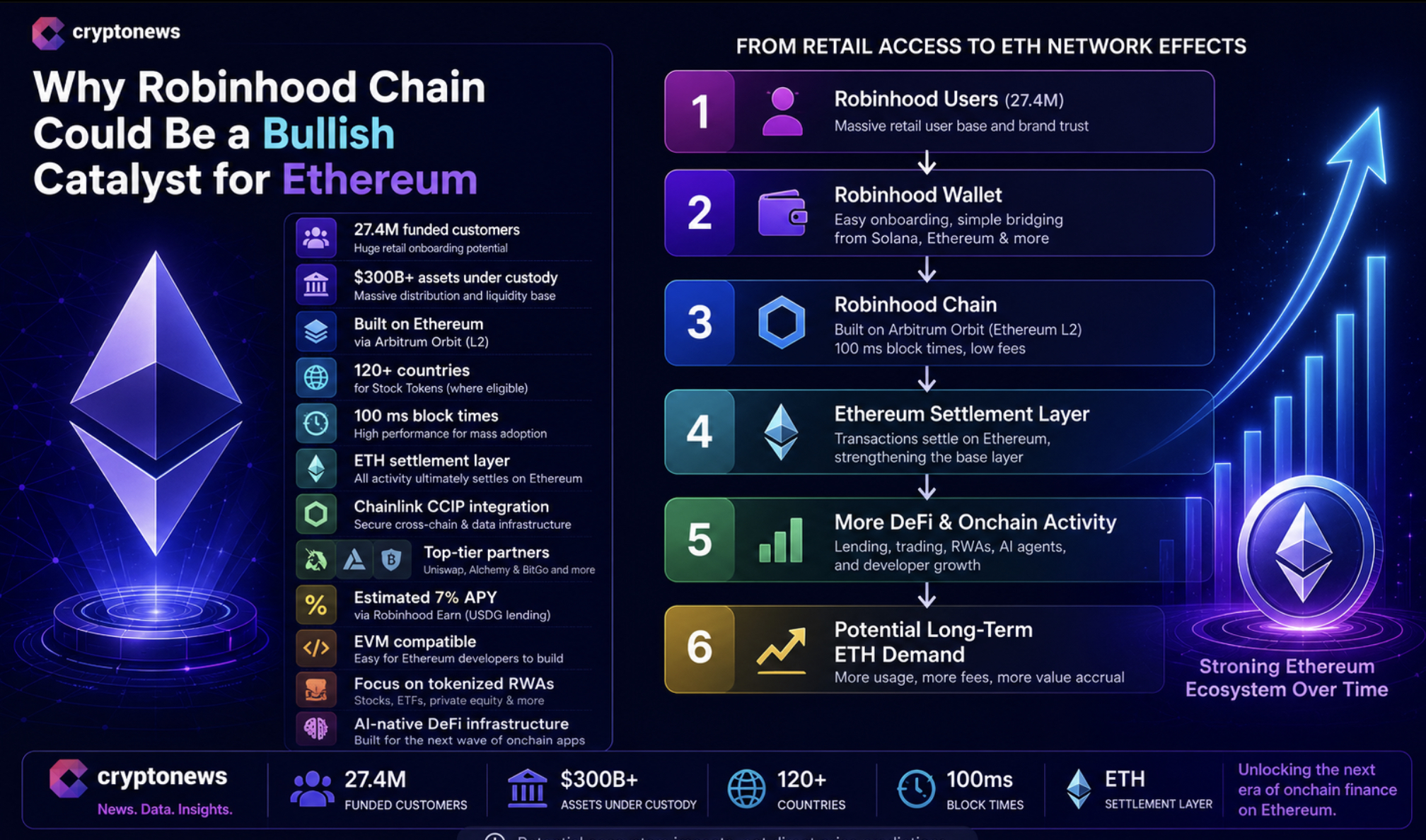
Robinhood Chain may not move the Ethereum price overnight, but it could quietly strengthen the network over time. Built as an Ethereum Layer 2 using Arbitrum Orbit, the chain settles transactions back to Ethereum and uses ETH for gas. This brings activity and ultimately feeds into Ethereum’s ecosystem.

The Ethereum price could also benefit if lawmakers deliver clearer rules for decentralized finance. Several industry groups continue urging regulators to create frameworks tailored to DeFi instead of squeezing it into decades-old financial rules. It’s looking bright for Ethereum price.

Discover: The Best Crypto to Diversify Your Portfolio

Crypto Regulation Is the Market’s New Catalyst

The biggest shift is psychological. A few weeks ago, people jumped at every geopolitical headline. Now they are dissecting committee schedules, regulatory guidance, and draft legislation with the same intensity.

That helps explain why Bitcoin and Ethereum price have held relatively resilient despite ongoing global tensions. Investors increasingly believe clearer rules could encourage fresh institutional capital, especially if Congress finally delivers long-awaited market structure legislation.

It’s becoming more obvious now, crypto regulation has replaced geopolitics as market’s conversation, and both the Bitcoin and Ethereum price are taking their cues from Washington more than the latest oil headline.

Don’t Miss Out on Our $1,000 USDT Airdrop on ByBit

Ethereum Crypto Resilience Proved as ETH Defends $1,700 While Cross-Chain Innovator LiquidChain Nears $1M

The global cryptocurrency market is demonstrating remarkable stability in the face of macroeconomic and geopolitical headwinds. Following escalated tensions between the US and Iran and the end of the previous ceasefire, traditional financial markets experienced brief volatility. However, the Ethereum crypto ecosystem and major digital assets have held their ground firmly, showcasing the mature resilience of blockchain technology.

Specifically, Ethereum has successfully defended its crucial $1,700 support zone, trading up 1.7% at approximately $1,750. Bitcoin has mirrored this steady performance, holding its position near $63,000 with a 1.8% daily gain. Amid this supportive market backdrop, a new interoperability-focused network called LiquidChain (LIQUID) is gaining momentum, with its presale crossing the $891,000 mark as it closes in on $1 million.

Ethereum Crypto Inflows Surge Amid Broader Market Stability

Institutional interest in the top altcoin remains highly robust. Spot Ethereum ETFs recorded $70.48 million in net inflows yesterday, marking their fifth consecutive day of positive momentum. This consistent institutional demand, combined with Bitcoin maintaining its footing above the $61,000 level (currently trading around $62,900), highlights the growing strength of the digital asset sector even as the US-Iran ceasefire is over.

This stable environment provides an ideal launchpad for utility-driven projects. Rather than relying on short-term speculation, LiquidChain is focusing on resolving one of the most persistent technical challenges in Web3: blockchain fragmentation.

Unifying Ethereum, Bitcoin, and Solana

For many users, navigating the decentralized web is a fragmented experience. Major networks like Bitcoin, Ethereum, and Solana function as isolated ecosystems with distinct rules and native currencies. Moving liquidity between these networks historically required complex bridging procedures, wrapped assets, or high transaction fees.

To address this, LiquidChain (LIQUID) is developing a Layer 3 network designed to act as a universal liquidity and data bridge. By securely verifying transactions across all three major blockchains simultaneously, the protocol allows developers to build cross-chain applications that offer users lower fees, faster execution, and a simplified user experience.

Currently in Stage 83 of its presale, LIQUID tokens are available at an entry price of $0.01478. Early participants who opt to stake their tokens during this phase can access an APY of 1,258%, allowing them to grow their holdings as the network’s infrastructure is built out.

How to Participate in the LIQUID Presale

For those interested in exploring the project, the process is designed to be accessible and straightforward. Interested users can visit the official LiquidChain website to view the roadmap and participate in the presale.

The presale supports popular Web3 wallets, including Best Wallet, which lists the LiquidChain presale directly under its “Upcoming Tokens” tab. Best Wallet can be downloaded for free from the Apple App Store or Google Play.

Transactions can be completed using major cryptocurrencies such as ETH, SOL, BTC, BNB, USDT, or USDC, as well as standard bank cards for direct fiat purchases. To stay updated on technical developments and community announcements, users can follow LiquidChain’s X account and join their Telegram group.

Visit LiquidChain.

Criminal Complaint Against Circle Puts USDC Freeze Policy Under a Microscope

A criminal complaint filed by Wisconsin prosecutors against Circle, the company behind USDC, has put an uncomfortable question back in the spotlight. Why does the world’s second-largest stablecoin issuer appear far less willing than Tether to help law enforcement recover stolen crypto?

An ICIJ investigation published on July 8 points to three issues driving the debate. Circle insists it only freezes funds after receiving valid legal orders, disputes claims it can simply burn and reissue stolen tokens, and rejects allegations from New York prosecutors that it profits by leaving frozen assets untouched. Meanwhile, critics say that the policy leaves scam victims waiting while their money disappears.

A statue of Lady Justice holding scales in front of a window.

The case started with a romance scam in Walworth County, Wisconsin. A resident identified only as “Victim #1” was convinced to buy USDC and send about 381,000 tokens to what turned out to be a fake investment platform. After investigators traced the funds, a judge ordered Circle to freeze the wallet. The company did so without delay.

Months later, the court took the next step. It ordered Circle to invalidate those frozen tokens and issue the same amount of fresh USDC to the Walworth County Sheriff’s Office. Circle refused, saying it does not have the technical ability to burn and reissue USDC held inside someone else’s wallet. Prosecutors responded with a criminal complaint, an unusual move against a company of Circle’s size.

Circle later asked the court to dismiss the case. It argued the Wisconsin court lacked jurisdiction and said prosecutors ignored alternative proposals it had offered to compensate the victim. Walworth County prosecutor Thomas Binger said the dispute shows how quickly scammers can move funds compared with the pace of the legal system.

The Wisconsin case is not the only one raising questions. Earlier this year, New York prosecutors told U.S. senators that Circle generally requires court orders before freezing USDC and has not consistently returned stolen funds after courts approved their release. Since stablecoin transfers settle within seconds, investigators argue valuable time is often lost before legal paperwork is complete.

Discover: The Best Crypto to Diversify Your Portfolio

The Debate Over Frozen Funds

New York prosecutors also made a more serious allegation. They argued Circle continues earning interest on reserve assets backing frozen USDC, giving the company little financial incentive to return those funds quickly. Circle has not accepted that claim.

Blockchain researcher Yury Serov estimates that at least 119 million USDC is currently frozen. Those tokens cannot move, but they remain backed by reserve assets unless another process removes them permanently.

Circle cryptocurrency logo with stylized dollar coins on a blue gradient background.

Circle’s technical explanation has also drawn criticism. Joshua Cooper-Duckett of Cryptoforensic Investigators told ICIJ the company could update its smart contracts to support burning and reissuing tokens held in third-party wallets. Circle did not answer when asked whether it could make those changes.

One detail from the court filings caught investigators’ attention. Circle disclosed it had already discussed a victim compensation process with federal prosecutors that involved permanently freezing stolen tokens before issuing replacement USDC. The company did not explain whether that arrangement applies outside federal cases.

Discover: The Best Token Presales

Circle USDC vs. Tether’s Model and the 30x Gap

The difference between Circle and Tether is hard to ignore. AMLBot data shows Tether froze about $3.3 billion in USDT across more than 7,200 wallets between 2023 and 2025. Circle froze about $109 million in USDC over the same period, a 30 times gap by value.

Part of that difference comes from Tether’s burn and reissue process. After freezing stolen USDT, the company can destroy those tokens and issue clean replacements to law enforcement or victims.

A Wisconsin criminal complaint against Circle reveals how USDC court-order policy leaves scam victims behind, while Tether acts 30x faster.

Tether says it has already reissued around $1.1 billion and frozen $4.7 billion linked to illicit activity. Circle does not currently offer the same public process for third-party wallets, although its court filings show it has discussed similar arrangements with federal authorities.

The companies also draw the line in different places. Tether has said it sometimes acts before courts become involved if law enforcement requests help. Circle says it only responds through formal legal process, arguing that the approach protects users from wrongful or politically motivated freezes. Investigators counter that by the time those orders arrive, stolen crypto is often long gone.

Milwaukee County detective Scott Simons told ICIJ he has worked on more than a dozen cases where Circle either declined an early freeze request or where the court order came too late. For many victims, he said, the answer is simply that the money is gone.

Don’t Miss Out on Our $1,000 USDT Airdrop on ByBit