

Binance outpaces Tron in rising USDT transfers – Here’s why it matters
From flows to TVL: BNB emerges as a stronger L1 contender.


Key Takeaways
BNB’s USDT transfer volume has jumped past 20%. What does this development mean for BNB’s on-chain adoption?
Tron [TRX] still commands 48.69% of Tether [USDT] flows, with Ethereum [ETH] at 42.23% and Binance Chain [BSC] trailing at 4.06%. This means Tron is attracting most on-chain liquidity.
But does it align with actual on-chain usage? According to AMBCrypto, that divergence could be what’s setting up Binance Coin [BNB] to flex as a serious L1 contender.
BNB chain gains traction in USDT transfers
USDT drives 60%+ of stablecoin activity, serving as the main liquidity rail.
According to Glassnode, since Q4 2022, Tron has dominated USDT transfer volume with over 50% share, Ethereum has hovered above 20%, and other chains collectively captured less than 30%.
Lately, Tron’s share has slipped to 45%, BNB jumped past 20%, and Ethereum reclaimed >30%. And these numbers are based on the 30-day MA of on-chain USDT transfers, so we’re looking at sustained flow shifts.
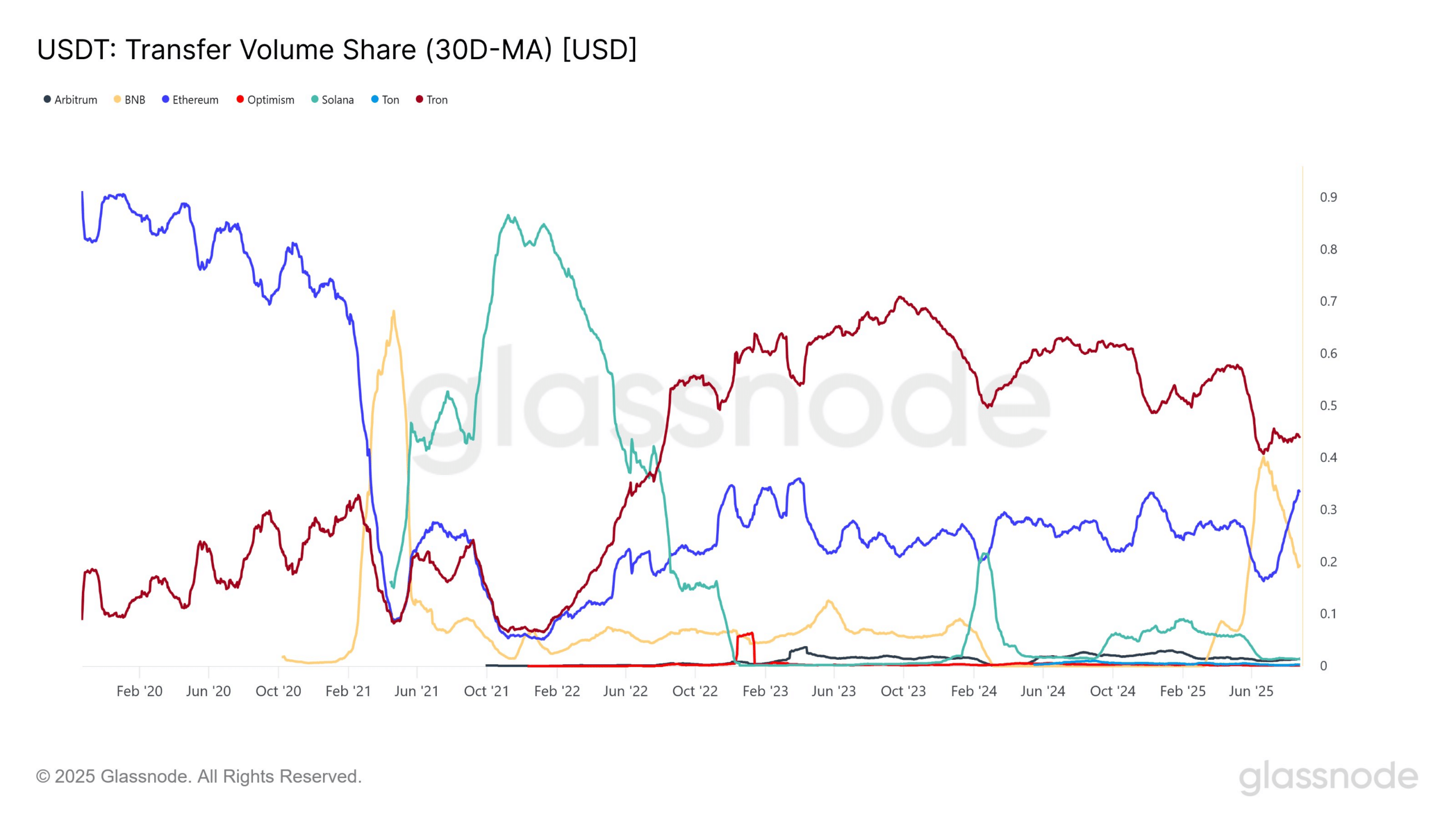
Simply put, BNB’s jump in USDT transfer volume shows it’s capturing a larger portion of stablecoin flows “on-chain.” Even with only 4% USDT dominance, capital is increasingly routing through BSC.
Why does it matter? Stablecoins aren’t just a “safe haven” during risk-off flows. They’re the liquidity engine powering DeFi activity, on-chain tx volume, and settlement rails across protocols.
Against this backdrop, rising USDT transfer volume on BSC is a subtle signal that BNB is flexing as an L1 settlement layer. In turn, hinting at the chain’s on-chain repositioning and growing network relevance.
On-chain flows signal BSC repositioning
With USDT flows shifting, it’s worth tracking where liquidity lands.
Since Q3 started, Tron’s Total Value Locked [TVL] ticked up from $5 billion to $6.2 billion, marking a 24% increase. Meanwhile, BSC’s popped from $6 billion to $7.8 billion, a 30% jump.
In this context, BNB is driving deeper on-chain capital deployment, acting as sideline liquidity when markets flip risk-on.
Backing this up, TRX delivered 23.3% ROI over the same window, while BNB came in at 28.41%.

The outcome? TRX/BNB hit its first red quarterly candle since Q1 2024.
On-chain metrics back it up: BSC’s daily active addresses are up 17% over three months to 226k, while Tron is down 0.7%. Clearly, rising USDT transfer volume on BSC is driving tangible network adoption.
Taken together, these shifts highlight growing on-chain momentum, positioning BSC as a credible L1 contender, and BNB as a key liquidity and settlement engine in the ecosystem.


