Executive Summary
The crypto market has continued to evolve significantly over the last year, with investment strategies in this space becoming increasingly more sophisticated. The maturation of these markets is reflected not only in improvements to liquidity and infrastructure but also in the broader set of financial instruments now available for trading and investment purposes. From spot markets to derivatives, traditional platforms to blockchain-based protocols, the advances in this industry have ushered in a wide array of products and tools for practitioners.
For BTC and ETH specifically, institutional players can now gain exposure through spot, fixed-term futures, perpetual futures, options, exchange-traded products (ETPs/ETFs) and equity proxies, among others. Perpetual futures have remained the largest venue for crypto trading activity globally by a wide margin, though this activity has historically been concentrated outside the U.S. While U.S.-regulated perpetual-style futures have emerged, they remain small relative to the offshore perpetual futures market and are best viewed, for now, as an incremental expansion of the domestic toolkit rather than a direct substitute for global perps liquidity.
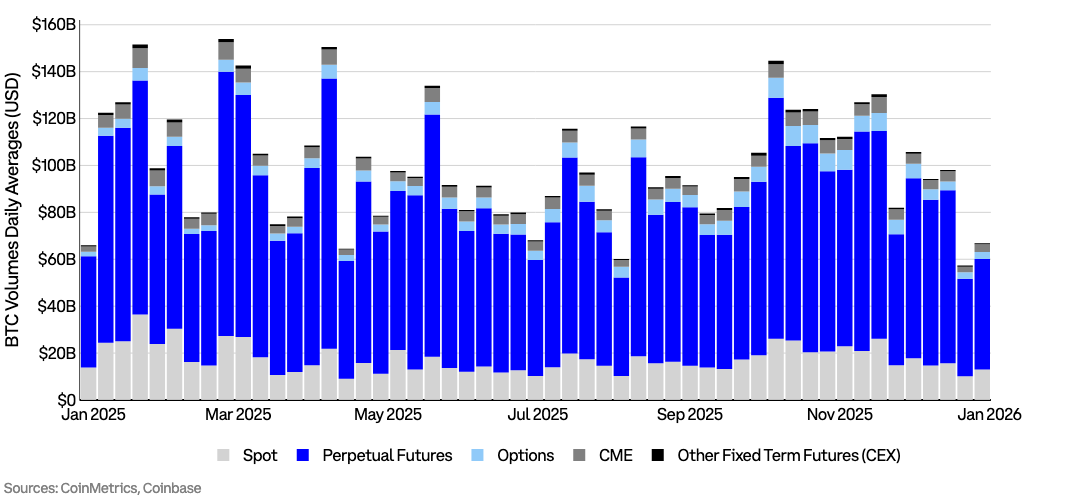
Meanwhile, spot bitcoin ETFs have become a firmly established access point for traditional investors, helping deepen institutional participation through regulated wrappers and familiar brokerage infrastructure. At the same time, the market backdrop in 2025 and early 2026 highlighted several of the defining features of institutional crypto adoption: ETF flows became an increasingly important driver of market direction, listed options on ETF products expanded the hedging toolkit available to investors, and bitcoin treasury strategies gained further visibility as a corporate capital markets approach.
In our view, the convergence of these trends marks a new phase for institutional crypto markets. In this report, we analyze the various products available to institutional investors by comparing their efficiency, size, costs and tradeoffs as well as examining the market dynamics shaping their adoption.
How Institutions Access Crypto
Institutional participation in the crypto asset class has matured significantly, moving beyond specialized funds to encompass major financial players. Access points have broadened, offering avenues for directional exposure, yield generation, hedging, and basis trading across regulated and offshore venues. Below is a truncated view of the primary methods that institutions can utilize to engage with crypto:
On-Exchange Spot. This method is characterized by direct engagement with the underlying assets (BTC, ETH, etc.), which involves direct trading on U.S.‑regulated exchanges (e.g., Coinbase). This adheres to Know Your Customer (KYC) and Anti-Money Laundering (AML) protocols, deep onshore liquidity, and look‑through to global liquidity via market makers, who bridge the gap to global liquidity by dynamically hedging their U.S.-based spot exposure using offshore perpetual futures and term futures markets.
Listed Funds (Exchange Traded Funds or Products). There are currently 11 Exchange-Traded Products (ETPs) based on the spot price of BTC and 9 ETPs based on the spot price of ETH. These are listed and traded on major US exchanges (NYSE Arca, Nasdaq, and Cboe). These vehicles allow institutions to gain direct price exposure to BTC and ETH without the complexities of direct asset custody.
Perpetual Futures (Perpetual-Style Futures). Perpetual futures contracts are a hallmark of crypto derivatives, offering a mechanism to trade a derivative contract that never expires. Offshore perps plus new CFTC‑regulated perp‑style futures in the U.S. (Coinbase Derivatives Exchange) offer 24/7 trading with funding‑rate mechanics that deliver leveraged exposure anchored to spot. The funding rate mechanism is the core of the perp contract, representing small periodic payments between long and short contract holders to ensure the perp contract price remains tightly anchored to the underlying spot price.
Exchange-Traded Term Futures. These are traditional, fixed-maturity futures contracts with defined expiration dates used across nearly every asset class, and now applied to digital assets. CFTC‑regulated fixed‑maturity futures on CME (operating around 23 hours a day, five days a week) and Coinbase Derivatives (24/7) are used for directional, basis and hedging trades, cleared via Futures Commission Merchants (FCMs) and Central Counterparties (CCPs) such as Nodal Clear.
Options. Options provide the right, but not the obligation, to buy or sell an asset, offering institutions the tools to manage risk, generate premium income, and execute volatility strategies. This category includes listed options on BTC and ETH futures (e.g., CME), offshore spot options (e.g., Deribit, which was acquired by Coinbase in August 2025), and listed options on spot bitcoin ETFs on NYSE and Cboe, enabling equity‑style vol and income strategies.
Equity Proxies. Many institutions choose to gain indirect crypto exposure by investing in publicly traded companies whose success is intrinsically tied to the crypto ecosystem, as these can be easily integrated into existing portfolios. Traditional equity portfolios can integrate crypto market exposure (beta) through publicly traded companies such as listed exchanged-traded crypto companies, bitcoin miners, and digital-asset treasury firms (DATs). These securities offer the advantage of being tradable and financeable within established equity prime brokerage frameworks.
Download the full report here


