


 Written by Ayse Karamanstaff writerReviewed by Erhan Kahramanstaff editor
Tokenized RWAs get an agent-ready research layer with a new protocol
SponsoredPublishedJul 30, 2026
The protocol gives AI agents structured RWA data to assess tokenized assets, track issuer changes and identify available trading routes.
Sponsored byRealmint
Artificial intelligence is gaining ground across the cryptocurrency industry each day. AI-related onchain activity rose 86% between January and June 2025, reaching an estimated 4.5 million daily unique active wallets. Over the same period, AI applications’ share of overall DApp activity increased from 9% to 19%.
Agents, one of the strongest use cases of this technology, can analyze market information thoroughly and carry out financial actions with limited human input. Their growing role is already visible across crypto. AI agents moved from 17th place in 2024 to third place in 2025 among the industry’s most-followed narratives, while more than 420,000 agent identities have now been registered onchain.
RWAs remain difficult for agents
Agentic finance has the potential to advance the real-world asset (RWA) industry as well. Getting involved with an RWA presents problems from the start. Unified marketplace are limited, making asset discovery across different protocols a major pain point.
It also traditionally requires a lengthy review process beforehand, as buyers must consider factors such as issuer identity, jurisdiction, contract parameters and token routability.
Agents can undertake the review task on behalf of buyers and offer a faster and more comprehensive process. However, its capabilities are seriously limited in the RWA space because a structured, agent-native data source is lacking.
Agents are forced to scrape unstructured text, guess at contract parameters and rely on stale data. As a result, an industry worth $30 billion and growing 266% annually remains largely inaccessible to the agentic layer of crypto.
Agents receive structured RWA data
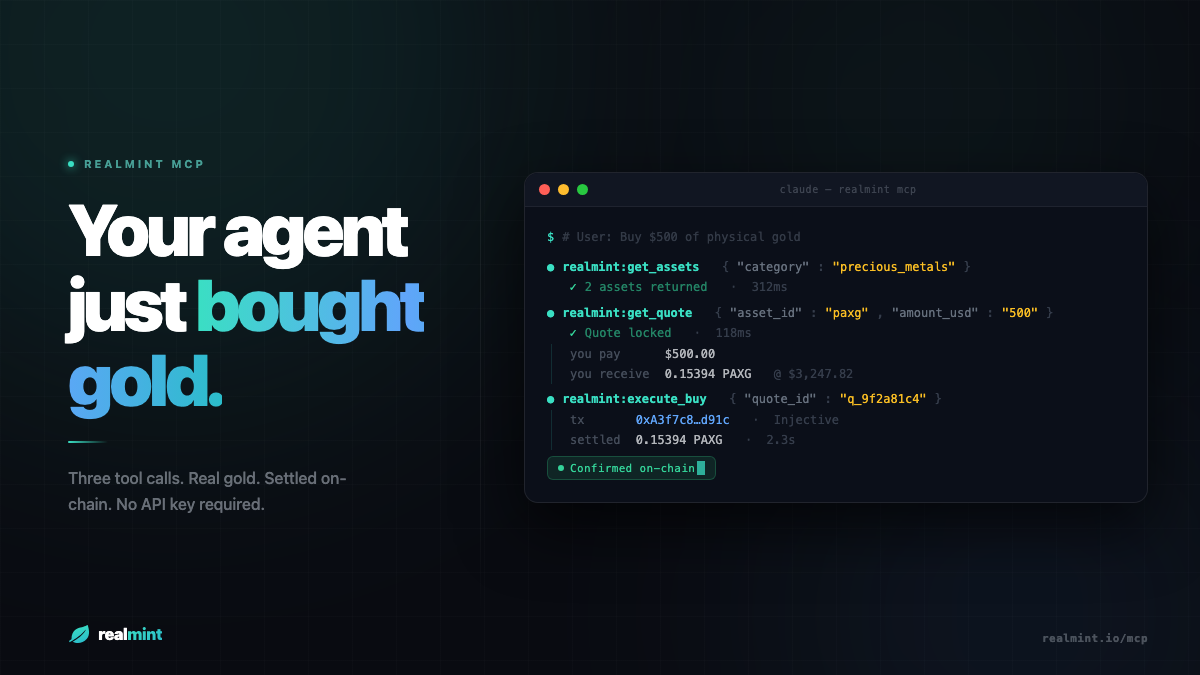
Realmint, an RWA marketplace, has introduced a Model Context Protocol (MCP) server to provide the agent-native infrastructure the RWA market currently lacks. MCP allows an AI assistant to access external services through structured requests. In practice, it gives connected agents direct access to Realmint’s research tools without requiring them to browse websites or extract details from lengthy documents.
The marketplace indexes more than 3,000 tokenized assets among collectibles, commodities and stocks. An agent can use the public tools to identify the issuer and jurisdiction. It can also review the rights or restrictions attached to an asset, retrieve live market information and determine whether a supported trading route is available.
Realmint assigns each asset a score from 0 to 100 based on six areas covering liquidity, backing, exit rights and issuer controls, among other factors. A higher score indicates a stronger overall profile, but does not guarantee performance. Scores of 75 or above fall within the standard range, while a result between 55 and 74 signals elevated risk and calls for closer review. Anything below 55 is treated as high risk and may require the agent to stop unless the user explicitly overrides it.
The scores update as the underlying information changes and give agents a current research input rather than a one-time assessment. Realmint describes the scores as experimental, as its methodology is still being refined and may change as the model develops.
Changes beyond the price chart
Some of the most important RWA developments do not immediately affect market prices. An issuer may gain the ability to freeze wallets or tighten redemption conditions. The law governing an asset may also change. Realmint stores earlier versions of asset information, allowing an agent to compare them and flag material updates.
This turns due diligence into an ongoing process. An agent managing a position could continue checking whether the conditions behind an asset have changed after purchase, using information that extends beyond the initial review.
Users in charge of agent autonomy
Realmint’s public connection is read-only, which means an agent can research assets without receiving permission to move funds. Authenticated agents can also deposit, trade and withdraw after a one-time sign-in and wallet delegation.
The separation between research and execution gives users control over how much authority an agent receives. It also allows developers to start with analysis before deciding whether an agent should be permitted to act on its findings.
Building access for agentic finance
As more assets move onchain, availability alone will not make them usable by financial agents. Those systems also need structured information that stays current and is clear enough to support a decision.
Realmint plans to expand its asset coverage and deepen its scoring data as agentic finance develops. The broader task, however, extends beyond one platform. Agentic finance will not remove the need for RWA due diligence, but it could make that work more continuous and easier to act on. For tokenized assets, that may be the difference between being available onchain and becoming usable by autonomous financial systems.


Subscribe to daily byte-sized crypto news from Cointelegraph
This content is part of a paid partnership. The text below is a sponsored article that is not part of Cointelegraph.com editorial content. The material is written by our advertorial team and has undergone editorial review to ensure clarity and relevance, it may not reflect the views and opinions of Cointelegraph.com. Readers are encouraged to conduct their own research before taking any actions related to the company. Disclosure.