
 Written by Nihatcan Yanik, Staff Writer. Reviewed by Erhan Kahraman, Staff Editor.
 Beyond APY: Why DeFi needs a trust layer to activate $232B in idle stablecoins
SponsoredPublishedMay 19, 2026
DeFi is struggling from a trust problem. This platform enables digital wallets to filter decentralized finance vaults through custom thresholds, scoring over 100 vaults.

This content is part of a paid partnership. The text below is a sponsored article that is not part of Cointelegraph.com editorial content. The material is written by our advertorial team and has undergone editorial review to ensure clarity and relevance, it may not reflect the views and opinions of Cointelegraph.com. Readers are encouraged to conduct their own research before taking any actions related to the company. Disclosure.

Addressing the lack of transparency in decentralized finance yields, independent trust layer Yieldo scores and monitors stablecoin vaults to provide objective risk and performance data for wallet integrations.
More than $232 billion in stablecoins sit idle onchain. At a conservative 4.5% yield, that's roughly $10 billion in missed returns every year. Most of it sits in retail wallets. Not for lack of yield products, DeFi has hundreds. The problem is that users don't understand them enough to tell which to trust.
They fall back on annual percentage yields (APY) and total value locked (TVL), the two things they recognize and understand. But both are systematically misleading: APY is often inflated by short-term incentives and marketing promises, TVL by institutional capital. Neither signals much about whether people should actually trust them.
Wallets, the natural distribution surface for yield, can't fix this from the inside. They're not yield experts and shouldn't be. Aggregators don't help either; they surface every yield on the market, weighted by listing revenue rather than performance.
What DeFi is missing is an independent layer that converts raw onchain activity into signals users can act on with confidence.
Moving from thesis to live infrastructure
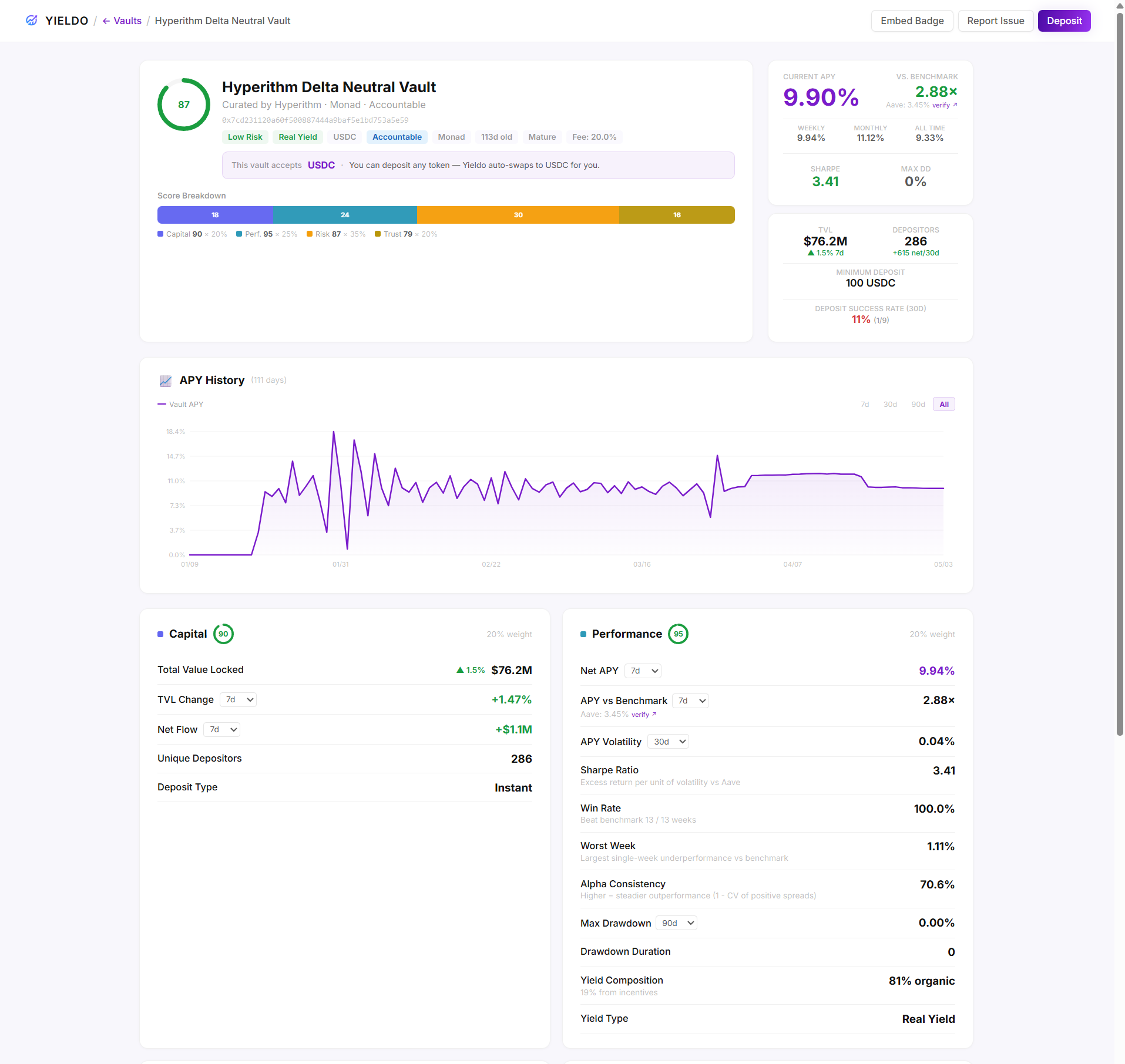
Onchain yield infrastructure Yieldo targets the role of an independent trust layer. It scores stablecoin yield vaults across four dimensions: capital, performance, risk and trust. It turns raw onchain activity into a single composite score from 0 to 100.
The model compares realized onchain APY against curator promises, benchmarks returns against Aave as the dynamic DeFi 'risk-free' rate and verifies exploit history and depositor flows in real time. Methodology is public: anyone can inspect the formula, the weights or challenge and improve the scoring logic.
The result is a vault page that a user can actually read. Not just an APY claim and a TVL number, but verified performance against a meaningful benchmark, depositor flow direction, exploit verification and the curator's track record, everything needed to decide whether a vault is worth trusting right now.
Source: Yieldo
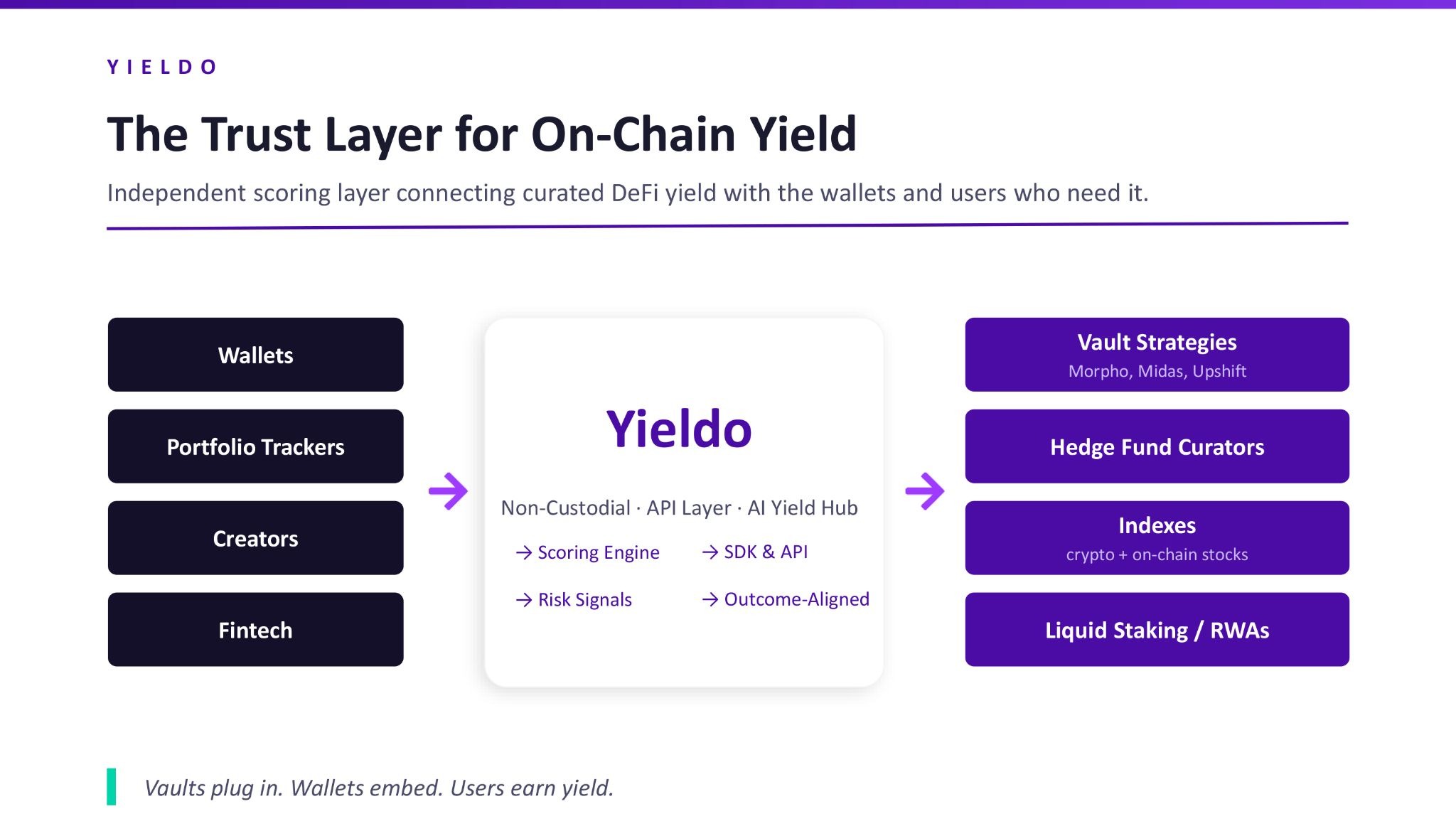
Wallets and fintechs plug into Yieldo through a single SDK and choose which scored vaults to surface to their users, typically only those clearing a defined score threshold. Recently audited by Hashlock, the integration is production-ready, with the first wallet partners going live now. Integration cost is zero. Revenue share starts from day one of any deposit, paid out on what users actually earn.
This is the architecture wallets and fintechs need to offer yield without becoming yield experts themselves. No DeFi research desk, no in-house scoring framework, no curation conflicts. Yieldo handles the evaluation; the integrator owns the user relationship.
Source: Yieldo
Yieldo also supports independent creators. Anyone with an audience interested in yield can build a simple landing page with their own curated selection of scored vaults and earn revenue from every deposit they bring. The selections are constrained to vaults that pass Yieldo's scoring threshold, which means creators aren't selling listings; they're sharing trusted picks from a vetted universe. The first cohort of creator invites is being released through the X account of Yieldo.
Across all three audiences, the structure is consistent: Yieldo earns revenue only when users earn, doesn't run any competing vault, wallet or custody product and publishes its methodology openly. That's what makes the trust layer credible.
The future of automated yield discipline
Yieldo's next step is AI-driven auto-invest. Users set a minimum score, a minimum APY and a risk ceiling. Capital flows only into vaults that meet those thresholds, and exits automatically when a vault drops below them, gets exploited or shows sustained depositor outflows. The pitch is simple: less manual vault hopping, more rules-based discipline.
Beyond auto-invest, the larger bet is that onchain yield becomes a default allocation channel. Not just for retail wallets, but for fintechs, neobanks and eventually banks reallocating between traditional and on-chain returns based on market conditions.
Whatever form on-chain yield ultimately takes — vaults, lending markets, yield-bearing stablecoins — institutional capital will need a scoring layer it can plug into.
Yieldo's founder Drex sees the next phase of DeFi growth as a trust problem first and a yield problem second:
"The next cycle of DeFi growth won't come from higher APYs. It'll come from making yield understandable to users who don't trust it yet."
The independent trust layer for onchain yield has to exist. The only question is who builds it.
This content is part of a paid partnership. The text below is a sponsored article that is not part of Cointelegraph.com editorial content. The material is written by our advertorial team and has undergone editorial review to ensure clarity and relevance, it may not reflect the views and opinions of Cointelegraph.com. Readers are encouraged to conduct their own research before taking any actions related to the company. Disclosure.
More on the subject