

 Written by Arijit Sarkarformer writerReviewed by Ana Paula Pereirastaff editor
Polygon zero-knowledge EVM Rollup aims at cheaper Web3 transactions
Latest NewsPublishedJul 20, 2022
Polygon uses zero-knowledge proof to club multiple transactions into groups before relaying them over to the Ethereum blockchain as a single transaction.

Polygon, a Web3 infrastructure on the Ethereum blockchain, announced the launch of Polygon zkEVM or zero-knowledge Ethereum Virtual Machine, a ayer-2 scaling solution aimed at reducing transaction costs and improving scalability.
The new zero-knowledge (ZK) scaling solution, Polygon zkEVM, operates in full compatibility with existing Ethereum (ETH)-based smart contracts, developer tools and wallets using zero-knowledge cryptography protocol, a.k.a., zk proof. Polygon uses zk proof to club multiple transactions into groups before relaying them over to the Ethereum blockchain as a single transaction.
This ability to transmit multiple transactions as a single transaction results in lower gas fees, which can be split between the various senders involved in the transaction — thus bringing down the gas fees when compared to sending them separately over the Ethereum blockchain.
While investors were subject to exorbitant gas owing to the rise in on-chain transactions, Ethereum's average gas fee fell down to $1.57 — a number last seen in December 2020.
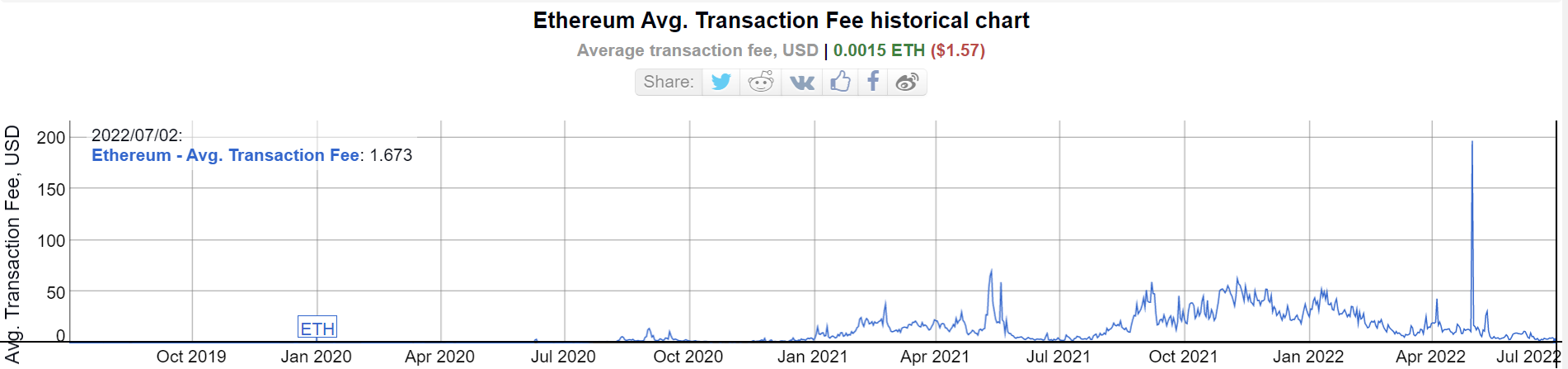
Ethereum average transaction fee YTD. Source: BitInfoCharts
As a result, Polygon zkEVM is well-positioned to bring down the infamous gas prices further. Polygon promises faster settlement and far better capital efficiency through the newly-launched solution, adding to its capability in easy migration of EVM-compatible decentralized applications (DApps) over to zkEVM.
Moreover, the company revealed that the solution also caters to the seamless creation of nonfungible tokens (NFT) and other blockchain-based applications. When compared to layer-1 solutions, Polygon estimates a 90% reduction in costs by using the zk-Rollup approach.
Related: Ethereum devs confirm the perpetual date for The Merge
While sub-ecosystems continue to launch solutions hoping to improve major blockchains like Bitcoin (ETH) and Ethereum, in-house developers support the drive by implementing consensus-based upgrades.
In a recent conference call, core Ethereum developer Tim Beiko propose September 19 as the tentative target date for the crucial transition from proof-of-work (PoW) mining consensus to proof-of-stake (PoS).
This merge timeline isn't final, but it's extremely exciting to see it coming together. Please regard this as a planning timeline and look out for official announcements!https://t.co/ttutBceZ21 pic.twitter.com/MY8VFOv0SI— superphiz.eth (@superphiz) July 14, 2022
Following up on the discussion, Ethereum developer superphiz.eth shared the roadmap and clarified that the proposed target date should be seen as a roadmap rather than a hard deadline.

Subscribe to daily byte-sized crypto news from Cointelegraph
Cointelegraph is committed to independent, transparent journalism. This news article is produced in accordance with Cointelegraph’s Editorial Policy and aims to provide accurate and timely information. Readers are encouraged to verify information independently.
More on the subject